Reviews / Language & Meaning
Nobody Had to Burn Anything
Fahrenheit 451 is remembered for its firemen, but its fire chief says the public quit reading first, and the endless scroll has borne out that half of the novel.
Language & Meaning · 10 min read
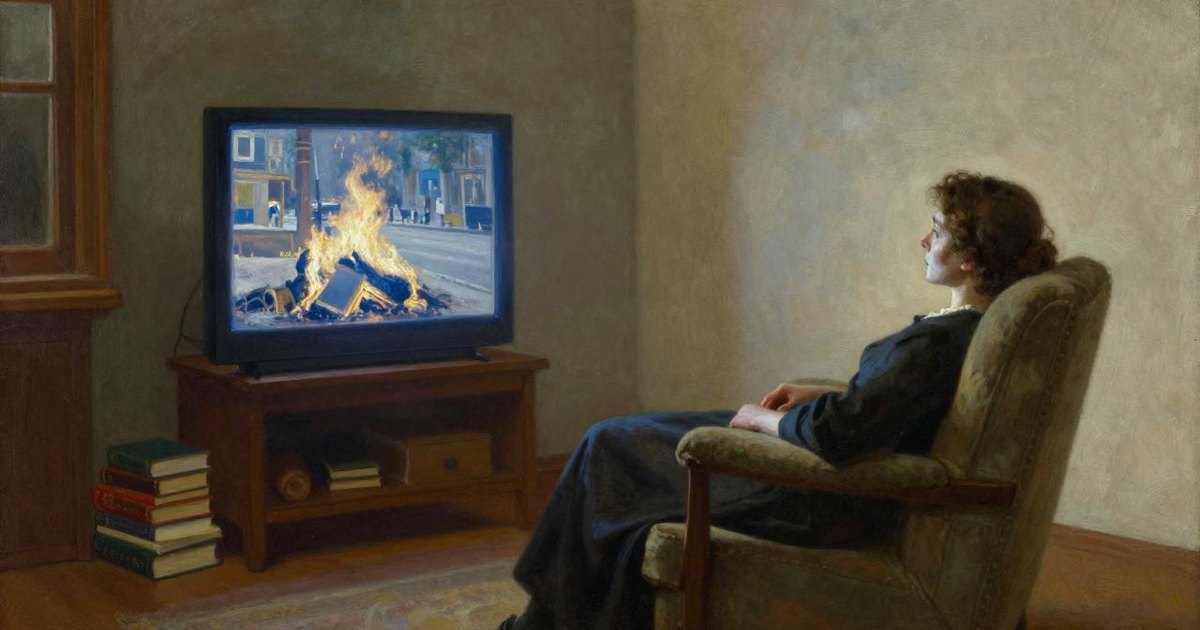
Ray Bradbury hands the history of his burning world to the man who runs the burning. The novel, published by Ballantine on 19 October 1953, turns on that choice. Is Fahrenheit 451 about censorship, or about people choosing not to read? Captain Beatty, the fire chief, says the second, and the novel mostly backs him. The public stopped reading first. The firemen came afterward to tidy up. On that order of events the book has aged well, though its censors have dated.
In the novel's first section, "The Hearth and the Salamander," an old woman refuses to leave her books and burns with them, quoting what Hugh Latimer is supposed to have said to Nicholas Ridley at the stake. On the ride back, Beatty finishes the quotation and names its source, down to the date: Oxford, 16 October 1555. The man who burns books is the best-read man in the novel.
The standard reading takes the fire at face value, and in 1953 it had a live target. That spring Senator Joseph McCarthy's aides toured American libraries abroad, books by suspect authors came off the shelves, and some were reported burned. On 14 June, four months before the novel appeared, President Eisenhower told Dartmouth's graduates not to join the book burners. In 1956 Bradbury told NBC radio he had written it amid "a threat of book burning." It is often taught as a censorship novel, with reason.
Bradbury later fought that reading. He once walked out of a UCLA class that insisted the book was about government censorship, and in 2007, at 86, he told LA Weekly it was about television destroying interest in literature. His own words were sharper: "Television gives you the dates of Napoleon, but not who he was." The censorship reading gets the events right and the order wrong. Beatty's speech tells those first readers that the purges were a late symptom.
Part II: What does Captain Beatty say happened to books?
Beatty calls the day after the old woman's fire, when Montag has stayed home sick, and lectures. Photography, film, radio and television came first, then mass appeal, then the digests: classics cut to fit fifteen-minute radio slots and shrunk at last to a dictionary entry of ten or twelve lines. Speed followed, and shorter schooling, sports, more people. "It didn't come from the Government down," he concludes.
His summary names three causes: "Technology, mass exploitation, and minority pressure carried the trick." Mass exploitation is market logic: the bigger the market, Beatty says, the less controversy it will carry. Minority pressure means every organized group with a grievance, from dog-lovers to Baptists, Texans and second-generation Chinese. In Beatty's telling it reaches race, with Black readers offended by Little Black Sambo and white readers uneasy with Uncle Tom's Cabin, each wanting a book burned. It is the novel's most contested strand, claimed by different camps in different decades.
Before Beatty ever lectures, Clarisse McClellan, the seventeen-year-old next door, asks Montag whether firemen once put fires out instead of starting them. He laughs. Her family sits up talking at night, and her uncle has a theory about the vanished front porches: the official reason was looks, the real one that nobody wanted people idle, rocking and talking. Within days she is gone. Appetite, the porches suggest, can be engineered.
Faber, a retired English professor with no reason to cover for the fire chief, backs him anyway. "The public itself stopped reading of its own accord," Faber says. What people lack, he tells Montag, is quality of information, leisure to digest it, and the right to act on both. He also admits he kept quiet when speaking might have mattered. The readers stopped talking too.
Montag's house supplies the evidence. He finds his wife, Mildred, in bed beside an empty bottle of sleeping pills, "the thimble radios tamped tight" in her ears. No doctor comes. Two technicians pump her stomach and replace her blood. Her days belong to the parlor, three walls of screen, and she wants a fourth at a third of Montag's yearly pay. The Montags have paid extra for a converter that makes the wall's announcer say her name. She calls the people on the walls her family.
Then Mildred's friends visit. Montag switches off the walls and reads them Matthew Arnold's "Dover Beach." Mrs. Phelps weeps. Mrs. Bowles turns on him, dismisses poetry as tears and mush, and the two women flee. They can still feel literature, and they run from it. When the alarm finally sounds on Montag's house, Mildred has turned it in, and her friends had tried first.
The novel's second section, "The Sieve and the Sand," takes its title from a childhood memory Montag relives on the subway, a cousin's dare to fill a sieve with sand. He sits with a Bible, trying to fix "Consider the lilies of the field" in his head while the car's speakers blare a jingle for Denham's Dentifrice. The verse pours in and runs out. It is the scene that has aged least, a man trying to keep one sentence against a sound built to be louder than he is.
Part III: Why do the rebels memorize instead of print?
Montag kills Beatty with the flamethrower, escapes by the river and finds a camp of wandering men who carry books in their heads. Granger has Plato's Republic, Simmons has Marcus Aurelius, and Montag becomes the backup Ecclesiastes, behind a man named Harris in Youngstown. Then Granger admits something. "We're book burners, too." They read each book and burned it before it could be found on them. A head cannot be searched. They call themselves "dust jackets for books."
The rescue also reverses an old argument. In Plato's Phaedrus (274c-275b), Socrates tells how the Egyptian god Theuth offered writing to King Thamus, promising wiser Egyptians with better memories. Thamus answers that writing will breed forgetfulness, because learners will trust marks outside themselves, and that its readers will have "the show of wisdom without the reality." That is Beatty exactly, a man full of quotations who believes none of them.
Socrates adds that written words are like paintings. Question them and "the speaker always gives one unvarying answer." The novel stages that helplessness at the firehouse, where Beatty turns quotation after quotation against books while Faber, a radio voice in Montag's ear, tries to answer. Socrates wanted "an intelligent word graven in the soul of the learner, which can defend itself, and knows when to speak and when to be silent." A dust jacket gives one unvarying answer.
Is a head a serious archive, or a romance? Walter Ong's Orality and Literacy (1982), on how cultures keep memory and knowledge without writing, suggests an answer. Word-for-word memory of long texts, Ong argued, is mostly a literate technique, practiced against a written copy. The Yugoslav bards Milman Parry and Albert Lord recorded swore they sang their songs exactly, and never sang one the same way twice. Exactness is a habit of people who own books. Thamus had it backward, in just the way Bradbury's ending needs.
So the book people are literate readers with a recall method twenty years in the making, keeping texts until the books can be set in type again. Lydia Chukovskaya did the same for Anna Akhmatova's Requiem. Akhmatova wrote the lines out, Chukovskaya learned them, and Akhmatova burned the page. It was printed in Munich in 1963, and in the Soviet Union in 1987.
The case, worked through
Premise: It's a censorship novel. Firemen burn books on the state's orders, and in 1953 the purges were real.
Objection: Beatty says the public did it first. Screens, digests and pressure groups did the work, and Faber agrees.
Revision: Bradbury leaned the same way. In 2007, at 86, he called it a book about television. Elsewhere he blamed pressure groups.
Objection: The memorizing rebels are romantic. A head is a poor archive, and oral cultures do not keep words exactly.
Verdict: Ong makes the ending plausible, as a relay of literates waiting for type. The living room still describes us. The firehouse has dated: today's censors move while the public is awake.
Part IV: Is short-form video the parlor wall?
Nobody has passed a law against reading, and the numbers fell anyway. Among American 12th graders, the share who read a book or a magazine almost every day dropped from 60 percent in the late 1970s to 16 percent in 2016, according to Twenge, Martin and Spitzberg. The share who had read no book for pleasure in the past year nearly tripled, to one in three.
Meanwhile 61 percent of American teenagers use TikTok daily, Pew reported in December 2025, and 21 percent are on it almost constantly. The scroll is Mildred's parlor shrunk to the width of a hand: a family of strangers on call all day, the thimble radios sold separately as earbuds, and a feed that, like the Montags' converter, seems to know your name. Faber's second necessity was leisure. The feed is built to leave none.
Ong's term for the culture of radio and television is secondary orality, a talk-like culture that feels spoken but could not exist without writing and print. Later scholars have stretched it to the feed. Mildred reading her part from a script that came in the mail is secondary orality in one scene.
Beatty's digest has come back too. Sixty-four percent of American teenagers use AI chatbots, the same Pew survey found, and Collin Jennings has argued that AI summaries flatten how ideas connect. Ask one for Fahrenheit 451 and it returns something near the ten or twelve lines that end Beatty's history.
The case against the parlor-wall reading comes in two parts. First, Carlo Iacono argued in Aeon in February 2026 that literacy panics recur, and that the dominant platforms are engineered to fragment attention for advertising revenue, which makes the problem one of design rather than of screens. If so, Faber's "of its own accord" fails for the feed. Attention was harvested. Second, a feed can also send people to novels, and a book heard is still a book kept.
Grant both points and the decline remains. An analysis of American Time Use Survey data, published in iScience in 2025, found that 28 percent of Americans 15 and older read for pleasure on an average day in 2004, and 16 percent in 2023. Its count includes audiobooks, so the book heard is already in those figures. The design objection does change the verdict, though. Faber blames appetite. Beatty's list names technology and mass exploitation beside it, and on the feed he is the better witness.
Part V: What about actual book bans?
Neil Postman named the novel's two fears. In the foreword to Amusing Ourselves to Death (1985), a passage that never mentions Bradbury, he set Orwell's fear of those who would ban books against Huxley's, a culture with no reason to ban one because "there would be no one who wanted to read one." The firemen belong to Orwell. The parlor belongs to Huxley. Bradbury fuses them in one scene. The Mechanical Hound hunts Montag on live television, and the broadcast ends with a stand-in, a man out walking, killed on camera.
Orwell's half has returned. PEN America counted 11,982 book bans in American public schools in the 2025-26 school year, a record. The American Library Association counted 4,235 titles challenged in 2025, and 92 percent of challenges came from pressure groups, government officials and decision makers. Pressure groups are Beatty's own cause. What he never pictured is pressure working through officials and school boards while the public still reads.
The market still keeps Beatty's schedule. From 1967 Ballantine sold a school edition of the novel with about seventy-five passages altered, "hell," "damn" and "abortion" cut. No government asked for any of that. Nervous editors did it, bit by bit. Bradbury found out in 1979, and his Coda that year blamed pressure groups: "There is more than one way to burn a book." In 2023 Puffin revised hundreds of passages in Roald Dahl, then, after an outcry, promised an unrevised Classic Collection alongside.
School boards have come for the novel too. A Florida board restricted it for vulgarity in 1987 and backed down after a lawsuit, and in 1992 Irvine parents got blacked-out words restored to a middle school's copies. In Bradbury's book the public is asleep before the state moves, and then the state is ferocious. In ours the prohibition arrives while readers are awake enough to sue.
The judgment splits along the book's own seam. Beatty's sequence survives in publishing houses, where books are still thinned bit by bit to spare offense. It fails for removals that officials order, where the state goes first. The living room aged best. Its argument, that a culture can lose the habit of sustained reading through its appetites and the machines built to feed them before anyone bans a thing, is borne out by the long-run measures of habitual reading.
Bradbury ends on the road. The bombers have flattened the city, and Montag, walking with the others toward what is left of it, finds the verses coming back: "a time to break down, and a time to build up," then "a time to keep silence, and a time to speak." He keeps one back, Revelation's tree whose leaves "were for the healing of the nations," and saves it for noon, for when they reach the city.
Related topics: Language & Meaning and Mind & Knowledge. Part of the Reviews column.
Read the book: Fahrenheit 451 at Bookshop.org, which supports independent bookstores.
Further Reading
The Volume Was the Argument
The other half of Postman's pairing, a state that wins by lying loudly instead of burning quietly.
The other half of Postman's pairing, a state that wins by lying loudly instead of burning quietly.
The Right to Be Unhappy
The Huxley novel Mildred's parlor keeps imitating, and what engineered contentment costs.
The Huxley novel Mildred's parlor keeps imitating, and what engineered contentment costs.
Shadows on the Wall, Rebuilt
Why a room whose walls do the talking is Plato's oldest image, and the feed's newest.
Why a room whose walls do the talking is Plato's oldest image, and the feed's newest.
Before the Law, Before the Algorithm
Kafka's court, which never names the charge, and the automated systems that copy it.
Kafka's court, which never names the charge, and the automated systems that copy it.