Reviews / Power & Politics
Before the Law, Before the Algorithm
Kafka's The Trial never names the charge, and Robodebt and a Medicare Advantage lawsuit show where the novel still holds and where it falls silent.
Power & Politics · 11 min read
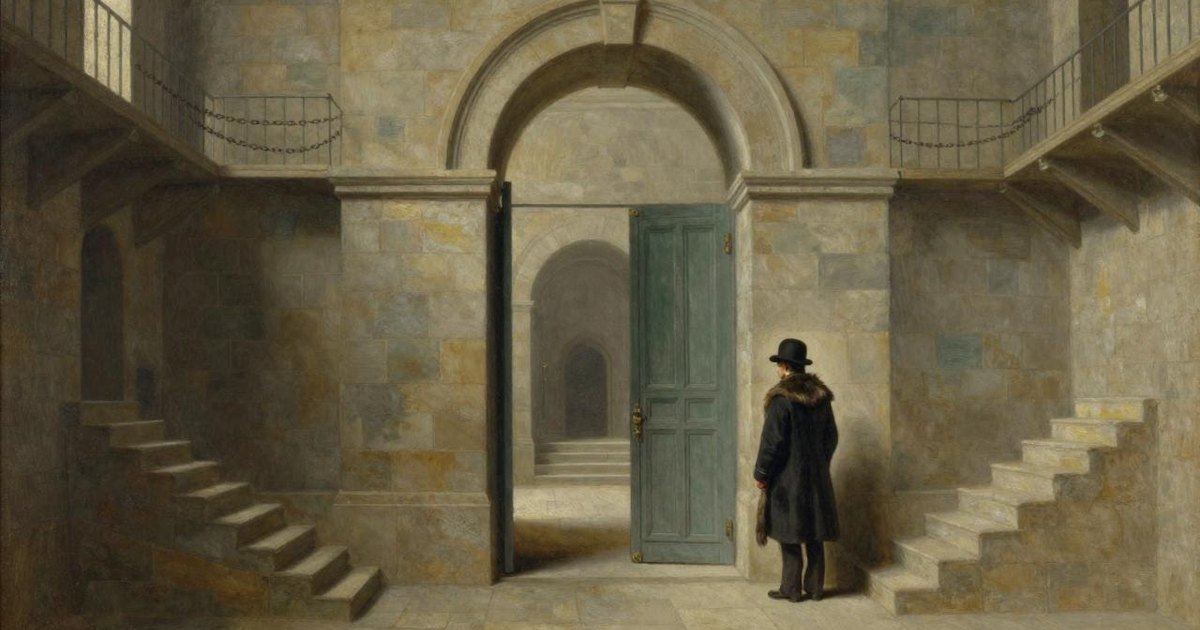
Franz Kafka fills The Trial with procedure and then removes the one thing procedure exists to produce, which is a charge. Josef K. is arrested, summoned, advised, lectured and finally killed, and nobody ever tells him what he is supposed to have done. A novel written in 1914 and 1915 reads like a description of algorithmic bureaucracy because Kafka saw that the worst harm an opaque system does comes before any verdict. The missing explanation turns the accused into his own prosecutor.
The first sentence of Der Prozess sets the terms: "Someone must have slandered Josef K., for without his having done anything wrong, he was arrested one morning." The slander is K.'s guess, and the novel never confirms his innocence. The supervisor cannot even say whether K., a senior bank officer, is accused, and assumes he will go to the bank as usual: "You are under arrest, certainly, but that should not stop you doing your job."
"Kafkaesque" has since shrunk to mean any queue, any form returned for a missing signature. In the strict sense, a system is Kafkaesque when it withholds the charge, makes the accused disprove it and never lets the case end, until the person under judgment begins to prosecute himself. Max Brod, who published the unfinished novel in 1925, read it theologically, others as guilt before a father. Hannah Arendt made the political case in a 1944 essay. This review follows her and adds the software.
Part II: What is Josef K. actually accused of?
Nothing the book ever states. On the first morning the warder Willem explains that his authority "does not go looking for guilt among the population but is, as the law says, attracted by guilt and has to send us warders out." When K. says he does not know this law, the other warder, Franz, makes the protest into evidence: "Look, Willem, he admits he doesn't know the law and at the same time claims to be innocent." Ignorance of the law is traditionally no excuse. Here it counts against him.
Secrecy does the rest, as the lawyer Huld explains. The proceedings are not public, and "the court's documents, above all the indictment, are inaccessible to the accused and his defense." Defense is "not actually permitted by the law, only tolerated." Since nobody knows what the first petition should answer, it can touch anything relevant only by chance, and it is usually lost.
The court painter Titorelli offers "three possibilities: actual acquittal, apparent acquittal, and protraction." He has never witnessed an actual acquittal, and K. draws the conclusion: "A single executioner could replace the whole court." An apparent acquittal, Titorelli goes on, is followed by fresh arrest, again and again. Protraction "consists in keeping the trial permanently at the lowest stage of proceedings."
Protraction has a face, the merchant Block's, five years into his trial and keeping five back-street lawyers besides Huld. Watching him with the lawyer, K. thinks, "That was no longer a client, that was the lawyer's dog," and listens as if commissioned to report the scene to a higher office.
K. himself plans an account of his whole life, with reasons for every important thing he has done, a defense against a charge he cannot read and so against everything. The chaplain names the process: "the proceedings gradually turn into the verdict." Nobody convicts Josef K. The procedure makes a convict of him.
Part III: What does "Before the Law" say about access to justice?
Kafka wrote the parable in late 1914 and printed it on 7 September 1915 in Selbstwehr, a Prague Jewish weekly. In the chapter "In the Cathedral" the prison chaplain tells it to K., who is, he says, deceiving himself about the court: "before the Law stands a doorkeeper."
A man from the country asks to enter the Law and is told he cannot enter now. "It is possible," says the doorkeeper, "but not now." The gate "stands open as always," and the doorkeeper steps aside. When the man peers in, the doorkeeper laughs, dares him to try despite the prohibition, and warns of doorkeepers in hall after hall, each more powerful than the last. The man had assumed that "surely the Law should be accessible to everyone and at all times," the principle of access to justice, voiced by the one person who believes it.
He studies the doorkeeper's fur coat and Tartar beard and decides to wait, his whole life, on a stool beside the door. The doorkeeper takes every bribe, he says in the parable's most exact line, only "so that you do not think you have left anything undone."
As his sight fails he sees a radiance streaming, unquenchable, from the door. His last question is about everyone else: if all strive for the Law, why has no one else asked to enter? The doorkeeper roars to reach his failing ears: "No one else could gain entry here, because this entrance was meant only for you. I am going now to shut it." The shutting is never shown. No one laid a hand on the man. A word held him, and a description of doorkeepers he never saw.
The chaplain then walks K. through the commentators. In one reading the doorkeeper shuts the gate only at the very end. In another, which many share, a gate that stands open as always cannot be shut even by its keeper. The chaplain's own defense of the doorkeeper is a line any compliance office could frame: "you do not have to take everything as true, you only have to take it as necessary." K. answers, "Lying is made into the order of the world."
Part IV: What do Robodebt and the Dutch benefits scandal share with K.'s arrest?
They share a structure, and Kafka knew it from the inside, as a lawyer at Prague's Workers' Accident Insurance Institute from 1908 to 1922. Max Weber, in Economy and Society, described such desks from outside: bureaucracy decides without regard to the person, by calculable rules, and "Bureaucratic administration always tends to be administration that shuts out the public." Kafka's court keeps the secrecy and loses the impersonality, its judges open to influence through their painter. Kafka sat at the desk by day and wrote from the chair across it, where hidden rules feel exactly like no rules.
Arendt named the arrangement in On Violence (1970): "the rule by Nobody," a "tyranny without a tyrant," a form of power in which no one can be asked to answer for what is done. The Trial stages it official by official, each holding only a fragment of the case.
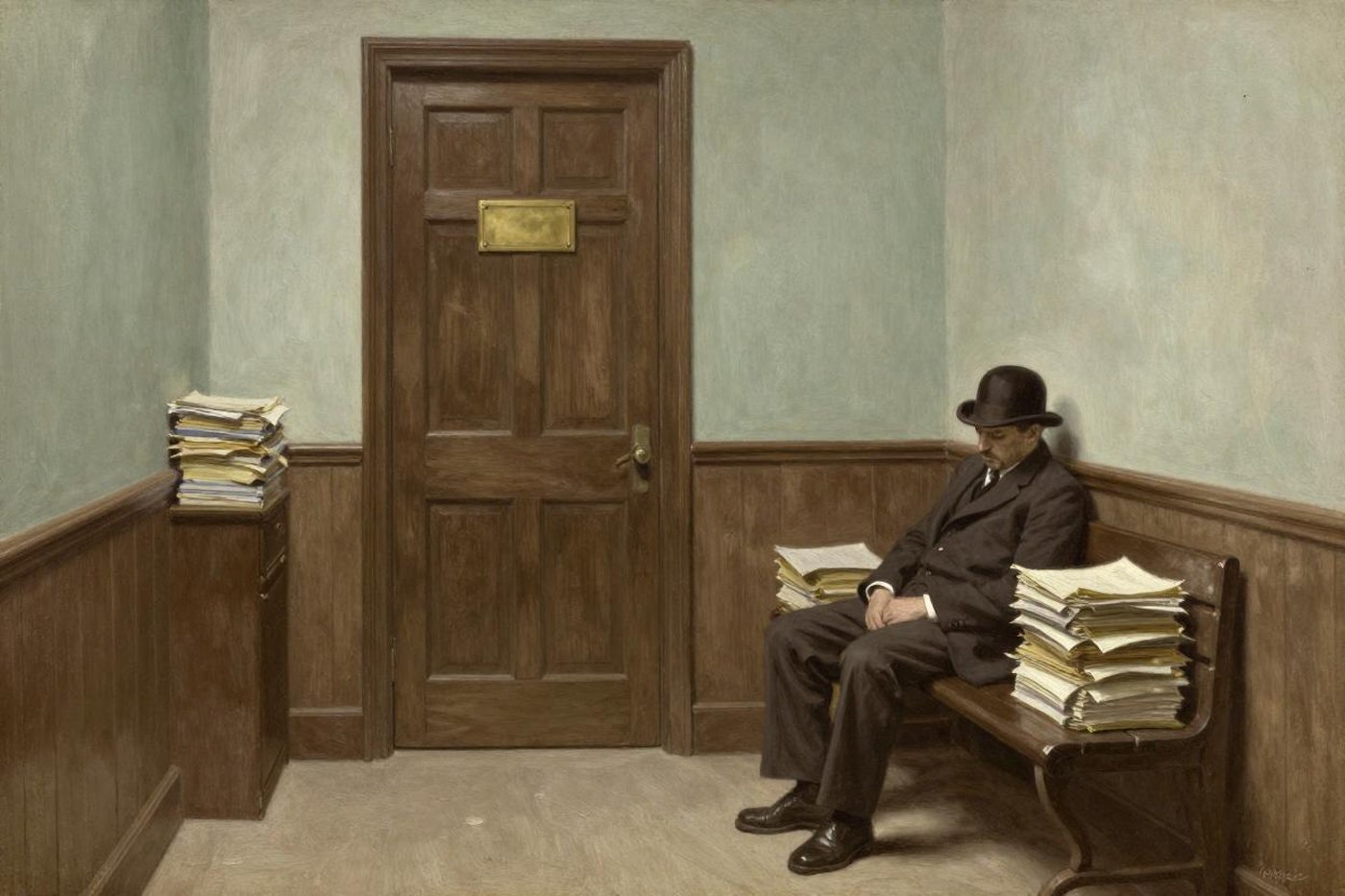
Moved out of its attic offices and into a database, the court becomes automated administration, which builds desk and chair into one system, calculable from one side and closed from the other. Australia's Robodebt, automated from July 2016, was rule-based data matching. Centrelink compared what recipients had reported earning each fortnight with tax-office income averaged across the year, and where the figures disagreed it asked them to confirm or update their earnings online, and where they could not produce payslips from past years it raised a debt on the average, in letters that did not explain the calculation.
Robodebt did name a sum, and K. is never named anything. But the letters withheld the reasoning, which leaves a reply where Huld leaves the first petition, right only by chance. Recipients had to rebuild a working past, fortnight by fortnight, auditing their own lives for their accuser.
In 2021 a court heard that A$1.73 billion had been unlawfully raised against about 433,000 people. The Royal Commission found in July 2023 that "Robodebt was a crude and cruel mechanism, neither fair nor legal, and it made many people feel like criminals." Families testified about relatives who took their own lives after the letters came.
In the Netherlands, according to Amnesty International, a self-learning risk model at the tax authority scored childcare-benefit applicants without Dutch nationality as higher risk. Willem's court disclaims any search of the population for guilt. This model searched it application by application, and in 2021 the Dutch Data Protection Authority fined the finance minister €2.75 million for unlawful, discriminatory processing of nationality. Much of the ruin was still human policy. The cabinet resigned on 15 January 2021, when France24 reported that around 10,000 families had been forced to repay tens of thousands of euros.
The third case is an allegation. Gene Lokken, 91, broke his leg and ankle in May 2022. On or around 20 July, says the class-action complaint later filed for his estate, UnitedHealthcare ended his skilled-nursing coverage in two sentences: "More inpatient days at the skilled nursing facility are not medically necessary. A safe discharge plan has been recommended." The suit alleges that a model called nH Predict was used to cut off such care. UnitedHealth called the tool a guide in 2023, and in court denies using it at all.
His family, the complaint says, paid $12,000 to $14,000 a month until he died in July 2023. In February 2025 Judge John R. Tunheim dismissed most claims as preempted by the Medicare Act, let the contract claims proceed and waived the appeals requirement as futile. Taking as true that the insurer issues fresh denials whenever a patient wins and pays the few claims that reach the end, the court wrote that "this practice would make it virtually impossible for any claim to progress through the entire four-step appeals process and be ripe for judicial review."
That is Titorelli in a federal opinion, each acquittal met by a fresh arrest and no case allowed to reach the court that could decide it. The order made no finding of wrongdoing, and as of September 2026 the case is in discovery.
Part V: Does any door in Kafka open?
The parable's gate is open throughout. Yet Brod recalls Kafka saying the trial was never to reach the highest court, and concludes that the novel could, in a sense, go on indefinitely.
The case, worked through
Premise: The Trial is about bureaucratic cruelty. A faceless court crushes a bank officer.
Objection: It is about what an unexplained charge does to the accused. Within months K. is defending his whole life.
Revision: Opaque systems produce self-incrimination. Robodebt's recipients audited their own pasts for their accuser.
Objection: The court may be right. Kafka never says K. is innocent, and an unstated charge may still be true.
Verdict: A diagnosis without a remedy. The novel ends on shame, which needs no proven guilt, and leaves help from everyone as an unanswered question.
On the accused's position the novel holds, and it takes the last mark of the definition further than any case. In the quarry, "K. now knew precisely that it would have been his duty to seize the knife himself, as it passed from hand to hand above him, and plunge it into himself."
He does not do it. He cannot take all the work from the authorities, he reflects, and the blame for this last failure lies with whoever denied him the strength. His final judgment blames an unnamed someone. The recruitment has nearly succeeded.
Then a casement flies open in a house beside the quarry, and a faint, thin figure leans out with arms outstretched. K. wonders whether it is one person or everyone, whether help remains, whether objections have been forgotten. There were, the text says, and asks where the judge was whom he never saw, and the high court he never reached. The book imagines collective help only as a question at a window.
Nor does the book convict him, and the guilt objection has weight. K. is contemptuous of the court, kisses Fräulein Bürstner like a thirsty animal and uses the women around his case, and the chaplain tells him his plea of common humanity is "how the guilty tend to talk." Yet Kafka withholds the verdict as carefully as the charge. "Like a dog!" K. says as the knife turns, and it is "as if the shame should outlive him." Shame needs no proven guilt, so the Robodebt comparison survives an innocence the novel never grants.
The novel's weakness is that it makes opacity metaphysical, a high court out of reach in principle. Its only accountability is bleak: two low warders flogged in a lumber room after K. complains. In Robodebt the opacity was a decision. The Royal Commission got through it, finding that legal doubts had been raised early, and in March 2026 the National Anti-Corruption Commission found serious corrupt conduct by two former officials, Mark Withnell and Serena Wilson, cleared four others and referred no one for prosecution. It is a thin reckoning, but it had names.
A reader who takes Kafka's fog for the whole truth grants the designers the escape Arendt thought most tyrannical, with no one left to be asked. The refusal that sharpens the diagnosis also leaves each accused alone at a door meant only for him, while redress in the real cases came collectively. Once the Commonwealth conceded in the Amato case, in November 2019, that averaged debts had no legal basis, the concession belonged to everyone who had received a letter, and in 2021 a class-action settlement worth at least A$1.8 billion was approved.
Kafka anticipated the obvious remedy. In the cathedral K. finally gets an explanation, a parable and a string of commentaries, and the simple story turns shapeless while he grows too tired to follow. An explanation can be one more gate. In February 2025 the EU's Court of Justice ruled against the chaplain's kind: a credit-scoring firm whose score cost a customer a phone contract must describe the procedure and principles it actually applied, clearly enough for her to understand and challenge the decision, and handing over the algorithm does not count.
Jason Grant Allen's 2026 essay "KafkaGPT" argues that human oversight of automated decisions fails without deliberate design. An explanation answers Kafka only when it is built in and can be pooled, so that one answer becomes everyone's evidence.
The novel will not build that door, and its author did not expect one. Declining to send Brod the novels, and asking himself what the point was of keeping work he had not yet burned, Kafka answered that one hopes the pieces will assemble into a whole, "some court of appeal on whose breast I shall be able to beat when I am in need. I know that this is not possible, that no help comes from there." The Trial leaves the gate open as always, and a man beside it, waiting to be told when now will be.
Related topics: Power & Politics and Science & Technology. Part of the Reviews column.
Read the book: The Trial at Bookshop.org, which supports independent bookstores.
Further Reading
The Cage You'd Choose
La Boétie on the servitude people maintain themselves, the political cousin of the duty K. feels, and refuses, to take the knife.
La Boétie on the servitude people maintain themselves, the political cousin of the duty K. feels, and refuses, to take the knife.
Evil Doesn't Announce Itself
Arendt on offices that divide a harm so finely that no one sees the whole of it.
Arendt on offices that divide a harm so finely that no one sees the whole of it.
Nobody Had to Burn Anything
Fahrenheit 451 and its fire chief's history of a public that quit reading first.
Fahrenheit 451 and its fire chief's history of a public that quit reading first.