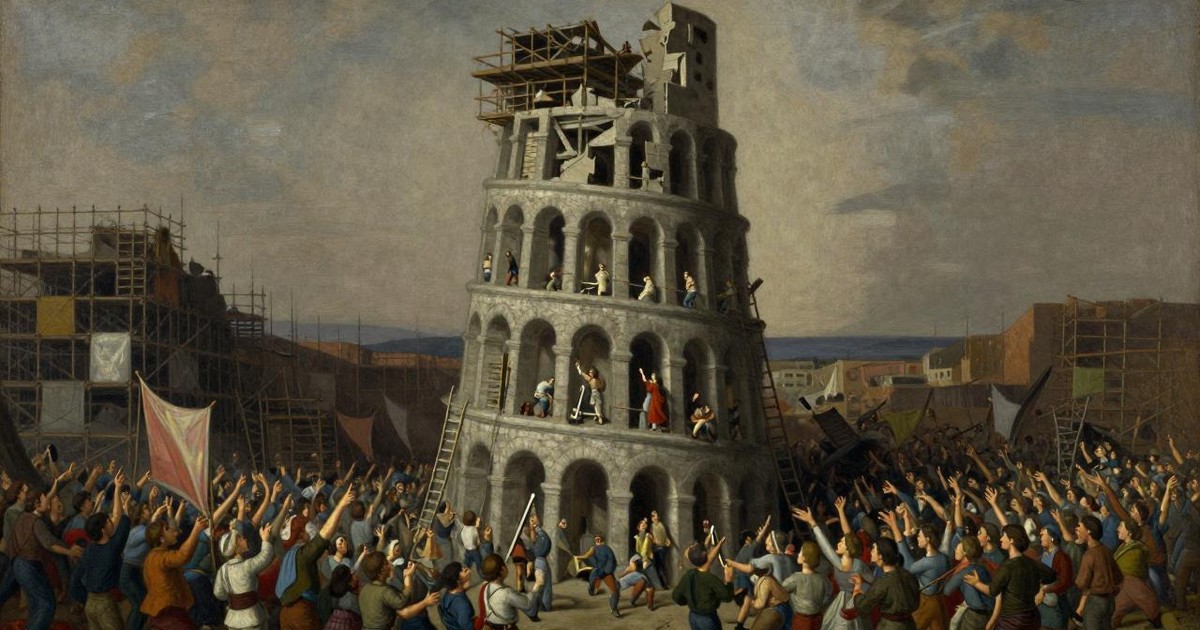
In 1949, a dying man in a cottage on the Isle of Jura finished a novel he had been too sick to properly revise. George Orwell had tuberculosis, a typewriter he could barely sit up to use, and a manuscript called Nineteen Eighty-Four that his publisher worried was too bleak to sell. It sold. It has not stopped selling since, and every decade rediscovers it as a users' manual for whatever that decade's propaganda happens to look like. But the novel is usually misquoted in the service of a claim it does not quite make. People reach for Orwell when they mean "they're lying to us," and that is not the insight. Governments have always lied. The insight is narrower and worse: the Party in the novel does not need you to believe the lie. It needs you to stop being the kind of person who can tell a lie from the truth at all.
The mechanism has a name in the book: doublethink, the capacity to hold two contradictory beliefs in mind simultaneously and accept both. Not confusion, not hypocrisy, but a trained faculty, exercised deliberately, that lets a person know a thing is false and continue asserting it is true with total sincerity, then forget they ever knew otherwise. The Ministry of Truth's actual daily labor is not inventing lies from nothing. It is revision: yesterday's newspaper said Oceania was at war with Eurasia, today Oceania has always been at war with Eastasia, and the archive is rewritten so thoroughly that no physical trace of the earlier claim survives to embarrass the new one. Winston Smith's job, before his arrest, is literally this: feeding old newspapers into a memory hole and writing corrected versions that make the Party's past pronouncements retroactively true. The past is not remembered. It is administered.
The famous slogan of the regime, WAR IS PEACE, FREEDOM IS SLAVERY, IGNORANCE IS STRENGTH, is not propaganda in the ordinary advertising sense, a claim designed to persuade you of something false. It is closer to a loyalty test disguised as a belief. To recite it and mean it, you must already have surrendered the part of your mind that checks statements against a stable external reality. That surrender is the actual product being manufactured. Once you can hold "two plus two equals five" as sincerely as you hold "two plus two equals four," whichever the Party currently requires, you have become ungovernable by facts and permanently governable by the Party, because the party is now the only remaining source of "what is true today." O'Brien, torturing Winston in the novel's final section, does not want Winston to lie and say two and two make five. He wants Winston to actually believe it, because a forced lie can be recanted the moment the pressure lifts, and a belief installed all the way down cannot.
Part II: The theorist behind the novelist
Orwell wrote fiction, not political theory, and it would be a mistake to treat Nineteen Eighty-Four as an argument rather than a portrait. The argument arrived two years later, from a very different kind of writer, and it is worth reading the two side by side because the theorist explains what the novelist dramatized.
Hannah Arendt published
The Origins of Totalitarianism in 1951, having spent the previous decade as a stateless refugee from the regime she was trying to explain. Her chapter on propaganda contains a claim that sounds paradoxical until you sit with it: totalitarian propaganda's "chief qualification," she wrote, is not that it is convincing, but that its audience has already lost the ability to distinguish fact from fiction, true from false, in the first place, so that the propaganda does not need to overcome disbelief. It only needs to keep the target population in a permanent state of not-quite-believing anything, including its own senses.
Arendt's sharper formulation: the ideal subject of totalitarian rule is not the true believer or the convinced ideologue. It is the person for whom the distinction between fact and fiction, true and false, no longer exists. Total loyalty, she wrote, is possible only when fidelity is emptied of all concrete content, because loyalty to a fixed, checkable set of facts would eventually collide with a regime whose facts change on schedule. A citizen who has stopped expecting consistency cannot be caught contradicting the regime, because contradiction requires a stable standard to violate, and the stable standard is precisely what has been dissolved.
This is the mechanism Orwell dramatized and Arendt named: the goal was never to make the lie convincing. Convincing lies are fragile; they can be fact-checked, refuted, embarrassed by a single surviving photograph. The goal is to make truth itself feel like one opinion among several, equally unprovable, equally a matter of which authority you trust today. Once that feeling is installed, a population does not need to be persuaded case by case. It has been persuaded once, at the level of epistemology rather than fact, and every subsequent lie rides in on that single prior surrender.
Arendt added a related observation that Orwell's novel only implies: the masses, she wrote, do not believe in anything visible, in the reality of their own experience; they trust only their imagination, which may be caught by anything that is at once universal and consistent in itself. A movement's factual claims do not need to survive contact with reality. They need to be internally consistent as a story, repeated without variation, because a population that has given up checking against reality will check instead for narrative consistency, and narrative consistency is cheap to manufacture. You do not need the facts on your side. You need the same story told the same way, forever, louder than any competing story.
Part III: The firehose replaces the ministry
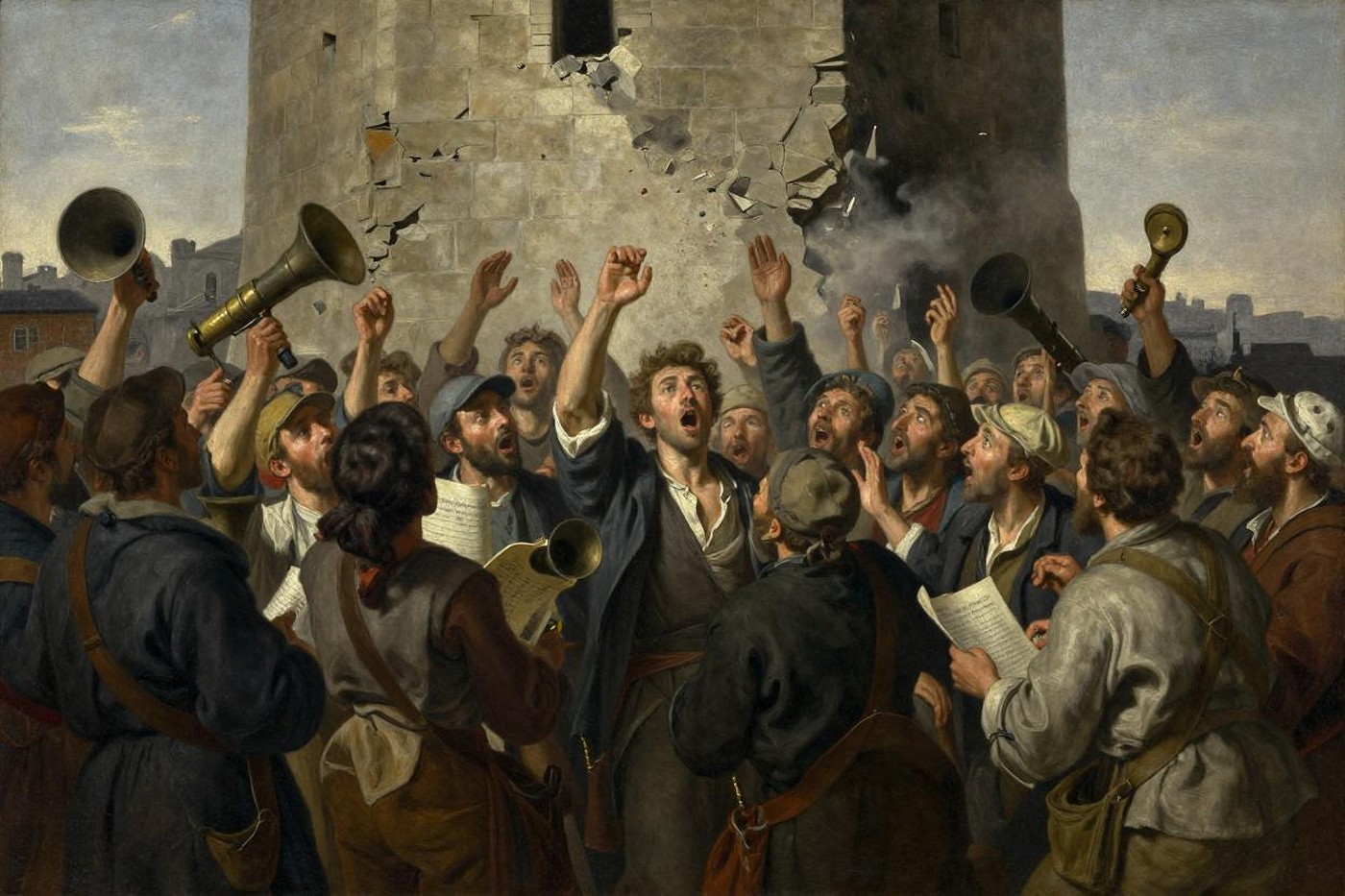
No single Ministry of Truth exists now, with a physical building and a staff rewriting newspapers by hand. It did not need to survive. Its function was distributed, automated, and made faster than any bureaucrat could have managed, and the resulting technique has a name researchers gave it after studying a specific case.
In 2016, analysts at the RAND Corporation published a report on the Russian state's information operations and coined a term for what they were seeing: the firehose of falsehood. Its defining features were not cleverness or subtlety. They were volume and speed: a high number of channels, delivering messages continuously and repetitively, often internally contradictory, making no commitment to objective reality or consistency. The report's core finding inverted a century of propaganda theory. Classical propaganda tries to be persuasive: coherent, plausible, aimed at winning the argument. The firehose does not try to win the argument. It tries to flood the field until no argument is winnable, because every claim now has an equally loud counter-claim, and an audience facing that noise, the research found, tends to disengage from the whole subject rather than adjudicate it. You do not need your lie believed. You need the true story and your lie to look equally uncertain, and drowning the true story in volume accomplishes that more reliably than refuting it ever could.
A former White House strategist put the same technique into four blunter words in an on-the-record interview: "flood the zone with shit." Not persuade the zone. Flood it. The metaphor is sewage, not argument, and the choice of image is instructive: sewage does not need to convince anyone of anything. It only needs to be everywhere, so that anyone trying to locate clean water spends all their energy on the search rather than the drinking.
Generative AI removed the last cost constraint on this strategy. Producing a firehose of falsehood used to require an actual staff, actual writers, actual translators, working in shifts, at actual expense. A large language model produces plausible, varied, endlessly reworded disinformation at a cost approaching zero, in every language simultaneously, faster than any fact-checking operation can respond in even one language. Researchers tracking synthetic news networks have documented the same false claim appearing across hundreds of nominally independent outlets within hours, each phrased slightly differently, each citing the others as corroboration, a closed loop of manufactured consensus that requires no single convincing article, only enough volume that the claim starts to look, on a cursory search, like something "everyone is reporting."
The doublethink layer has its update too, and it is sharper than the original because it does not require anyone to hold a belief for more than a few minutes. Researchers studying the aftermath of high-volume disinformation campaigns describe something they call the liar's dividend: once a population has been trained to expect that video, audio, and documentary evidence can all be fabricated, genuine evidence of real wrongdoing becomes deniable by the same reflex that makes fake evidence dismissible. The wrongdoer does not need to disprove the real footage of them. They need only gesture at the general unreliability of footage, a doubt the firehose has spent years installing for free. Orwell's Ministry rewrote the archive to make the past agree with the present. The modern version does not need to rewrite anything. It only needs enough manufactured uncertainty in circulation that the real archive can be waved away as possibly manufactured too.
Part IV: The case that this changes nothing
The strongest objection to treating any of this as a new phenomenon is that propaganda by repetition is not new at all, and dressing it in Orwell and a 2016 acronym risks flattering the present with a sense of unprecedented crisis that lets everyone off the hook for ordinary vigilance.
Repetition has been recognized as a persuasion technique since antiquity; the illusory truth effect, the finding that a statement repeated multiple times gets rated as more believable regardless of its truth, has been documented in psychology since the 1970s, decades before anyone was flooding a digital zone. Nazi propaganda under Goebbels ran on volume and repetition across every available channel, radio, film, print, loudspeaker, long before the internet existed to accelerate it. The claim that "now, finally, propaganda has become unmoored from truth in some qualitatively new way" has, ironically, been made by every generation encountering a new medium, radio in the 1930s, television in the 1960s, cable news in the 1990s, social media in the 2010s. Treating the current moment as uniquely post-truth may itself be a symptom of the very disorientation being described, a failure of historical memory dressed up as sober diagnosis.
There is also a more optimistic empirical counter-current worth taking seriously. Fact-checking organizations, for all the mockery aimed at them, have measurable effects on belief in controlled studies, smaller than anyone would like but real and durable in some populations. Media literacy interventions, tested in randomized trials, do improve people's ability to distinguish reliable from unreliable sources, at least in the short term. The claim that audiences are simply defenseless against volume, that the firehose always wins, understates human beings' actual track record: authoritarian propaganda states have collapsed, sometimes from internal contradiction their own citizens noticed regardless of the doublethink demanded of them. The Soviet Union's population became expert at reading between the lines of its own state media, a skill Arendt's framework does not fully predict, since it assumed the erosion of the fact-fiction distinction would be closer to total. It was not total. It never has been.
Both objections are worth granting, and both leave the harder point standing rather than resolved. Yes, repetition-based propaganda is ancient, and yes, populations retain some capacity to resist it even under sustained pressure. But the RAND researchers' actual finding was not that the firehose fools everyone. It was that the firehose does not need to fool everyone; it needs only to exhaust the specific cognitive resource, sustained attention capable of distinguishing signal from noise across dozens of simultaneous claims, that democratic self-governance depends on, and it needs to do this at a volume no previous propaganda apparatus could sustain because no previous apparatus was free to produce. The Soviet citizen reading between the lines was working against one state monopoly on information, a single adversary whose lies, however total, were at least internally coordinated and thus decipherable as a system. The present firehose is often uncoordinated by design, sourced from bots, state actors, genuine ideologues, and confused ordinary people simultaneously, which makes it not merely hard to believe but hard to even locate an author to disbelieve. You cannot read between the lines of a text with no single writer.
Orwell's Winston Smith had, at least, an adversary he could name, a face on a poster, a ministry with a building. The firehose offers no comparable target, which was always the more efficient design. A population exhausted into disengagement requires no torture chamber, no Room 101, no O'Brien holding up four fingers and demanding you see five. It only requires that checking be more expensive than not checking, at scale, forever, until the muscle atrophies from disuse rather than being broken by force. Arendt thought the totalitarian subject had to be made to stop believing in reality. The contemporary subject can be left believing in reality entirely, and simply worn down past the point of being willing to go find out which version of it, among the hundred currently circulating, happens to be true.
The question this essay leaves you with is not whether you can spot a lie. Most people can, case by case, given time and motivation. The question is whether the volume has already made you someone who no longer has the time or motivation to check, and whether that exhaustion was the actual target all along, dressed up as an argument you were never really meant to win or lose. Two and two do not need to equal five. They only need to feel, by the fortieth contradictory headline of the day, no longer worth adding up.
Further Reading