Archive / Flourishing
Attention Is the Rarest Form of Generosity
Simone Weil argued attention is a moral act, not a resource. A long read on what it actually costs to pay it.
Flourishing · 16 min read
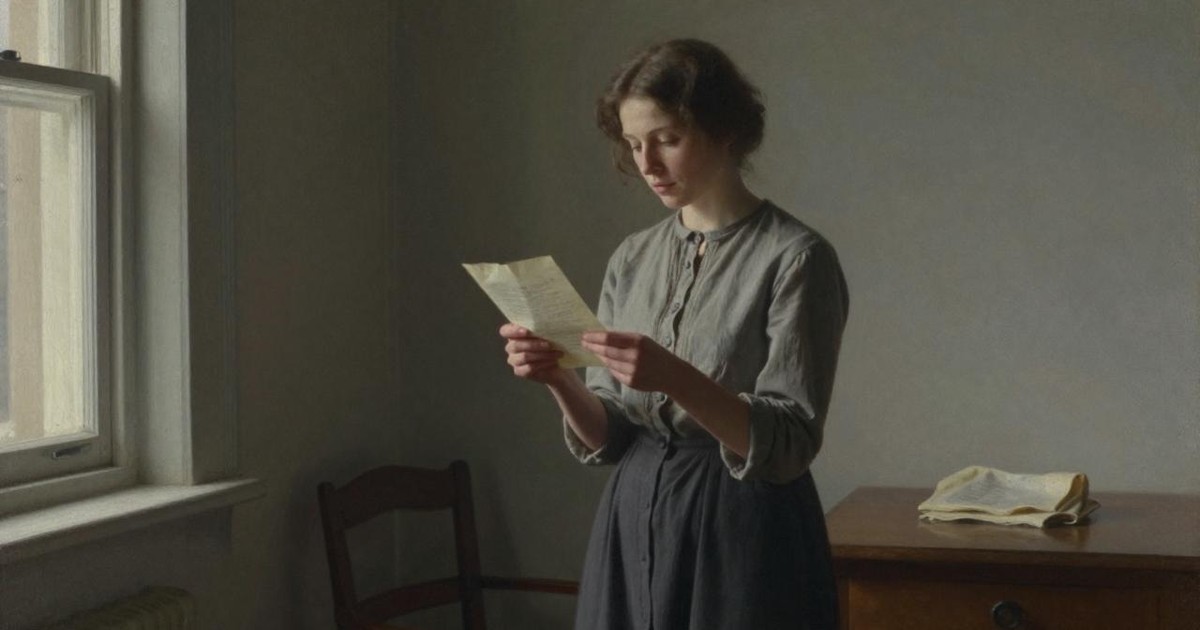
Simone Weil died in August 1943, in a sanatorium in Ashford, England, at the age of thirty-four. The coroner's report noted that she had refused food, and recorded a verdict of suicide, "by the neglect of the self." The facts behind that verdict are sadder and more complicated than the phrase suggests. Weil had tuberculosis, and had been ill for a long time, and was eating, by her own account, no more than her fellow citizens in occupied France were rationed under German occupation. She was a Jew in exile, a French patriot in despair, a mystic whose body had been, since childhood, an instrument she treated as inessential. Her doctors believed she simply declined to get well. Her friends believed she would not eat while her countrymen starved. Both were probably true, and neither is the whole of it. She had spent her whole life behaving as though her body were an administrative inconvenience belonging to a soul with urgent business elsewhere.
Any honest essay about her has to start there, with the extremity, because everything else she wrote stands downstream of the way she lived. And the extremity is a warning label: this is not a writer whose prescriptions can be followed safely, at full strength, by anyone who intends to survive. But between the start of that life in Paris in 1909 and its end in Kent, she wrote a body of work, in notebooks, letters, and essays, that some readers rank among the most original religious philosophy of the twentieth century, and one sentence in it has been climbing out of its context for eighty years, quoted by monks and therapists and productivity bloggers alike, always slightly hollowed by the quoting:
"Attention is the rarest and purest form of generosity."
She wrote that in a letter, in 1942, from Marseille, to the poet Joë Bousquet, who was dying slowly of wounds he had taken in the First World War. It is worth restoring the sentence to its surroundings, because the surrounding sentences are strange. Weil told Bousquet, in effect, that his suffering had a function, that his bedridden existence contained an unrecognized treasure, and that if he attended to his own affliction with total purity, something would be revealed to him. This was her message to a dying man. Not comfort, not distraction, not even hope in an ordinary sense. Attention. The offer that his pain mattered if he would look at it completely.
That is the register of her thought, and it is a demanding one, because her claim about attention is not that it is a nice thing to cultivate, an aristocrat's virtue, a nicety of conversation. Her claim is that attention is the substance of morality itself, the faculty from which every good act flows, and that its absence, which is the ordinary condition of humanity, is the thing our cruelty and indifference are made of. She means this quite literally, and the argument runs through her whole body of work like a thread, from her notes on factory labor to her mysticism to her startling little essay about homework.
To follow the thread, we have to start where she started: not in the chapel but on the factory floor.
Part I: Force, and what it does to a soul
Weil was born into a secular, assimilated, affluent Jewish family in Paris, a prodigy of legendary gifts. Leon Trotsky visited her family's table when she was fourteen, argued economics with her, and was defeated, to the satisfaction of her brothers. She finished first in the entrance examination to the École Normale Supérieure, the philosophical academy of France, one place ahead of Simone de Beauvoir, who never entirely forgave her. She taught philosophy in provincial lycées, organized for the unemployed, took the side of workers in every argument available to her, and wrote with such ferocity on pacifism, and then such complicated anti-pacifism as fascism rose, that both sides claimed her.
But the decisive year was 1934, when she did something no other philosopher of the first rank had done: she took a year's leave from teaching and hired herself out as an unskilled factory worker in Paris. Presses, stamps, milling machines. Piece rates. Twelve-hour shifts at machines whose tempo tolerated no thought. She was clumsy, myopic, and physically fragile, and the work nearly destroyed her, and she went back and did it again at a different plant. What she brought out of that year was a discovery, recorded in a diary that was published decades later as Factory Journal, and the discovery was about attention, though she did not yet have the word positioned.
Workers, she observed, are degraded not primarily by hunger or wages, although those were bad enough, but by the destruction of thought. The machine's rhythm is foreign to the rhythm of thinking; to keep pace with it, the worker must abandon every inner continuity, every attention to what their hands are doing, and become the appendage of a process whose meaning they are never shown. The suffering of factory labor, she concluded, is the suffering of having one's attention confiscated. The body is rented, and with it the mind's faculty of attending, and the direction of the attention is issued by someone else, for purposes that exclude the one attending. The final humiliation, the one that persists after wages rise and hours shorten, is that the worker cannot even be present to their own life while it is spent.
Out of that year, and out of her reading of Homer, came her greatest essay, "The Iliad, or the Poem of Force," written in 1939 as Europe began the second of its wars. The essay's thesis has entered the bloodstream of literature. Force, Weil argued, is the true hero and true subject of the poem, and what force does, centrally, is to turn anybody subjected to it into a thing. The living become the dead before dying; the corpse is only the most complete case of a transformation the soldier undergoes while alive. A man under orders is a thing. A man awaiting the spear is a thing. And the mechanism of the thing-ification, again, is attention. The masters of force attend to people only as instruments, as weight, as quantity, as obstruction. The victim's attention is shattered by terror into pure reaction. What has been abolished on both ends is the presence of a person to a person, the kind of attention that sees what is in front of it as an end and not a means.
Read the essay, as generations have, and you find a definition of ethics hiding inside a literary analysis. For Weil, moral perception is attention, and moral failure is a defect of attention before it is anything else. The enslaver, the general, the functionary of every machine, have misperceived their victims as material. Not because they reasoned wrongly, though they also did that, but because their attention never landed. They looked, and did not see.
She called the primary fact of ethics, in one notebook entry, the existence of other beings, and added that these others are encountered only through attention. Love, she wrote elsewhere, is not a feeling. Feelings are contingent weather. Love is direction. "Those who are unhappy have no need for anything in this world but people capable of giving them their attention," she wrote after her factory year, in a sentence that makes most therapeutic literature look evasive. The capacity to give one's attention to a distressed person is infinitely rare, she found, rarer than charity, rarer than donation, rarer than the courage of rescuers, though she admired that too. What people in extremity starve for is not advice, not management, not even help first, but the experience of being seen, and being seen requires somebody whose attention has been emptied of everything else.
Which sounds, as stated, like a pleasant sentiment, suitable for framing. Weil's next move is the one that made her career unbearable to the people around her: she asked what it would actually take, in the human apparatus, to give that attention, and found the answer so severe that she pursued it to death.
Part II: The emptying
The heart of her teaching on attention is a paradox that has to be held carefully: attention, in her sense, is not concentration, not focus, not the narrowed beam that productivity culture now sells under the name.
Her technical term for the false kind is, in places, will. The will, for Weil, is clenched, muscular, goal-directed, and the source of error. If I sit across from you determined to understand you, I will project my categories onto you and receive back only my own preparation. Aiming at understanding is exactly how understanding fails. What is wanted instead is something more like vacancy: a suspension of the self's projects, a waiting that has no object, an openness that does not know in advance what it is open to. This is why she could write, scandalizing both the practical and the pious, that studies in mathematics, pursued rightly, are better training for prayer than the repetition of formulas, because geometry cannot be forced. The proof yields or it does not. The student who stares harder does not see farther; the student who holds the problem before the mind, with energy but without grasping, waits for a reorganization that arrives as a gift. Attention, in her strict definition from the essay on studies, is "negative effort," the effort of not filling the interval with oneself.
Three faces of the paradox are worth slowing down on, because each one detaches her notion from the thing now sold under the same name.
First, attention is incompatible with self-consciousness. The moment attention curves back onto the attender, it ceases. The person who listens in order to be seen listening hears nothing. Her model here is the scholar absorbed in a problem, the lover absorbed in the beloved's face, the worker, in a rare factory moment, absorbed in a task whose rhythm joined with the mind's. Absorption is not a side effect of attention. It is what attention is: a temporary absence of the self to itself.
Second, attention is costly in a currency unrelated to time. Her startling claim, from the studies essay, is that twenty minutes of attentive effort, fully given, is more valuable in prayer than hours of distracted piety, and likewise more valuable for the person attended to than days of hovering. We tell ourselves we give people time, but time, unpurified by attention, is a presence in name only. A parent can spend the day around a child without a single moment of attention. A friend can listen to a confession while composing a response. The currency that can only be counterfeited by exactly these substitutions, the currency that cannot be stored, transferred, or delegated, is unmixed attention, and Weil's word for what it does when it lands is, startlingly, creation. To attend to someone fully is to consent to their existence. It is the only thing that ever made anyone more real.
Third, and most dangerously: attention is annihilating. To see what is in front of you, you must let go of the world as organized by your interests, and the self is precisely the lens of those interests. Fully given, attention decreates the giver, in her vocabulary. This is where her mysticism and her politics, factory floor and cathedral, meet: both sides of her work identified the self as the interference, and both proposed emptying it. From this comes her terrifying indifference to her own comfort, her refusal to eat while others starved, her lifelong pattern of giving away her salary and her shoes, her always-chilled, always-headachy presence that her colleagues half admired and half could not bear. She treated her own body as the last and least claimant on her attention, and she seems, at the end, to have listened to herself accordingly, or rather not listened, which was the point, and the coroner wrote down what resulted.
The warning label, again. Generosity of attention was, for her, so total that it had no firewall, no reserve, no margin for the survival of the giver. Most people, reading Weil, take the outline of the doctrine and decline the dosage, and this is not cowardice. It is what she herself recommended in the one place she wrote about how ordinary people should conduct their lives, the studies essay, where the prescribed regimen is small and daily and domestic: attention practiced on work, on learning, on the people one already lives among, as a kind of rehearsal whose consecration is the whole of one's business and whose success is nobody's to measure.
She has, at this point in the argument, given us a complete inversion of the way her century, and ours, frames the economy of the mind. Attention is not a resource that is consumed by attending. It is not, first of all, scarce. It is not distributed according to merit, effort, or worthiness. It is not accumulated or banked, and cannot be owned. It is not even, in the crucial instances, controlled by its payer. It is the one pure act of divesting that a human can make, and the entire moral drama of the species, on her account, consists in how rarely we make it, and what we install in the intervals where it is withheld.
Which sets the stage for the present case, because a civilization has now been built, with unusual precision, on filling exactly those intervals.
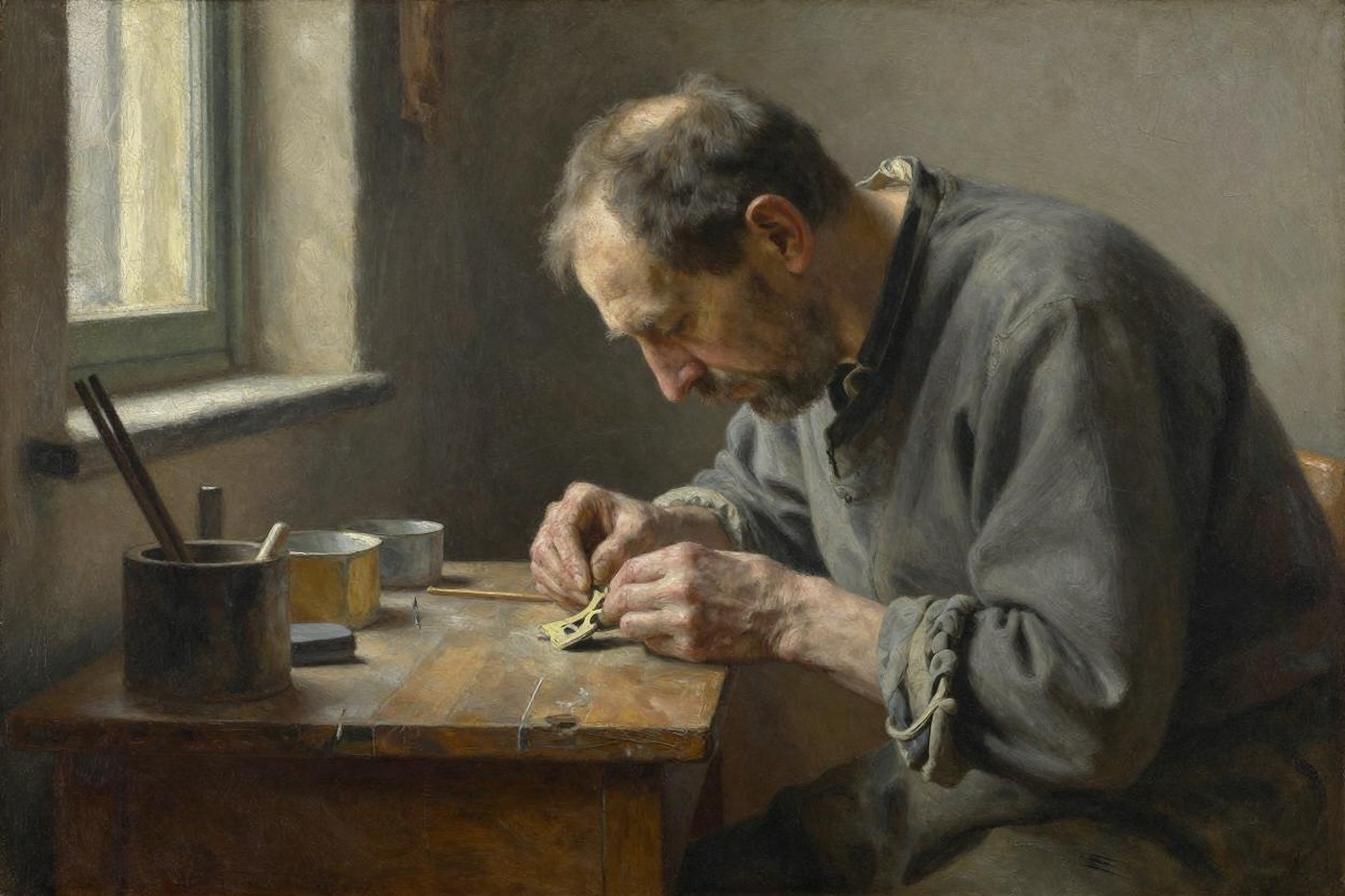
Part III: The confiscation, industrialized
Two claims are about to collide. The first is Weil's: that attention is the rarest and purest form of generosity, the substance of love, the faculty whose absence constitutes cruelty, and that giving it unmixed requires a suspension of the self that human beings almost never accomplish.
The second is a business plan.
In 1971, Herbert Simon, a Nobel-winning economist, wrote a sentence that was accurate in the way of a prophecy: a wealth of information creates a poverty of attention. In the decades after, the information wealth arrived in the quantities he foresaw, and then a technical answer was found to the poverty: bidirectional auctions, run in milliseconds, selling intervals of human attention to the highest bidder, on every screen on earth, continuously. The business is known as advertising, but that word is almost misleadingly antique, like calling an aircraft carrier a boat. What is brokered in the modern exchange is not access to eyeballs beside content, but the intervals of human attention themselves, priced dynamically, like any commodity. Weil's rarest and purest generosity, warehouse-sized, extracted, and wholesaled.
Here is where it becomes necessary to say what this essay is not arguing, because the naive version is everywhere and it is false. It is not that the phone harvests an attention that used to be freely given to friends and books and sunsets, and that we have all thereby become victims of force in the Iliad's sense. Weil herself would have refused the flattery. She did not think pre-industrial humanity was attentive. Her entire diagnosis predates the smartphone by seventy years, aimed at peasants, priests, generals, and homemakers, and it indicted them all as incurably distracted by their own centers of gravity. The self's interference, in her account, is the default of the species, and the machinery did not create it. The machinery monetized the default.
But what the machinery did create is new in kind, not degree, and it is worth being precise about the two respects in which our condition is not Weil's.
First, the intervals are now filled before they can occur. The competition among bidders is a competition to eliminate vacancies. Every lag, every moment of potential boredom, every pause between the messages, is an unsold advertising interval and a defect to be remediated by autoplay, by preload, by infinite scroll. Now recall what attention, in Weil's strict sense, requires: an interval held open, an emptiness sustained against the self's pressure to fill it, a waiting without an object. The vacancy is the precondition. A civilization engaged in the total elimination of vacancy is, without needing to intend anything so coherent, engaged in the elimination of the precondition, at the level of infrastructure, for the specific faculty that Weil identified as the substance of the moral life. One need not believe in her God, or her severity, to find that worth a thought. The engineering target and the mystical precondition are the same coordinate: the pause.
Second, the self that must be suspended is now the product being serviced. Attention, on her account, empties the attender of self-interest in order to receive what is actually there. The feed does the reverse: it studies the self, models its interests, and renders the world in the shape of them. Personalization is the precise inverse of decreation. It is a technology for guaranteeing that nothing appears to you that is not already shaped to your gravity, and the result is that the suspension of self, which she considered almost impossible under the best conditions, now has the entire weight of an optimization loop bearing against it. The force in "The Iliad, or the Poem of Force" turned persons into things by terror. The subtler annihilation, which she did not live to see, turns persons into audiences by flattery, and the person converted this way has a representation of the world in which every object testifies to the importance of their interests. On Weil's map of the soul, that condition is not connection. It is a sealed room.
Now the objection, because there is a real one, and it deserves the same fullness.
Part IV: The counterfeit, and the thing it counterfeits
The strongest reply to everything above is that Weil's rarity has been democratized, not destroyed, and the reply has more force than her partisans usually allow.
A man in Marseille in 1942 wrote to an afflicted poet in one of the most fraught correspondences of the century, and the attention exchanged between those two, under those circumstances, in that diction, was indeed the rarest thing imaginable: the pure attention of a saint, total, physically suicidal, purchased at the price of a life. Set against that standard, almost every human act of attention in history was a counterfeit, including most of the acts performed by people who loved each other in Marseille, and by their ancestors, and by us. The ordinary generosity of ordinary attention, half-mixed, interrupted, contaminated with self-regard and intermittent comprehension, was never pure, is not pure now, and yet it has always carried almost all of the world's tenderness. The mother who attends to her child at seventy percent purity, tired, distracted, catching herself and returning, is performing, on any sane accounting, more moral substance in a week than the sealed saints of the tradition extracted in a lifetime. Weil, one suspects, knew this, and said so, in her gentler entries. The purity is not the point. The pointing is the point.
Against this, the digital mediators do sometimes genuinely serve the act. The widow who attends to her granddaughter's voice across an ocean is not being defrauded. The rare-condition patient who finds, out of the feed's indiscriminate reach, the only other four hundred people on earth who know the disease, is receiving something that Weil's village attention economy could never manufacture: communities of the rare, assembled out of a vacancy that only the total network could search. The tool is capable of serving attention in configurations no village ever offered. That it primarily aims at the reverse is an ownership problem, not a property of the wires.
So the two facts, held together: the precondition for the purest generosity human beings are capable of is an interval of vacancy, held open, undefended, in a self that is mostly interference. And the most successful enterprises in history exist to fill every vacancy with content shaped to the self they have modeled, and they are winning, not because the self is weak, but because the vacancy was always the hard part. Weil did not need a smartphone to refuse the interval. Sixty years of prayer did not reliably open it. The machinery did not defeat our attention. It monetized the difficulty we already had.
Her sentence, restored to context, was written to a paralyzed man, at the bottom of a war, by a woman who was starving herself by increments, and it did not counsel comfort. It told him the most generous thing that could happen to him was already inside his powers, powers consisting entirely of the direction of what remained of his attention. That is what the sentence means, and why it was worth exhuming from the rubble, and why it survives the greeting cards and the apps. The rarest and purest form of generosity is still attention, and it is still rare, and the pure part is still the waiting, and there is still nothing else like it in the world's inventory of things one human being can give another.
Somebody in your life is waiting inside an interval right now. The machine's plan for that interval is on the record. Yours is not yet. The interval is open, it always was, it is open now. What fills it next is, as Weil said to the dying poet, and meant entirely, up to you.
A non-Western counterpoint to individualism, and to an epidemic of loneliness.