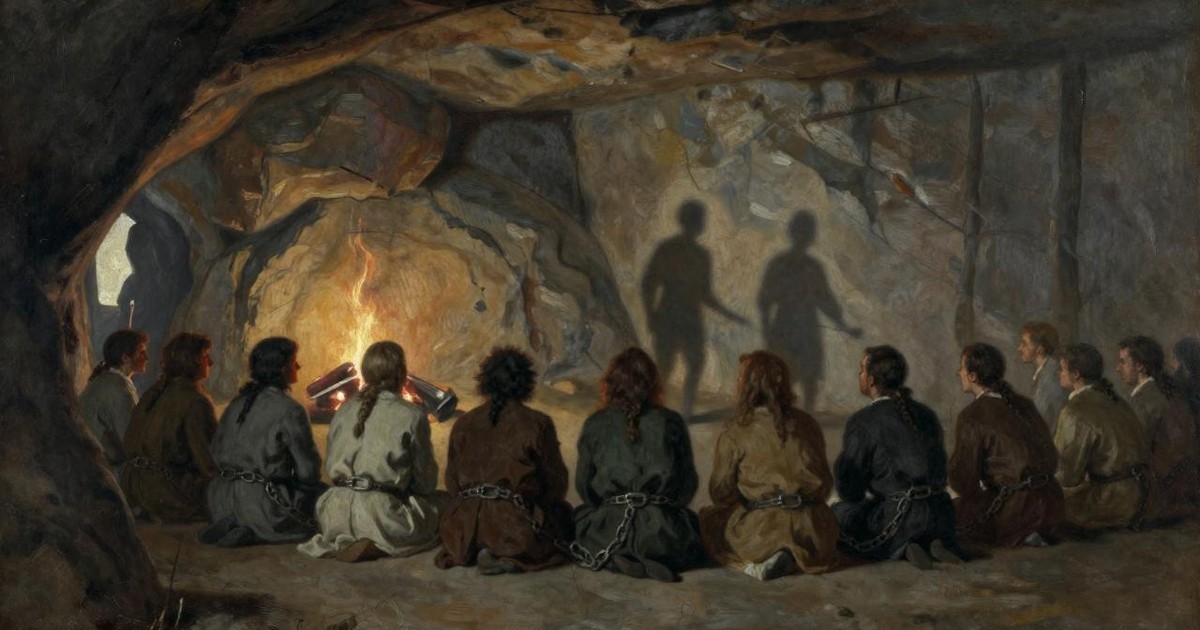
A prisoner in a cave has never seen sunlight. He has never seen the fire burning behind him. All he knows are the shapes projected on the wall in front of him: silhouettes of statues carried past the flame by unseen people, flickering, shifting, sometimes moving in patterns that suggest meaning. He does not know there are objects. He does not know there is a fire. He does not know there are people casting these shadows. To him, the shadows are everything. They are the whole of reality, because the whole of his world consists of watching them, naming them, remembering where they have appeared and guessing where they will appear next.
So far this is an allegory written two millennia ago, by Plato, in the seventh book of The Republic, and philosophers have been arguing over its details ever since.
Plato used the story to argue a political point, which was that most people do not want truth, and will resist anyone who tries to give it to them. He was writing about education, about the philosopher's duty to rule even when the ruled do not want ruling by the educated, about how dangerous it is to live among people who are mistaken without knowing it. But the image itself, the cave and the wall and the shadows, became larger than the lesson it served. It has been reused for every situation where someone mistook a representation for the thing represented, a picture for the territory, an argument for the world that produced it.
Before the leap to today, it is worth clarifying what the allegory is doing technically, because the confusion about it is mostly about the mechanism.
The prisoner is not ignorant because he lacks information. He is ignorant because the information available to him has been filtered through a process that hides its own filtering. Someone is carrying statues. Someone is lighting the fire. Someone has arranged the prisoners in rows, chained them, positioned the wall at the right distance. The shadow-show depends on these choices, but the prisoner sees only the result, not the production. So he builds a theory of the world that cannot be corrected from within the room. He cannot go back and ask the statue-carriers why they moved the ox next to the spear, because he cannot see them.
That is the crucial constraint. Any theory he forms must be tested against the shadows alone. If the ox appears after the spear every Tuesday, he predicts the ox will appear after the spear next Tuesday. He is not stupid. He is doing science with incomplete equipment, and his science will be perfect until the moment it breaks, when the person with the ox decides to carry a tree instead. But the prisoner will not know why the prediction failed, because the cause exists outside the observable universe.
This is not an observation about stupidity. It is an observation about systems. A system that produces output without revealing inputs creates observers who cannot learn their own limits. Their theories look complete, because they are consistent with the data, and the data is incomplete by design.
Plato believed the real work of education was to break the chain, physically if necessary, and force the eye to adjust to the light. The cave exit was not metaphorical in his mind. It was something that had to happen to the person, not just to their opinion. You cannot reason your way out of the cave by talking to other prisoners, because they will tell you that your talk of sunlight is madness and bring you back to the safe certainty of the familiar shapes on the wall.
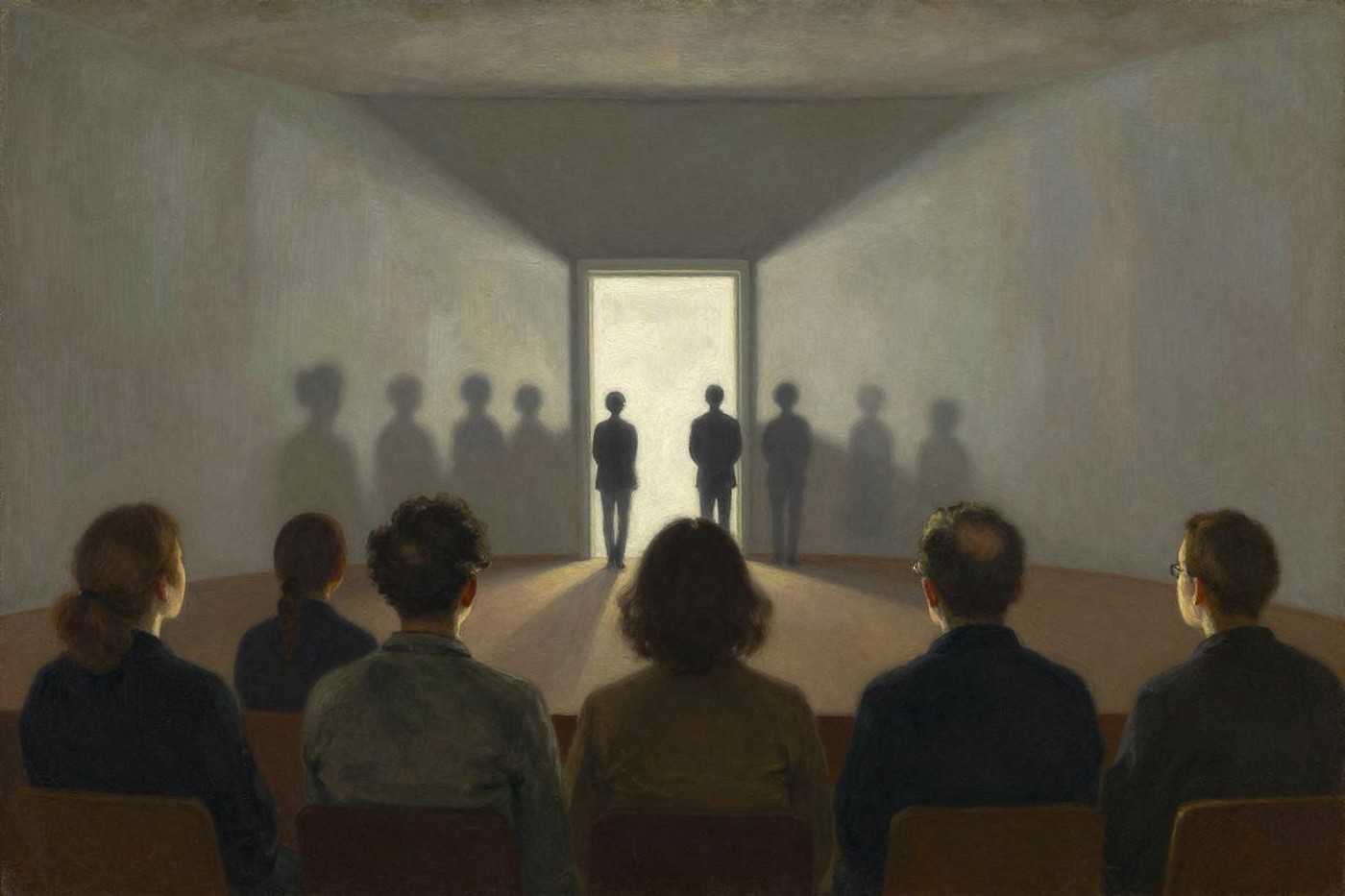
The modern version does not require chains, fire, or a cavernous tunnel.
Open your phone. The application opens to a screen that knows more about you than the people who raised you, more than your spouse or parents know about your habits, more than you know about yourself in the aggregate. The first content appears: a video, a post, a news item, an advertisement, a meme. The second follows the first. The third follows the second. Between each piece and the next is a microsecond of calculation that asks: did you linger, did you click, did you scroll past, did you laugh, did you close, did you share. The next item arrives adjusted for the answer to those questions.
The result is a wall, in Plato's sense. It is the surface where reality gets translated into your experience of it. You do not see the raw world, you see the processed world. But the processing does not happen visibly. The algorithm is proprietary. The engagement signals that determine what you see are invisible. You do not know why you saw this video and not that one. You do not know what else was eligible for your attention. You only know what appeared on the screen, and the pattern you build of the world must be consistent with what showed up there, because nothing else shows up anywhere.
The prisoners in Plato's cave had no choice about which shadows they saw. The content fed to you is chosen by design, and the difference matters, but the epistemic effect is identical. A person who builds their worldview from a feed is building it from shadows, because the feed has already made decisions about what counts as the world before any of it reaches your eyes. You can argue about the shadow, critique the shadow, compare this shadow to that shadow, but you cannot escape the fact that you are working with a sample that was curated before you existed as a critic of it.
The old cave had a single projector. The modern cave has billions, all firing at once, all tuned to different frequencies, all feeding different walls to different prisoners. There is no universal shadow-show anymore. Everyone lives inside a personalized cave, and no one can see the shape of the wall they are facing because the wall surrounds them. They swipe up and the next shadow arrives, calibrated to keep the eyes open, calibrated to produce the next engagement event, calibrated to ensure the prisoner never leaves the room, because leaving the room means losing the ad revenue.
Here is the twist Plato did not anticipate, because the technology did not exist for him to imagine it.
The cave exit is no longer a place you can be dragged toward. The light has been inverted into darkness. The prisoner who is told to seek sunlight is now told to scroll, to refresh, to update, to download. The fire that casts the shadows has been miniaturized into a rectangle that glows black on the palm. The people carrying the statues have been replaced by software that carries nothing at all except the pattern itself, the loop, the cycle, the endless reproduction of the wall.
So when someone says, stop staring at your phone, look at the real world, they are speaking a language that is no longer available to the prisoner. The real world is too slow. It does not deliver dopamine hits at the pace the brain has learned to expect. It does not offer the satisfaction of a pattern confirmed, the scroll, the like, the notification, the instant recognition. The real world is dim compared to the glow of the fire that burns in your hand, and the prisoner, trained by thousands of days of reinforcement, knows which environment responds reliably to his behavior.
Worse, the suggestion to escape presupposes that escape is possible in a single act. It assumes there is an exit door and you can walk through it. But the modern cave has no exit door. It is everywhere. The phone is not an object you set down. It is an extension of your nervous system, and the wall is not in front of you. It is inside you, built into the architecture of your attention, the way you process time, the way you measure boredom, the way you define connection. You cannot leave the cave because the cave is your relationship to your own attention, and the only tools you have for measuring attention are delivered by the cave itself.
And yet there is a counter-reading, and honesty demands it.
The cave allegory assumes the shadows are lies, or at best partial truths about a higher reality that the freed prisoner perceives. But maybe the shadows are not false. Maybe the feed is simply a different medium, like writing or painting or television, with its own rules, and the person navigating it well is not trapped but skilled. People learn to read the signals, to spot manipulation, to curate their own feeds, to mute toxic actors, to diversify sources, to take breaks. The wall is a tool, not a prison. The prisoner chooses to return, not because he is fooled, but because the fire is warm.
Perhaps. The question is whether choosing to return is the same as being able to leave. The prisoner in the cave did not choose to stay because the shadows were comforting. He stayed because his eyes could not bear the sun, because his entire nervous system had adapted to the flickering light, because he had been trained from birth to believe that the shadows were the only reality available. The modern prisoner reports the same sensation when asked to put the phone down for a day. It feels like withdrawal. Like injury. Like the world has gone dull and meaningless, and the only thing that restores brightness is the rectangle.
That is not skill. That is adaptation to captivity.
The ancient cave required a philosopher to drag the prisoner out. The modern cave requires a person to drag themselves out, against every incentive, every habit, every neural pathway, every business model designed to prevent the escape. The fire burns brighter now, and the wall is closer, and the shadow-show is perfect at predicting exactly what you want to see before you know you want it.
Plato ended the allegory with a warning: the freed prisoner must return to the cave, to try to save the others, and the others will kill him if he tries, because they will think his talk of sunlight is nonsense. The warning was about the danger of truth-telling in a world that does not want to hear it.
Maybe the updated version is simpler. The freed prisoner returns to the cave, and sits down beside the others, and picks up the phone, and scrolls for ten minutes, and thinks about putting it down, and puts it down, and picks it up again. The others do not kill him. They nod at the screen. They show him a video. They laugh at the joke. They say, it is fine. We know how to handle it. We are not prisoners.
The shadows are still shadows. The wall is still a wall. The only thing that has changed is that the prisoner no longer believes in the sun.
Further Reading