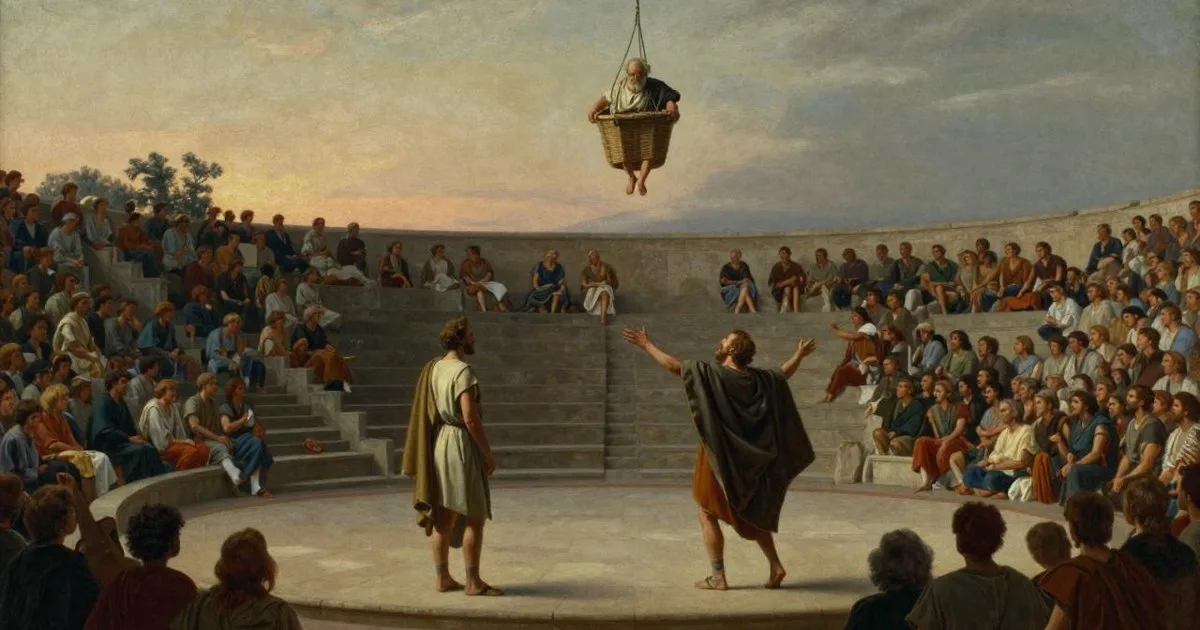
An actor playing Socrates dangled in a basket above the stage of the Theatre of Dionysus, explaining to the Athenian crowd at the City Dionysia of 423 BCE that he was walking in the air. The play was Aristophanes' The Clouds, and in the version that survives it asks what every comment section still asks: why do bad arguments beat good ones in public? The play's answer, which Plato sharpened and Aristotle partly resisted, is that a crowd rewards the argument that flatters it and looks like winning, and both come cheaper than being right.
The plot runs on debt. Strepsiades, ruined by his son's taste for horses, hears that Socrates' Thinkery will teach anyone who pays to win an argument, right or wrong, and he wants the one that will talk him out of his debts in court. He enrolls, proves too forgetful, and forces his son Pheidippides to go instead.
The play lost, third of three, and the comedy by Ameipsias that beat it, the Connus, had a Socrates on stage too. Aristophanes revised the script, and that revision, apparently never staged, is the only Clouds we have. An ancient summary, the Hypothesis, lists the great debate and the burning of the school among the rewritten scenes. If it is right, the version in which the crowd decides the argument never faced a crowd at all.
Part II: What happens in the debate scene of The Clouds?
Socrates is not in it. He leaves, and the Stronger and the Weaker Argument argue in front of Pheidippides, in lines 889 to 1104 of William James Hickie's 1853 translation, which calls them the Just and Unjust Cause. The Weaker Argument is the case that deserves to lose and wins anyway, the charge that would follow Socrates into court: making "the worse appear the better cause." Aristotle traced the skill to Protagoras, one of the sophists, the paid teachers of speaking.
The Weaker opens with a jab the Stronger never answers: if justice lives with the gods, how did Zeus go unpunished for chaining his own father? The Stronger calls for a basin. Called debauched and shameless, the Weaker thanks him for the roses. An insult its target wears as a compliment cannot wound, and a speaker who feels no shame cannot be shamed into stopping.
Then the pitches: pompous nostalgia for the men of Marathon, with a leer at the gymnasium boys, against women, wine and cottabus.
The finish takes about twenty lines. The Weaker gets his opponent to agree that advocates, tragic poets and public speakers come from the blackguards, Hickie's polite word for a Greek obscenity, then points past the stage: "look which class among the audience is the more numerous." The Stronger looks, finds the blackguards in the majority, and gives up: "We are conquered. Ye blackguards, by the gods, receive my cloak, for I desert to you." If the honored men and most of the house wear the insult, it has stopped being one, and shame stops working.
The argument is settled by counting the house.
Schooled in the Worse Cause, Pheidippides beats his father and offers to prove he may beat his mother too. Strepsiades cannot refute him. He burns down the Thinkery instead, mocking Socrates from the roof with the philosopher's own line about walking on air.
Part III: Why did Socrates name a comedy at his trial?
In 399 BCE Socrates, past seventy, stood trial before about five hundred jurors, citizens over thirty chosen by lot, on a charge of impiety (asebeia): refusing to recognize the city's gods, introducing new divinities, corrupting the youth. In Plato's Apology, he says his most dangerous accusers are older ones, who reached the jurors as children, and that he cannot name them, unless one is a comic poet. Then he names Aristophanes.
The Clouds was the one source he named. He calls the charges ready-made, the kind thrown at every philosopher. Plato, a devoted student writing a defense, had reasons to prefer the story. Benjamin Jowett, introducing his translation, noted something closer to power and politics: the names of Alcibiades and Critias, once Socrates' companions, were fresh in Athenian memory and hated by the restored democracy.
His method, the question-and-answer testing called the elenchus (Greek for refutation), needs someone to answer. A comedy cannot be cross-examined, and a rumor with that many tellers has no author to put on the stand. He must, he says, "fight with shadows."
Against his accuser Meletus the method works, and does not help. Asked who improves the young, Meletus names the laws, the judges, the audience, the councillors, the Assembly: every Athenian except Socrates. It is the head count from The Clouds turned around, and Socrates takes it apart with horses, which one trainer improves and most handlers spoil. He wins the exchange. About five hundred other men hold the vote.
The dialogues imagine another arrangement. In the Gorgias, when Polus laughs instead of answering and tells him to "Ask the company," Socrates refuses to count. If Polus has no better argument than numbers, he will take the vote of one witness, the man he is arguing with, and "with the many I have nothing to do." Callicles later puts Aristophanes' suspicion to him directly: Polus lost only because he was too ashamed to say what he thought, and Socrates, playing on that shame, is a mob orator himself.
At the trial the company was counted: roughly 280 to 220, thirty votes short of acquittal. Asked to name his penalty, Socrates first proposed free meals in the Prytaneum, the honor Athens gave Olympic victors, since a victor gives the city the appearance of happiness and he gave it the reality. Then he offered a fine of thirty minae, with Plato among his sureties. The jurors voted again, against him by a wider margin, says Diogenes Laertius, writing centuries later.
They sentenced him to death.
Part IV: What's the difference between refuting someone and appearing to?
Aristotle, Plato's student, set out to tell real refutations from fake ones. His On Sophistical Refutations opens with counterfeits, tin that passes for silver. A sophistical refutation is an argument that looks like a refutation, to the person answering or to those listening, and refutes nothing. The sophist's art, he says, is "the semblance of wisdom without the reality."
Most of his tricks work on the answerer. Speed is one, since someone left behind looks less far ahead. Anger is another, provoked by making a show of playing foul and being "altogether shameless," a character Aristophanes had already staged. A few work on the room: use a general rule the answerer never granted, and the audience will assume he did.
The man who gave logic and argument its first textbooks held two views of the crowd. His Rhetoric says the true and the just tend by nature to win, so a bad verdict is the speakers' fault, then concedes that some audiences cannot be taught, whatever the speaker knows. He approves Gorgias's advice to meet seriousness with jokes and jokes with seriousness, but draws a line: "the ironical man jokes to amuse himself, the buffoon to amuse other people." By that standard the Weaker Argument is a buffoon.
Arthur Schopenhauer wrote the manual from the other side. The Art of Being Right (translated in 1896 as The Art of Controversy), written around 1830-31 and published in 1864, four years after his death, gives thirty-eight stratagems for winning, right or wrong. Its premise: "A man may be objectively in the right, and nevertheless in the eyes of bystanders, and sometimes in his own, he may come off worst." He blamed vanity, which needs no audience.
The stratagem closest to The Clouds is the twenty-eighth, the appeal to the audience: an objection only an expert could see through, made before non-experts, and ideally funny. "People are ready to laugh, and you have the laughers on your side." The rebuttal would take a long explanation, and nobody stays for it. The last stratagem is to get personal.
Whether he meant it straight is disputed. His translator called much of the book ironic. Schopenhauer said such a catalogue helps a debater recognize the tricks, then added that dialectic must aim at victory, and later set the manuscript aside.
Part V: Can honest argument survive an audience?
Read the stratagems with a phone in hand.
The quote-post dunk is the Weaker Argument's gesture, the finger pointed past the stage. Twitter made Retweet with comment official in April 2015, TechCrunch reported, letting anyone hold up another person's post before their own followers. In 2018 Mastodon's founder, Eugen Rochko, refused to build quoting, because it makes you "speak at your audience." Mastodon added quote posts in 2025, with controls that let authors refuse them, which gives the person being answered some say over the room.
The ratio, when replies outrun likes, is the head count done in public. A 2021 PNAS study by Rathje, Van Bavel and van der Linden, covering 2.7 million posts from news outlets and members of Congress, found that each word about the political out-group raised the odds of a share by 67 percent, though the data are correlational and the accounts elite. Sorting the house into us and them was the Weaker Argument's closing move. From 2017, the Washington Post reported, Facebook's feed ranking counted emoji reactions, the angry face among them, as five times a like, and in 2019 its own data scientists linked angry-reaction posts to misinformation and toxicity. Aristotle listed anger among the tricks played on an answerer, since an agitated man guards himself less well. A ranking system that pays for anger plays the trick on everyone reading.
The evidence does not all point one way. Burton, Cruz and Hahn (Nature Human Behaviour, 2021) found that a much-cited model of moral contagion online did no better than a deliberately implausible control. Marks and colleagues (PNAS, 2025) found hostility toward the other side usually the best predictor of engagement, but saw in-group solidarity surge after the crises of July 2024.
Then there is the staged confrontation, the studio version of "debate me," which The Clouds would recognize fastest. Jubilee's Surrounded, launched in September 2024, seats one guest against twenty to twenty-five opponents, who come forward one at a time and on a clock, which is Socrates' rule of one answerer. The room keeps the verdict: when a majority raises red flags, the challenger is removed. The guests have come from the right and the left. Slate reported 8.9 million views in the first week for the July 2025 episode featuring the journalist Mehdi Hasan, 1 Progressive vs 20 Far-Right Conservatives.
The case, worked through
Premise: Public dialectic purifies belief. Question-and-answer reasoning tests a claim, and doing it in public should spread the benefit.
Objection: From the seats, dialectic and sophistry look alike. The joke needs a crowd that cannot tell Socrates, who said he never charged, from the paid teachers.
Revision: Teach the difference. Aristotle separates real refutation from the apparent kind, and anyone who learns his catalogue can spot the trick.
Objection: People argue to win, even alone. Schopenhauer blames a vanity that needs no audience, and a crowd adds the laughers.
Reply: The format decides, up to a point. Socrates questioned Meletus alone and still lost, because about five hundred others held the vote, so perhaps dialectic needs a room where the one answering decides. That takes the vote from the crowd, not the vanity from the arguers, and whether such a room can be built in public, and who gets in, stays open.
Plato left an untidy picture of the other room. In the Symposium, Socrates skips Agathon's victory party, "fearing a crowd," and comes to dinner the next day, with Aristophanes among the guests. Alcibiades, whose friendship with Socrates the jurors of 399 had not forgotten, describes him at Delium "stalking like a pelican, and rolling his eyes," quoting The Clouds to its author's face. Then someone leaves the door open and revellers pour in. By dawn Socrates is arguing Aristophanes and Agathon into a conclusion they accept, Plato says, being too drowsy to follow it.
The old texts admit what small rooms cost. The young men with time to follow Socrates were rich, though he said anyone, rich or poor, could question him. Aristotle warned against arguing with everyone, since with some people any argument degenerates, and Schopenhauer ended on that rule: "scarcely one man in a hundred is worth your disputing with him." A room that small needs a door, and someone keeps it.
An essay is closer to the comedy than to the dialogue: one speaker, nobody who can stand up and answer. The Clouds we read survives only as a text. This site's Objection column tries to build a smaller room on the page, setting out an idea's strongest case before anyone argues back. Socrates knew the position from the other side.
Think of the last time an argument changed your mind. Count how many people were in the room, and whether any of them had a vote.
Further Reading
The Words Went FirstThucydides and Confucius on political fights over what words mean, the quarrel beneath the insult exchange.