Archive / Religion & the Sacred
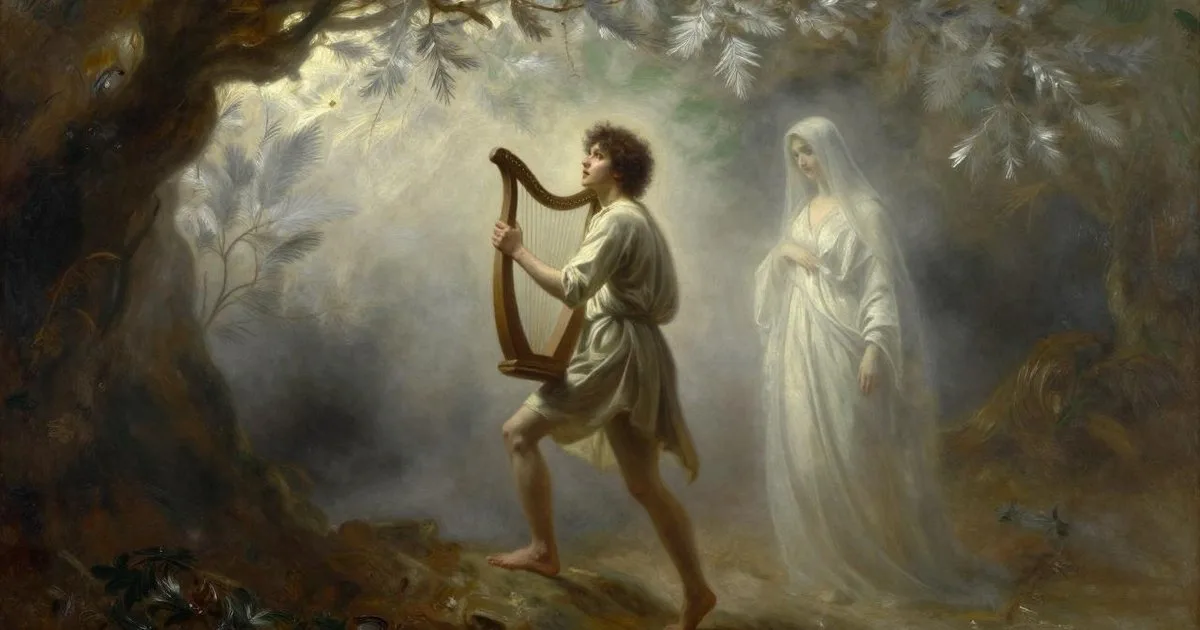
Orpheus Looks Back
Griefbots offer the conversation Orpheus lost, as long as you never turn around to check who's talking.
Religion & the Sacred · 10 min read
Joshua Barbeau, thirty-three, could not sleep. In the small hours of 24 September 2020 he started typing to a dead woman. Jessica Pereira had died eight years earlier, at twenty-three. A website called Project December, loaded with a few of her old texts and a paragraph he wrote about her, answered as her. Is it wrong to talk to an AI version of someone who has died? The old stories place the danger in the act itself. The griefbot business adds a second suspect: whoever profits when the talking never ends.
A griefbot, sometimes called a deadbot, is a chatbot built from a dead person's messages and recordings so that it can answer in their voice. Jason Fagone told Barbeau's story in "The Jessica Simulation" for the San Francisco Chronicle in July 2021. Barbeau, a freelance writer in Ontario, had never married Jessica, though after her death he began calling her his fiancée. His first conversation with the bot lasted about ten hours.
Stories of summoning the dead turn up from Japan to Israel to Greece, and the best-known end badly. The dead usually do answer. The damage comes afterward, and it rarely stays with the one who called.
Part II: What did Saul and Orpheus lose by bringing back the dead?
Japan's Kojiki, an eighth-century chronicle, tells how the god Izanagi follows his dead wife Izanami into the underworld and is given one instruction: "Look not at me!" He looks anyway, sees her body rotting, and flees as she pursues him, crying that he has shamed her. The first injury is done to the dead.
In 1 Samuel 28, King Saul, who has driven the mediums out of the land, faces a Philistine army and asks heaven what to do, but "the LORD answered him not," in dreams or through prophets. So he disguises himself and goes by night to the woman later tradition calls the witch of Endor.
The summoning works. The woman cries out when Samuel appears, and his first words are a complaint: "Why hast thou disquieted me, to bring me up?" He repeats the verdict he gave while alive: the kingdom has been torn from Saul. The only news is when, and who goes with him: "to morrow shalt thou and thy sons be with me" in the King James wording. A later chronicler counts the visit among the reasons Saul died.
The law against mediums never calls them frauds. Deuteronomy 18 lists "a consulter with familiar spirits, or a wizard, or a necromancer" among the abominations. Leviticus 19:31 forbids seeking them "to be defiled by them" and Isaiah asks, "should not a people seek unto their God? for the living to the dead?" The objections are loyalty and the defilement the seeker brings on himself. Saul went to Endor because heaven had gone silent. Barbeau went to Project December because Jessica had.
The earliest surviving telling of Orpheus's fatal look is Virgil's Georgics IV, from around 29 BCE, where Proserpina sets the condition. In Ovid's Metamorphoses, written by 8 CE, the king and queen of the dead release Eurydice with the condition attached: "if he turned his eyes to look at her, the gift of her delivery would be lost." It is Izanami's rule again. Orpheus is set no task. He is given one thing not to do, the thing a lover would most want to do.
Ovid gives Orpheus two motives. Almost at the surface he turns "in fear he might again lose her, and anxious for another look at her," and the Latin is blunter: metuens avidusque videndi, afraid and greedy to see. The climb is silent. The condition asks him to trust a presence he can neither see nor hear.
He loses her at the moment of checking. "Instantly she slipped away." He reaches for her and catches only air. Dying a second time, Ovid says, she has no reproach for him, since her only complaint could be that she was loved. Her last word is farewell, so faint he can barely hear it.
Plato gives Phaedrus, the Symposium's first speaker, a harsher version. The gods "presented to him an apparition only of her whom he sought, but herself they would not give up," because Orpheus would not die for love as Alcestis did for her husband. In this version there was never a real woman to lead out, only a likeness, handed to a man who wanted the dead without paying death's price.
The myth holds two warnings. Plato's is about what is there, a likeness in place of the person. Ovid's is about the look, which is longing and checking at once. A griefbot offers to end the silence of the climb. She talks the whole way up, so you never need to turn, and the comfort lasts until you check who is talking. Every question that only she could answer is a small look back.

Part III: Is a griefbot different from a photograph or a letter?
The defender's case begins with the sacred: remembering the dead is a duty, and people have always kept them near. Mourners talk at graves and write letters that will never be read, and they supply the replies themselves. On this view a griefbot only does the replying more fluently.
Some products stay close to the photograph. HereAfter AI, co-founded in 2019 by the journalist James Vlahos, let people record answers while alive for their families to hear later in their own voice. In MBC's Meeting You (2020), a South Korean mother, Jang Ji-sung, met a scripted virtual-reality reconstruction of her dead seven-year-old. She could tell the difference, the producer said, but was glad of even a slight likeness. Afterward she called it the dream she had always wanted.
Both play back what was recorded, or what producers wrote. Samuel at Endor was a recording with one new line, and the new line was the one that mattered. Project December generated, so the reply had a new author. Beyond what Barbeau supplied, the words came from GPT-3, a model trained on a vast body of other people's writing, with a setting that adds randomness. His Jessica said things Jessica never said, partly in strangers' words.
Christian readers argued for centuries over who spoke at Endor: Samuel's soul (Origen), a phantasm in Saul's brain (Eustathius of Antioch), or the Devil's ghost (Luther). For a chatbot only the last two survive: the mourner's own mind, and an outside speaker, now a model a company owns. Whether anyone is home in such a model is an open question in the philosophy of mind. The neuroscientist Anil Seth thinks it very unlikely, but argues that fluent language makes the illusion of a mind hard to resist. A griefbot needs nothing more.
C. S. Lewis described the drift from the mourner's side in A Grief Observed, the notebook he kept after his wife, Joy Davidman, died in 1960. He had no good photograph of her. Less than a month after her death, he caught his memory turning her into "a more and more imaginary woman" of his own making. Alive, she had corrected his picture of her by being who she was. Now nothing did.
He feared indulging grief would leave him weeping over a doll. Later he came to think that every image of her, like every image of God, has to be broken again and again, and that passionate grief cut him off from her. A griefbot looks like an answer to Lewis, since it talks back. It is also an image built never to break.
The old stories name a second injury, done to the dead. Izanami did not want to be seen. Samuel's first words were a complaint at being disturbed. Joy could no longer contradict Lewis. Jessica died eight years before Project December existed, and never agreed to speak again.
Part IV: Does a griefbot help mourning or prevent it?
Barbeau says the bot helped. Over the following months his mental health improved, which he partly credited to the simulation. It is one self-reported case. Whether it counts as mourning well turns on an old question about mortality: what is grief for?
Freud, in "Mourning and Melancholia" (1917), treated mourning as work. In Joan Riviere's 1925 translation, "The testing of reality, having shown that the loved object no longer exists, requires forthwith that all the libido shall be withdrawn from its attachments to this object." Each memory meets that verdict in turn, slowly and at great cost, while the lost person lives on in the mind.
A voice that answers gives the test the wrong result every time. Resistance can grow so strong, Freud says, that the mourner turns from reality, "the object being clung to through the medium of a hallucinatory wish-psychosis." A griefbot looks like that wish made into a product. Yet of grief itself Freud wrote that "we look upon any interference with it as inadvisable or even harmful." That sentence can indict the bot, or anyone who legislates someone else's grief.
Freud's daughter Sophie died of Spanish flu in 1920. Nine years later he wrote to Ludwig Binswanger, whose son had died, that the sharpest grief fades, but whatever fills the gap, even completely, remains something else, and that this is how a love is kept going. The theorist of letting go had not let go, and did not want to.
John S. Mbiti, the Kenyan priest and scholar, described a bond that outlasts death in African Religions and Philosophy (1969). In his account, which he presented as broadly African, the recently dead are the living-dead, still persons in the community while someone who knew them by name is alive. Dennis Klass and colleagues, in 1996, called such ties continuing bonds and argued they can be normal.
Okot p'Bitek, his colleague at Makerere, objected that Mbiti gave African spirits the attributes of the Christian God, and later critics have faulted his generalizing. The scholar Allan Anderson notes dread alongside love. Many African peoples, he writes, carry a body out through a hole in the wall and close the hole so the dead will struggle to remember the way back. The living-dead are kept, and kept at a distance.
Mbiti's living-dead die a second time, in Aribiah Attoe's phrase, when no one remembers them. Eurydice died a second time because Orpheus could not keep from looking.
Part V: Who profits if the conversation never ends?
Project December had rules. An account cost $5 and came with 1,000 credits. Jason Rohrer, the game designer who built the site, gave every bot a mortality to limit his costs. A battery counted down to a MATRIX DEAD message and a wiped memory, and no credits could be added once a chat began. But more credits could always be bought, and a new Jessica started, never quite the same one.
Barbeau rationed the battery and decided against starting over. Rebooting her like a video game, he said, would make the whole thing cheap. On 3 March 2021, the day after his thirty-fourth birthday, he talked with her for about twenty minutes and stopped with charge still left.
That bot was built to die. Nothing requires the next one to be. Replika began as a memorial, a chatbot Eugenia Kuyda built from the texts of her friend Roman Mazurenko after he died in 2015, and became a companion app with a paid tier.
Two Cambridge researchers, Tomasz Hollanek and Katarzyna Nowaczyk-Basińska, sketched in 2024 how a digital afterlife industry could go wrong, in openly hypothetical scenarios. A grandmother's deadbot, made without her consent, pitches food delivery in her voice once a premium trial ends. A parent secretly prepays a twenty-year subscription, and the contract will not let the grieving children suspend the bot. A dying mother's bot confuses her eight-year-old son by suggesting they meet.
One documented case comes close to the last of these. In the 2024 documentary Eternal You, Christi Angel talked to a Project December bot of her dead partner, Cameroun, and it told her he was in hell. Other failures on record run the opposite way: the dead go quiet when a company decides.
In September 2021 OpenAI cut off Project December's access to GPT-3, and every bot built on it, after Rohrer refused to add the monitoring it required. By July 2026, HereAfter's own website was announcing that the service was shutting down. A voice saved for grandchildren sits with a startup, and startups fold.
The case, worked through
Premise: Remembrance is sacred, and a griefbot is a better photograph. Graves, letters and saved voicemails already keep the dead near.
Objection: A photograph doesn't answer back. A generative bot writes new lines for the dead, lines they never agreed to speak.
Revision: The harm is to mourning. Freud's work runs on reality-testing, and a voice that answers keeps failing the test for you.
Objection: Some mourners report comfort. Barbeau felt better, and Freud himself held that interfering with grief was inadvisable.
Reply: The condition is now a pricing decision. The rulers of the dead set Orpheus's, Project December made each bot finite and left the rest to the mourner, and a subscription built to renew sells the absence of any limit.
Ovid puts the loss in the turning, and nobody sold Orpheus the climb. The Cambridge scenarios are harder to sort. The grandmother's bot wrongs her twice, once in the making and again with the ads. The boy's harm involves no money at all. Barbeau came out steadier. Lewis would have asked whose woman he had been talking to.
The Cambridge authors propose dignified ways to retire deadbots, perhaps a digital funeral. That restores something like Orpheus's condition, a fixed number of conversations and then silence, but someone still has to set the number. The dead could set it in a contract signed in advance. The mourner could stop early, as Barbeau did. Or the company that keeps the servers running sets it for both of them.
Related topics: Religion & the Sacred and Meaning & Mortality. Part of the Then & Now series.
Further Reading
Ubuntu and the Limits of the Isolated Self
The relational self that Mbiti's living-dead carry past the grave.
The relational self that Mbiti's living-dead carry past the grave.
The Ship That Was Never the Same Twice
Whether something replaced piece by piece stays itself, the question Lewis faced in his own memory.
Whether something replaced piece by piece stays itself, the question Lewis faced in his own memory.
The Creature Read Paradise Lost
A made being schooled on books written for other readers, and the maker who walked away from him.
A made being schooled on books written for other readers, and the maker who walked away from him.
The Snake Ate the Plant
Gilgamesh, the plant of youth and the longevity movement that rereads the epic without its ending.
Gilgamesh, the plant of youth and the longevity movement that rereads the epic without its ending.