On January 1, 2025, Netflix released a documentary called Don't Die: The Man Who Wants to Live Forever, about a tech entrepreneur who measures his body every day and treats aging as a disease to be defeated. About four thousand years earlier, scribes pressed into clay the story of another powerful man who refused to die, and who lost. What does one of the oldest works of literature say about the dream of beating death? The Epic of Gilgamesh says that the search for more life can cost the life you already have, and that the only lasting thing may be what you build and leave to others. It never says whether that is wisdom or consolation.
Gilgamesh is king of Uruk, which R. Campbell Thompson's 1928 translation calls Erech. He is two-thirds divine, restless, and cruel to his own city until the gods make him a rival, the wild man Enkidu. They fight, then become inseparable. Together they kill the guardian of the cedar forest and the Bull of Heaven. For this the gods decree that one of them must die, and Enkidu sickens and dies.
The king then goes looking for the man who survived the flood, to learn how he escaped death. What he finds instead, over and over, is advice he does not want. The longevity movement, meaning the scientists, investors and self-experimenters who treat aging as a problem that medicine can slow or reverse, has now funded his journey.
Part II: Why does Gilgamesh go looking for eternal life?
The quest begins at a corpse. In the Old Babylonian version, Gilgamesh refuses to let Enkidu be buried. He sits with the body for days, until the decay is undeniable. Thompson renders the moment with an image that is almost unbearable: "He like a worm hath lain on his face ... Death which I dread I will see not!" The grief and the fear arrive in the same breath. He is mourning his friend, and he is also seeing his own future.
That second recognition sends him out. The king who fought monsters for fame now understands that fame does nothing for the famous body. He crosses mountains where the sun travels at night and comes to the edge of the world. One sentence drives him, repeated in different forms: I do not want to become what Enkidu became.
At the edge of the sea he stops at a tavern. The keeper is the alewife Siduri, whom Thompson calls "the Wine-maker." On an Old Babylonian tablet, which Thompson printed from a Berlin fragment he dated to about 2000 BC, she gives the most famous speech in the poem. It opens with a verdict: "Gilgamish, why runnest thou, (inasmuch as) the life which thou seekest, / Thou canst not find?"
The gods, she goes on, allotted death to man and kept life for themselves. Then she turns from theology to instructions. "Gilgamish, full be thy belly, / Each day and night be thou merry, (and) daily keep holiday revel." Wash your clothes, bathe, dance. "Cherish the little one holding thy hand," she says, and let your wife be happy in your arms. This is what a human being has been given. Her words are in Thompson's translation on the Internet Archive.
It is easy to hear this as a shrug. It is more pointed. Siduri is not telling Gilgamesh to stop caring about death. She is telling him that the search is itself a way of losing what he has. He has a city, a people, a life with other lives in it, and he has left all of it to run toward an absence. Her argument is about opportunity cost, delivered by a woman pouring beer.
The later Standard Babylonian version, the twelve-tablet epic most readers now know, keeps Siduri but drops this advice. Nobody knows why. My own guess is that the later poem wanted its lesson to arrive through events, not speeches, and the events it chose are harsher than anything she says.
Part III: Is death actually bad for the person who dies?
Gilgamesh assumes it is. So does the longevity movement. Around 300 BC, the Greek philosopher Epicurus argued that both are confused. In his Letter to Menoeceus, preserved by Diogenes Laertius and translated by R. D. Hicks, he writes: "Accustom thyself to believe that death is nothing to us, for good and evil imply sentience, and death is the privation of all sentience." Then comes the famous formulation: "Death, therefore, the most awful of evils, is nothing to us, seeing that, when we are, death is not come, and, when death is come, we are not." The full letter is on Wikisource.
The argument is tidy. Harm requires someone to be harmed. After death there is no one. So death harms no one. Epicurus aimed it above all at the fear of misery after death, and that makes it fit the ancient Gilgamesh better than it first appears. When Enkidu dreams of the underworld before he dies, he sees a house of dust where the dead sit in darkness and eat clay. Gilgamesh is afraid of that house. Epicurus would tell him there is no one to live in it.
The modern longevist fears something else, plain nonexistence, and in 1970 the American philosopher Thomas Nagel explained why that fear survives Epicurus. In his essay "Death," he argued that something can be bad for you without your experiencing it. Being betrayed behind your back is bad for you even if you never find out. This is the deprivation account: death is bad for the one who dies because it takes away the goods that more life would have held.
Nagel's account is the longevity movement's best philosophical friend. If death is bad because it cuts off future goods, then postponing it is simply good, and more postponement is better. Enkidu lost everything he would have done. Gilgamesh was right to grieve, and right to fear.
Part IV: Would living forever be a gift or a sentence?
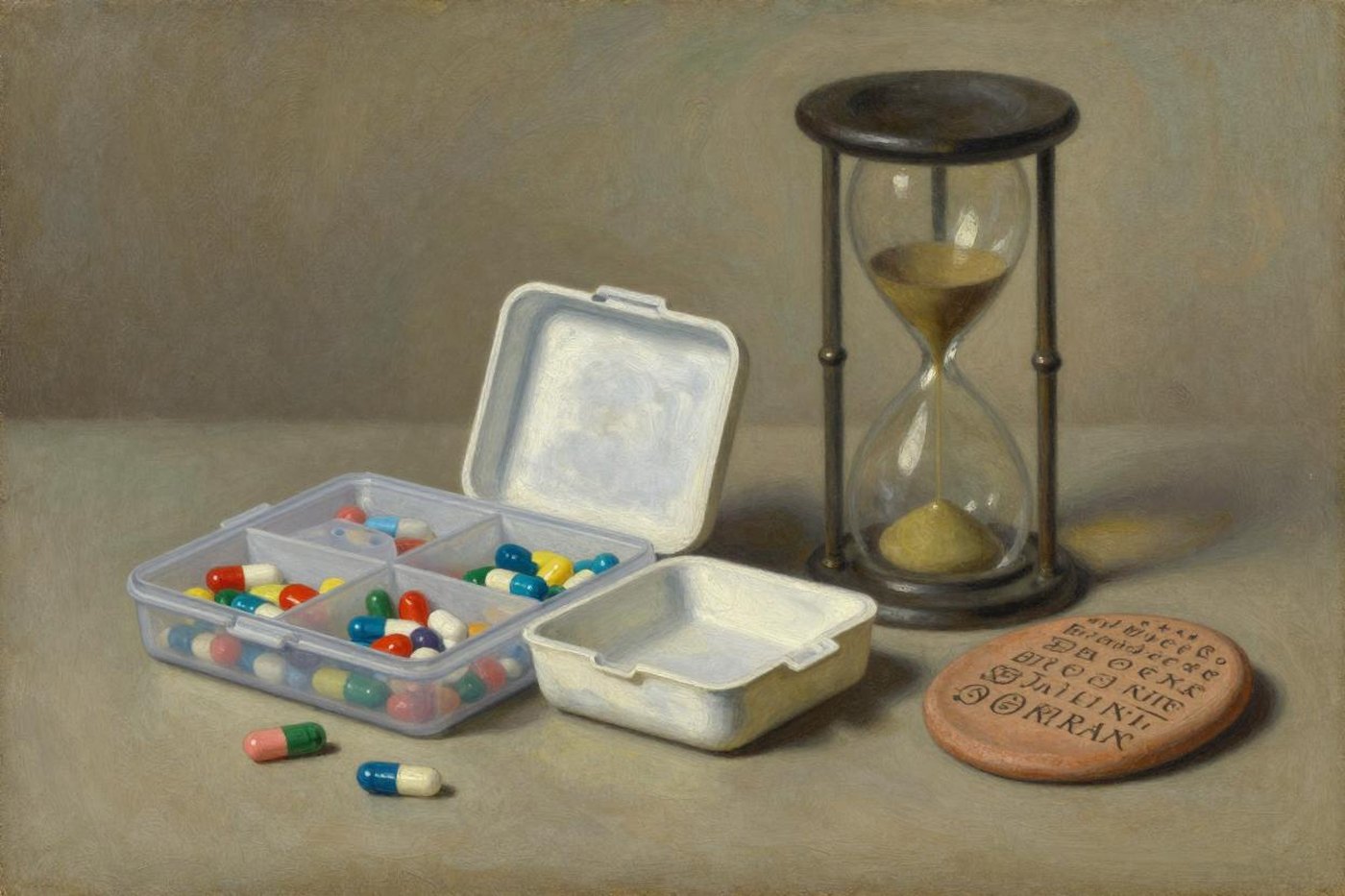
The present case takes Nagel at his word. Bryan Johnson's Blueprint regimen, as widely reported, costs about $2 million a year and has involved more than a hundred pills a day. The Netflix film showed him exchanging plasma with his teenage son and his father, a practice he has since said he stopped. His slogan, "Don't Die," is Gilgamesh's cry at Enkidu's body turned into a brand.
Peter Attia's Outlive, published in March 2023, is gentler, and it carries the movement's strongest reply. Attia aims at healthspan, a longer healthy life, not an endless one: pushing frailty, dementia and dependence into as short a stretch at the end as possible. Most people who take statins or lift weights at seventy are doing it for Siduri's reasons, to be at the feast longer and in better shape, still able to hold the child's hand.
Altos Labs launched on January 19, 2022 with $3 billion in committed funding for what it calls cellular rejuvenation programming. The company talks about reversing disease by making old cells behave like young ones, which is close to what the plant at the bottom of the sea did. Behind it sits a hope that the gerontologist Aubrey de Grey popularized as "longevity escape velocity," the point at which medicine adds more than a year of remaining life expectancy for every year that passes.
In 1973 the British philosopher Bernard Williams asked whether we should want to get there. His essay "The Makropulos Case" takes its title from Karel Čapek's 1922 play The Makropulos Affair. Its heroine, Elina Makropulos, has lived more than three hundred years on an elixir made by her father, a court physician to the emperor Rudolf II. By the end she is cold and bored, and she refuses to take the elixir again.
Williams built a dilemma on her. We keep living because of what he called categorical desires, projects that give us reasons to go on. Either your character stays fixed across endless time, and those desires run out into boredom, or it changes so completely that the one living is no longer really you. His critics answer that some pleasures, music, friendship, a good meal, do not wear out with repetition.
Williams and Siduri point the same way from different places. Williams says an endless life would drain its own meaning. Siduri says the pursuit of more life drains the one you already have. The first is a claim about eternity. The second is a claim about Tuesday. The movement can answer Williams by saying nobody is asking for eternity, only for another forty good years. It can answer Siduri too, as Attia does, for anyone whose regimen serves the feast. Her objection survives only as a claim about proportion, the point where the regimen crowds out the life.
The case, worked through
Premise: Death is a loss. On Nagel's view it robs us of future goods, so fighting it is rational and longevity research is ordinary medicine extended.
Objection: Nobody is there to lose. Epicurus says that while we exist death is not present, and when death comes we no longer exist, so no one is left to be harmed.
Revision: Harm without experience. Nagel replies that a person can be harmed by what they never feel, as the betrayed are, and death takes every good that more life would have held.
Objection: Too long, or too costly. Williams says endless life would empty desire of its point, and Siduri says the quest itself makes Gilgamesh miss the life he is holding.
Reply: Length or use. The choice stays open between Nagel's measure, more years, and the measure Siduri and Seneca use, what the years are spent on. The epic's last scene can be read for either.
Part V: What is the longevity movement optimizing for?
Seneca, writing about AD 49 to his friend Paulinus in On the Shortness of Life, moved the whole debate. "It is not that we have a short space of time, but that we waste much of it." And later, "life, if you know how to use it, is long." (The translation is John W. Basore's, on Wikisource.) Seneca, a Stoic, did not think death an evil at all. His argument here does not need that premise. Even granting that death is bad, length is not the variable that matters most.
That is a real challenge, because the movement is built on measurement, and length is the easiest thing to measure. Biomarkers, biological age and sleep scores can all be graphed. What Siduri recommends cannot. A regimen that fills the day with protocols may add years while consuming the hours in them, the old fear about a life reduced to its numbers. Its defenders would say the metrics serve the life, and that is their best answer.
There is a further question about whose life is being extended. Siduri's advice is social: the child's hand, the spouse, the feast. The drive to optimize can turn a person into a project managed alone, the self-exploiting achiever of Byung-Chul Han's The Burnout Society.
The epic has its own test for the optimizer. Gilgamesh finally reaches Utnapishtim, the flood survivor, who tells him that his immortality was a one-time gift of the gods. Then he sets a challenge: stay awake for six days and seven nights. Gilgamesh falls asleep at once. Utnapishtim's wife bakes a loaf for each day he sleeps, and the loaves sit beside him, going stale in order, so he cannot deny it. A man who cannot beat sleep, the small death that comes every night, will not beat the large one. The modern regimen scores sleep nightly. The epic counted it in bread.
Still, Utnapishtim's wife persuades him to give a parting gift, and he reveals a plant at the bottom of the sea. Its name means something close to "the old man becomes young." It does not grant eternal life. It restores youth. Gilgamesh ties stones to his feet, sinks to the bottom, and brings it up.
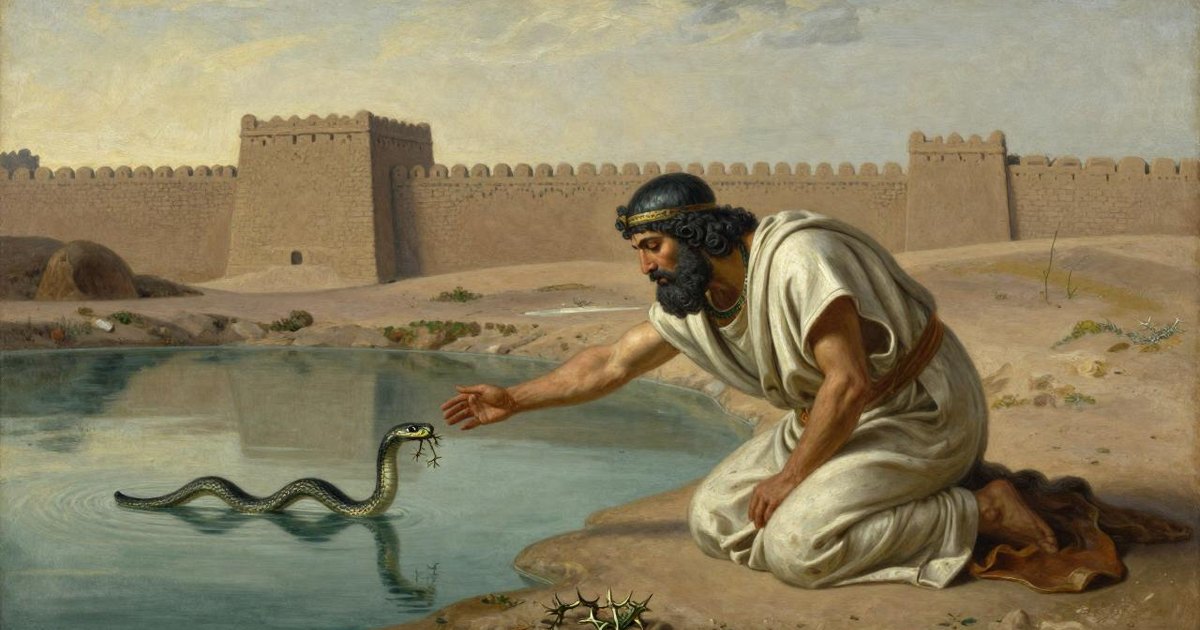
On the way home he sees a pool, and Thompson's lines are almost casual: "Gilgamish spied out a pool of cool water, (and) therein descending / Bathed in the water. (But here was) a serpent who snuff'd the plant's fragrance." The snake takes it, and in the epic it sheds its skin as it goes. "Then Gilgamish sate him, (and) burst into weeping." He has crossed the world and won rejuvenation for a snake.
In the older version a tavern-keeper told him to bathe. In the later one, bathing is how he loses the plant. Read that way, the snake needs no god behind it. A man carrying the cure also has a body that wants cool water.
Then Gilgamesh goes home, and the epic ends with him showing the boatman Ur-shanabi his city. "Do thou, Ur-Shanabi, go up and walk on the ramparts of Erech, / Look on its base, and take heed of its bricks, if its bricks be not kiln-burnt." The same lines open the poem. The story closes on walls a mortal king built and other mortals will keep standing on.
One reading is that these walls are the answer: the only immortality available is what you make and leave to others, and Gilgamesh finally accepts it. Another is that the walls are what a man points to when he has failed, a consolation offered because the real thing was lost. The epic gives both readings the same lines.
That is where the question now stands, in Meaning & Mortality and in Science & Technology at once. If the plant came back up from the sea, tested and safe, Nagel would say take it. Williams would say take it, but not forever. Siduri would ask what you left at home to go looking for it.
Further Reading
Orpheus Looks BackThe other mortality piece in this series, on grief and the refusal to let the dead go. The Numbered SelfZamyatin's We and what happens when a life becomes its measurements.