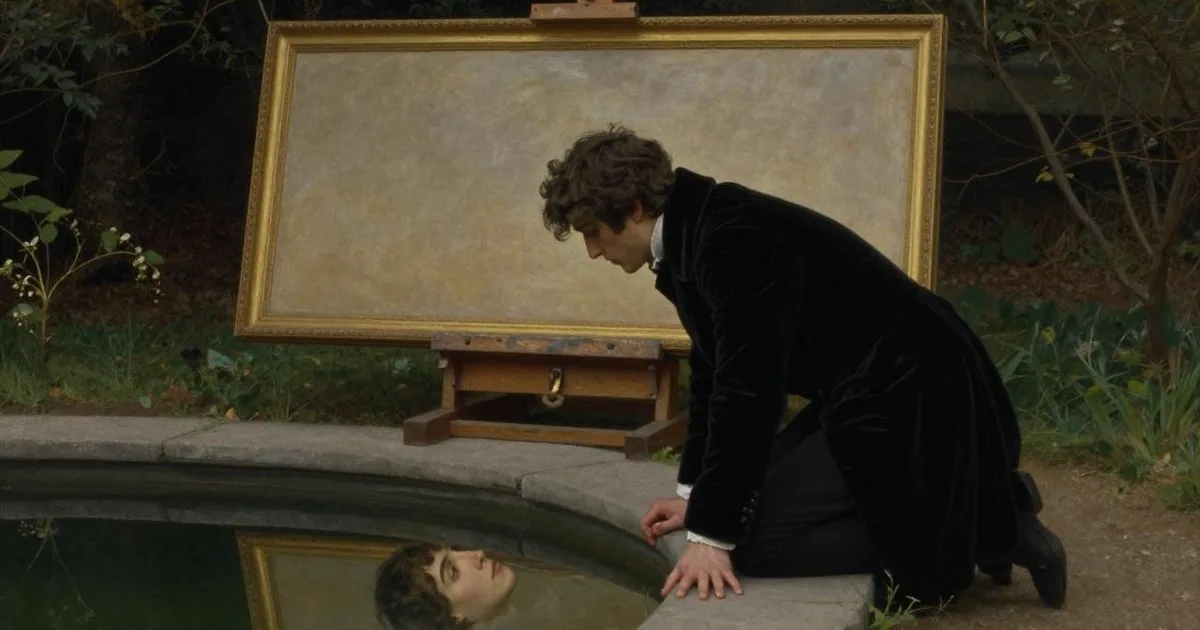
Lippincott's Monthly Magazine put a complete novel at the front of its July 1890 issue, published on 20 June: Oscar Wilde's The Picture of Dorian Gray, about a young man who stays beautiful while his hidden portrait grows old and cruel for him. The question it raises now, what beauty filters do to our idea of beauty and to the self that wears one, is one Wilde could not have phrased. They run Dorian's bargain backward. The filtered picture becomes the face that counts and stays young in public, while the face in the mirror is left looking like the damaged portrait.
The bargain comes in the second chapter, and nobody signs it. Basil Hallward has just finished the portrait, and Lord Henry Wotton has spent the afternoon praising youth. Dorian looks at it and breaks: "If it were only the other way! If it were I who was to be always young, and the picture that was to grow old!" His price follows. "I would give my soul for that!" There is no devil and no contract, and no one answers. Later the picture changes, and Dorian never learns whether his words did it.
Did Wilde see the filter coming? The book edition of April 1891 opens with a Preface of epigrams that ends on a shrug: "All art is quite useless." Wilde meant it as praise. Art, he wrote to a reader named Bernulf Clegg that spring, aims only to create a mood. The beauty filter is a picture built to be used.
Part II: What bargain does Dorian Gray make, and who pays for it now?
The portrait pays, and keeps accounts. The first entry appears after Dorian casts off the actress Sibyl Vane: "One would have said that there was a touch of cruelty in the mouth." He locks the canvas away upstairs, and later creeps up with a mirror to compare canvas and glass, "wondering sometimes which were the more horrible, the signs of sin or the signs of age." A filter smooths a sneer and a wrinkle with the same stroke.
The novel closes the account in two scenes. Dorian shows Basil the painting, calls it "the face of my soul," the soul he offered in the second chapter, and kills him there with a knife. At the end, when his one good deed adds only a hypocrite's wrinkle to the painted mouth, he takes the same knife to the canvas to kill the past. His servants find the portrait young again and, on the floor, a withered corpse in evening dress.
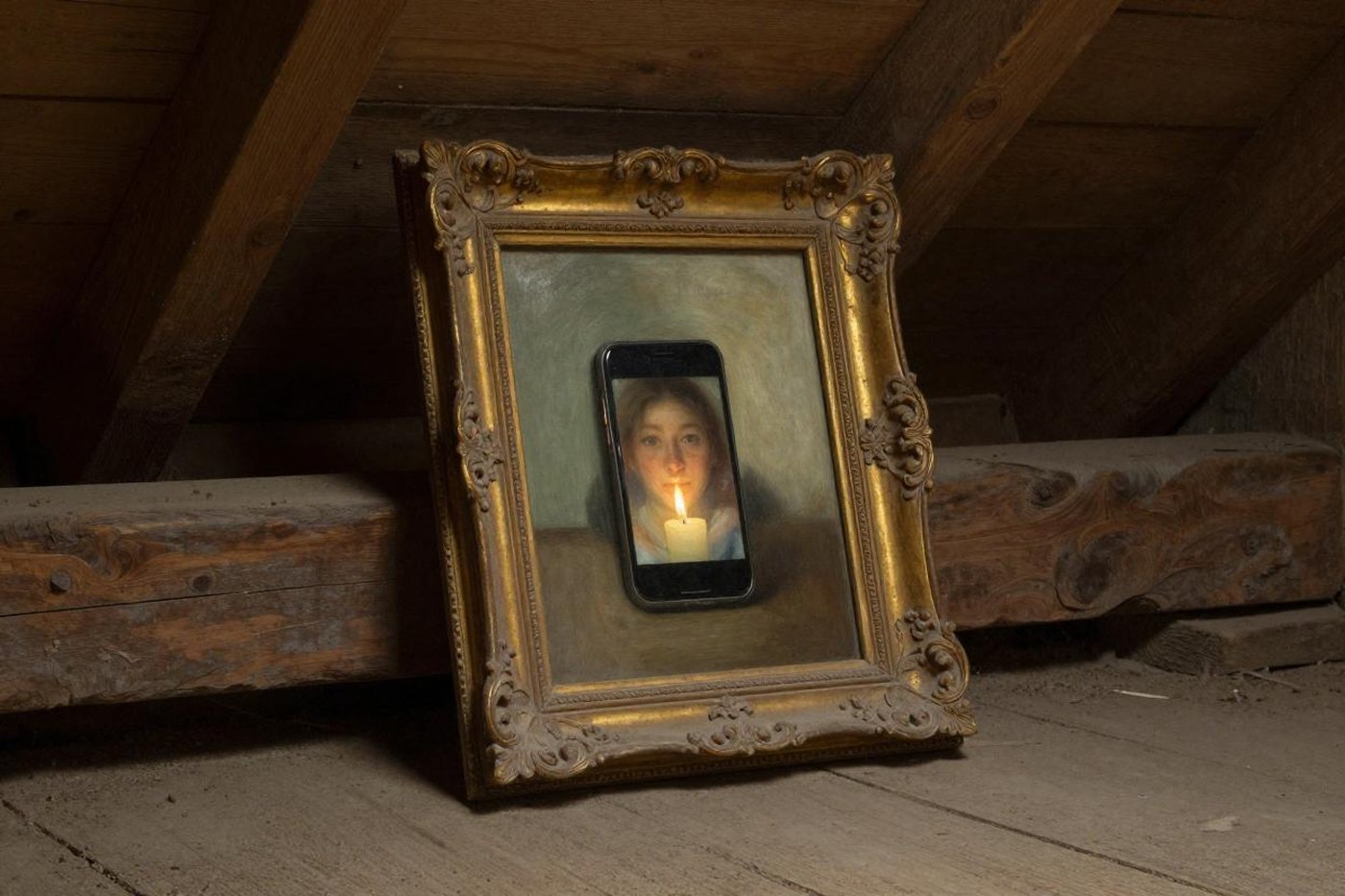
A London cosmetic doctor, Tijion Esho, gave The Independent a name for a new kind of patient in February 2018. Snapchat dysmorphia is the wish to have your face altered to match a filtered picture of it. Patients who once brought him photographs of celebrities, Esho said, were increasingly bringing filtered pictures of themselves. He turned one such client away and referred her for counselling.
Later that year three Boston University researchers carried the term into medical debate in JAMA Facial Plastic Surgery. The label is not a formal diagnosis. Jia Tolentino described the target in The New Yorker in December 2019, by which time it already had a name. Instagram face, in her account, has poreless skin, high cheekbones, catlike eyes, a small nose and full lips, and it had spread from influencers to ordinary women.
A beauty filter is software that reshapes a face in the camera image, usually live. TikTok's Bold Glamour, released in February 2023, was realistic enough that outside experts assumed a generative AI model was behind it. TikTok would not say how it works. A study of ten women found that it rotated and thinned the nasal tip, filled the lips, lifted the right brow, strengthened the cheekbones and smoothed the skin. Most of the changes were under 10 percent.
In Wilde the hidden picture absorbed the damage. With the filter the perfect picture is the public one, and the record falls to the unfiltered face in the bathroom mirror, which starts to look like the portrait in the locked room. Nothing has moved into that mirror but time. Dorian's canvas showed what he had done. The glass shows only what the years have done, and some people learn to be ashamed of it anyway.
Part III: What is a beauty filter optimizing for?
Kant's Critique of Judgment (1790) draws a line that arguments about art and beauty still lean on. On one side sits the pleasant: "That which pleases the senses in sensation is pleasant." On the other sits the beautiful, the object of "a disinterested and free satisfaction," Kant's term for looking without caring whether the thing exists or could be owned. Wilde's useless art asks for that kind of looking. The filter asks to be used.
A host whose guests all go home pleased has taste, Kant grants, but only comparatively: many happen to like the meal, and no one is obliged to. Bold Glamour, used more than 16 million times in its first weeks by MIT Technology Review's count, is a very good host. Kant warned against charms "passed off as in themselves beauties." The pleasure of a filtered selfie hangs on the existence of one face, mine, seen by others, which is what Kant meant by interest.
Kant's own examples complicate the line. A man stranded on a desert island, Kant observed, would not bother to decorate his hut or himself. Adornment began as a way of sharing pleasure with others. Nobody's face was ever looked at disinterestedly, powdered or plain. The live question is whose interest the filter serves.
His account of the average face points toward an answer. He pictures the imagination laying the images of a thousand grown men over one another until an average stature emerges, then an average head, an average nose. This "normal Idea" forms "in the country where the comparison is instituted," so each people has its own, and it pleases without being beautiful. "The presentation is merely correct."
A filter first smooths a face toward that average, then pushes past it, lifting a brow and filling the lips, into what a footnote of Kant's calls caricature. For Kant the ideal human face is beautiful by what it expresses, since "the Ideal consists in the expression of the moral," and a perfectly regular face says almost nothing about its owner. Dorian's portrait showed a great deal, though what it made visible was corruption. A filter smooths that record away.
Whose average, then? A training set, the photographs a filter learns from, is a country in Kant's sense. FaceApp's "hotness" filter lightened users' skin in April 2017, and its chief executive blamed training-set bias. In 2023 an Asian American MIT graduate asked an AI image app, Playground AI, to make her selfie a professional LinkedIn photo, and it gave her lighter skin and blue eyes. Its founder doubted one picture proved systematic bias. A 2024 study by Piera Riccio and colleagues found social media beauty filters brightening skin and reshaping features toward white, Eurocentric norms.
Defaults raise the stakes. Google announced in October 2020 that face retouching would be off by default on its Pixel 4a and 5, noting that default filters can quietly set a beauty standard some people compare themselves against. In Black Skin, White Masks (1952), Frantz Fanon, writing of the colonial Caribbean, described colonized people learning to see themselves through a white gaze and to want what it approves. The mechanism travels. A default that brightens skin delivers that gaze as a product feature, before anyone has asked.
Part IV: Haven't faces always been flattered?
None of this is new, the first objection says. Makeup is a flattering image worn on the living face and carried into every mirror, and it is ancient. Courts flattered too. In 1594, with Elizabeth I past sixty, her government adopted an ageless face pattern for her image, associated with the miniaturist Nicholas Hilliard and known to art historians as the Mask of Youth. The queen aged. Her official face did not.
Wilde would have enjoyed pressing the objection further. In "The Decay of Lying" he has Vivian argue that "Life imitates Art far more than Art imitates Life," and Vivian's first exhibit is a face, a type of beauty invented by Rossetti and Burne-Jones and now seen on living women at every private view. Vivian counts it a triumph. If Wilde saw the filter coming, he gave Vivian the lines to welcome it.
Still, the objection misses what is new. Makeup changes the face, so the mirror and the street show the same one. The filter changes the picture and leaves the face behind, and it reshapes geometry makeup can only shade, the length of a nose, the line of a jaw. That gap closes only in a clinic, which is where Esho's client took her selfie. And what once took a court of painters for one queen now ships as a phone setting.
The deeper difference is the loop, and for that there is an older story. Ovid had written it into the Metamorphoses by 8 CE. Narcissus's mother asks the prophet Tiresias whether her son will live to old age. The answer, in Brookes More's translation, is a riddle: "If he but fail to recognize himself, a long life he may have." It turns the Delphic command to know thyself into a threat.
At sixteen, having refused every admirer, the boy bends to drink at a clear pool and finds a face there. Ovid steps into his own poem to tell him that what holds his eyes "is nothing save the image of yourself reflected back to you," and adds a line that reads like a note on the front camera: "it will depart if you will only go."
Ovid's Narcissus, unlike the fool of many retellings, comes to know what he is looking at: "No more my shade deceives me, I perceive 'Tis I in thee." The knowledge saves nothing. In the underworld he is still gazing at his reflection in the Styx.
The wearer of Bold Glamour stands where Narcissus stood. Knowing the face is yours, adjusted, breaks nothing. The harm is in the repetition, a face always on hand and always a little better than the one you brought. The people scrolling past may not know the face was adjusted at all, and that half of the problem still belongs to Dorian.
Part V: Where's the portrait in the attic now?
Wilde also wrote the filter's defense. In "The Critic as Artist" he has Gilbert say, "Man is least himself when he talks in his own person. Give him a mask, and he will tell you the truth." Gilbert means Shakespeare, whose plays reveal him more fully than his confessional sonnets, because a mask is a form that lets the maker say what the plain voice cannot. On that view the filtered face might be the honest one, and a filter that gives you cartoon dog ears plainly is.
The sociologist Joseph Davis would add that the plain voice is no longer plain. Authenticity, he argued in Psyche in 2021, has turned from an inward ideal into a display that must look unscripted, which makes the proudly unfiltered selfie one more performance.
Gilbert's masks announce themselves. Nobody mistakes Hamlet for Shakespeare, or dog ears for a face. Bold Glamour's appeal was its realism, a mask built to pass as a face, which puts it closer to Dorian's portrait than to Gilbert's truth. Basil Hallward admits that "every portrait that is painted with feeling is a portrait of the artist, not of the sitter." Vivian's types came from painters with names, and a realistic filter comes mostly from builders nobody sees. A filter paints its builders.
The case, worked through
Premise: Filters serve the pleasant. They feed what pleases and borrow beauty's name.
Objection: Faces were always flattered. Makeup is a live, flattering image, and Elizabeth had her Mask of Youth.
Revision: The difference is the loop. Makeup changes the face. The filter changes the picture, leaves the face behind and follows you all day, like Narcissus's pool.
Objection: Wilde would defend the mask. Gilbert says a man tells the truth behind one.
Reply: Dorian's tragedy is the hidden portrait. A mask that announces itself can be honest. What destroys Dorian is a self that takes the damage out of sight. Where is that hiding place now?
Wilde never calls the portrait's room an attic. He puts the painting in the old schoolroom at the top of the house, shut for years, and has it carried up under a purple satin coverlet. Attic is shorthand, then, for what every version of the bargain needs: a hiding place for the costs, so the displayed face can stay clean. In Wilde the costs went upstairs. With the filter they seem to have come down, into the glass over the sink and the camera that catches you from the side.
The servants who got into that room did not know Dorian by his face. They knew him by his rings. The portrait kept his youth, and the body on the floor carried everything else.
The attic is still there, only it is less clear which face is hanging in it.
Further Reading
The Gaze That ColonizesFanon on a self formed under other people's eyes, and the question of whose face counts as the norm. Just Be YourselfButler's performativity against the command to be authentic, the other half of Wilde's case for the mask. More Real Than RealBaudrillard's simulacra, for the moment the copy becomes the standard the original is judged by.