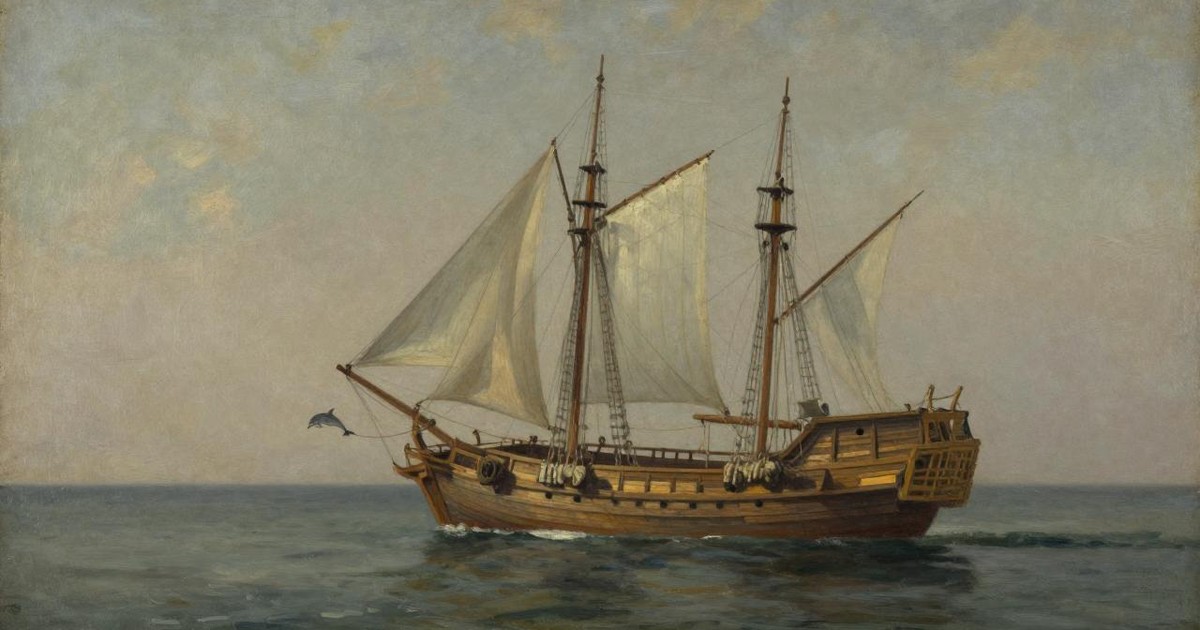
Somewhere in the debris of the ancient world, a story got loose about a ship, and the story has been doing damage for two thousand years. The version that survives comes to us through Plutarch. The ship of Theseus, the vessel the Athenians preserved for generations, was kept seaworthy by constant repair: rotten planks replaced with new timber, worn oars swapped out, sails patched and re-patched, until, over the years, nothing original remained. And then the question arrived, the way questions do, pretending to be simple. Is it still the ship of Theseus?
The puzzle seems at first like a game for people with too much leisure, one of those paradoxes filed alongside Zeno's tortoise. But notice what it is actually about. The ship is not changing its location, its owner, or its purpose. It is remaining the same thing while having all of its parts exchanged. The question is not about ships. The question is about what we mean when we point at something and say same, and what we are willing to pay to keep saying it.
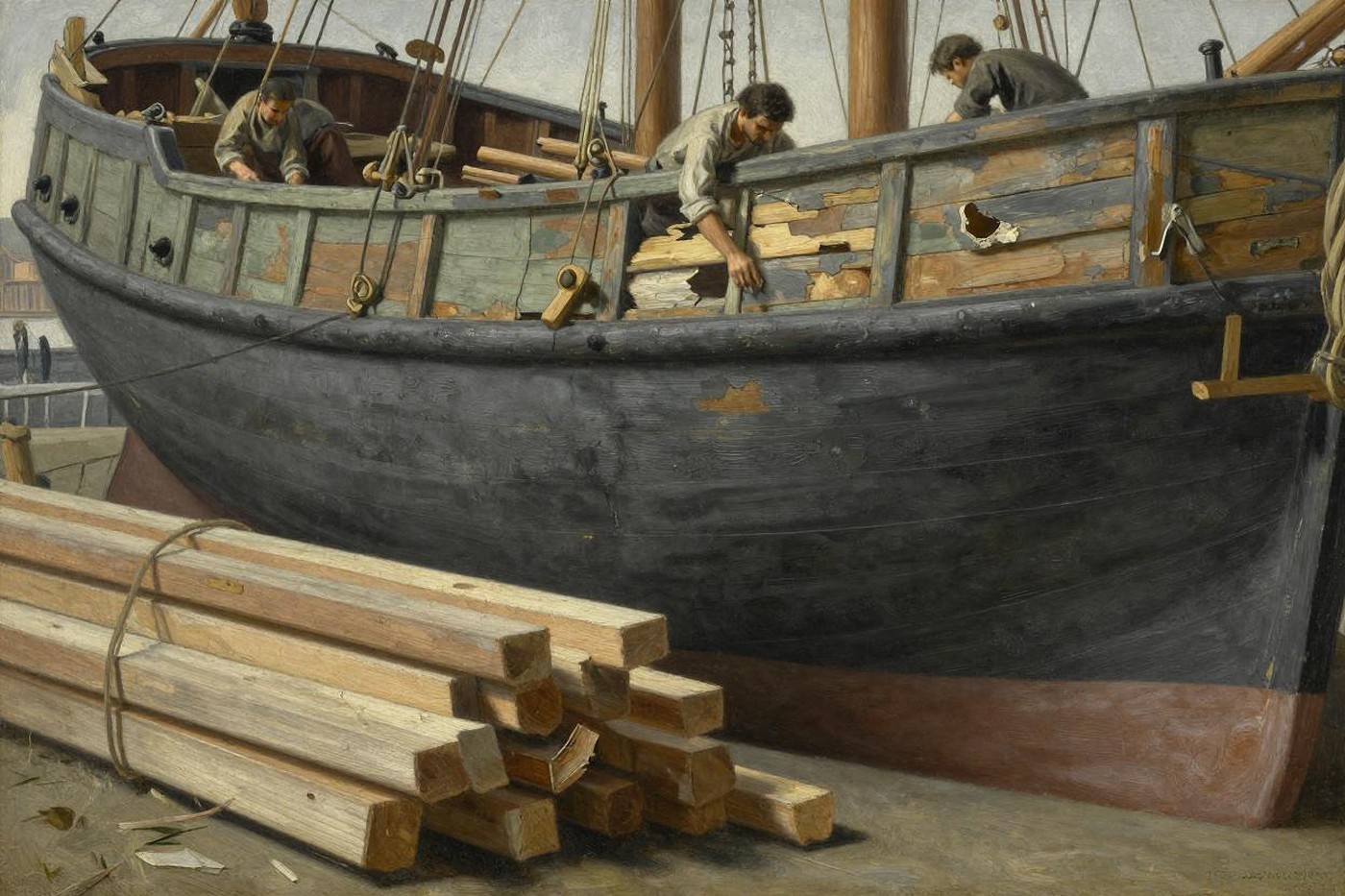
Plutarch added the sting in the tail. The philosopher Hobbes later sharpened it. Suppose, Hobbes asked, someone had gathered up every discarded plank and nail as they were removed from the Athenian ship, and reassembled them elsewhere, plank by rotten plank, into a ship of their own. Now there are two vessels. The one in the harbor, fully functional, continuously replacing itself, no original parts. The one on the beach, all original parts, never having sailed in its assembled form. Which is the ship of Theseus? Continuity of matter votes for the beach. Continuity of function votes for the harbor. Continuity of form splits the ticket. The puzzle, fully armed, walks into the sea of metaphysics and refuses to drown.
The history of philosophy has not resolved it. The responses form a familiar taxonomy. The conservative says identity is material: a thing is its substance, and the ship left with the parts. The pragmatist says identity is functional and conventional: the harbor ship sails the memorial route, so it is the ship, and the beach ship is a replica made of an old ship's corpse. The Buddhist, arriving from a different tradition entirely, declines the framing: there was never a fixed ship to begin with, only a process the name temporarily gathers, and the question dissolves rather than answers. The perdurantist says the ship is a four-dimensional object extended through time, and "same ship" refers to overlapping temporal stages rather than a continuous core. None of these has won. The puzzle remains the standard-issue tool for probing intuitions about persistence, and every introductory philosophy course deploys it, because it works.
Now put the tool down carefully and walk toward the present tense.
Part II: Bodies, brains, banks
Before the digital case, the material one deserves its due, because the ancients already had the human version of the ship.
You are doing it too. The cells of your body are replaced on staggered schedules, the lining of your stomach in days, your skin in weeks, your red blood cells in months, your skeleton over years. The neurons mostly persist, but their proteins turn over, their synaptic connections remodel, the composition of the tissue you think with is not the composition it had. Some of you is original. Less every year. Heraclitus, upstream of the whole tradition, said you cannot step into the same river twice, and possibly that you cannot be the same person stepping, and the fragment's ambiguity has kept translators employed for centuries.
Yet the persistence of persons is different in kind from the persistence of ships, and the difference is where the question gets its teeth. If you replace every plank of a ship, you have a ship question. If you replace every part of a person, or even a decisive part, you have a legal, moral, and existential question, and civilization has litigated it in earnest. Organ transplantation: is the recipient the same person? Memory loss: the Alzheimer's patient whose loved ones mourn someone still living. Brain injury: Phineas Gage, the railway foreman who survived an iron rod through his skull in 1848 and was reported by his doctor, at least, to have become another man, profane, unreliable, no longer Gage. The ship of Theseus was never a parlor game. It was always a rehearsal for asking whether the person in front of you, changed past recognition, owes the debts, keeps the name, holds the marriage, serves the sentence.
The philosophers responded with criteria. The memory theorists, following Locke, held that personal identity consists in chains of remembered experience: you are the one who remembers being you. The psychologists noticed the memory criterion does not survive a night of heavy drinking, let alone amnesia, and proposed instead continuity of character and overlapping psychological connections. The animalists countered that you are an organism, and the organism persists as bodies do, regardless of what the psychology is doing upstairs. A courtroom, meanwhile, holds all of these positions simultaneously, depending on the docket: probate law leans organism, sentencing law leans a strange mixture of memory and body, and family law leans psychological continuity whenever it must decide whether the person who wrecked the marriage is the one now asking to save it.
The puzzle survives because every criterion captures something and drops something. There is no fact of the matter buried under the disagreement, waiting to be excavated. There is a set of overlapping human practices, naming, promising, punishing, inheriting, marrying, each with its own tolerance for replacement, and the word same is the patch of ground they fight over.
Now the present case, which takes that patch of ground and puts it under a strobe light.
Part III: Five bios and two names ago
The puzzle assumed slow replacement. Rotten planks, decades, one vessel at a time. Human identities used to turn over at roughly that rate: a hometown, a church, a profession, a marriage, and the reinventions came at the pace of decades and were expensive, requiring a migration or a conversion or a scandal.
The platform changed the clock speed. Consider the ordinary contemporary arc.
A person constructs a profile, a name or handle, a photograph, a bio of ninety characters declaring who they are. The profile succeeds or fails as a performance. Either way, it is editable. The handle is traded for a cleaner one, the photograph updated to a better one, the bio rewritten as the self-description cycles through its genres: ironic, sincere, professional, spiritual, minimal. Followers are pruned or abandoned. The whole account is deleted and relaunched, more than once, and the relaunch is not experienced as trauma. It is experienced as an upgrade.
Meanwhile the substance turns over underneath. The opinions are replaced wholesale, sometimes annually, sometimes with the politics, sometimes with the feed algorithm's quiet suggestion. The interests rotate: the runner becomes a climber becomes a photographer becomes a poker player, each hobby installing a new peer group, a new vocabulary, new content preferences, which feed back into what the person sees, reads, and becomes. The friend set churns. The location changes, repeatedly, cheaply. Even the name: two names ago, the person was someone searchable under a different string entirely.
Hold the ancient puzzle up against this. Is it the same person? Material continuity says yes, emphatically, the same stubborn mammalian body has been dragged through every iteration. Psychological continuity says mostly, with interruptions, the memory chains intact even where the character has rotated. Social continuity, the Plutarchan question, the one the puzzle was always really asking, is where the answer wobbles. The harbor ship's advantage was that its repairs were gradual and its route continuous. The digital self's repairs are dramatic, its route mutable, and the people watching from the dock, the followers, the exes, the former colleagues, keep arriving at different harbors to find different ships.
Two features of the new arrangement sharpen the old problem into new shapes.
First,
the replacement is now archived. The ancient ship shed its planks into the sea; the sea forgot. The digital self sheds its iterations into servers; the servers remember. The person five bios ago is still there, screenshot, indexed, retrievable, confronting the current assembly with its own Hobbesian beach ship: a fully preserved earlier self, every original part, reassemblable by anyone with the link. The puzzle's two ships now sail simultaneously, and they know about each other. The person you become has to live downstream of the person you were, in a way no Athenian planking ever had to, and the mortification of the old logs, the deleted tweets, the former handles, is the sound of the harbor ship learning what the beach ship has been saying.
Second, the replacement is strategic. The Athenians repaired the ship to preserve it. The digital self revises to escape things: reputations, communities, mistakes, markets. Identity turnover, once a crisis, is now a feature, cheap and on demand. And the institutions built on the old tolerances have not adjusted. Hiring is done by scanning the beach ship. Relationships persist across the harbor ship's renovations, with varying success. The law, still more or less organism-based, treats the string of personas as one continuous defendant, which they are, materially, whatever they have decided to be.
Part IV: The sea accepts both answers
The counter-reading deserves its full weight, and it is the one the tradition itself supplies.
The Buddhist dissolution, the pragmatist convention, and the perdurantist's stages all suggest the same thing from different angles: the demand for a single verdict is the error. Of course the person five bios ago is the same person; the debt follows the body, the memories persist, the mother still calls them the same name. Of course they are not the same person; the commitments were renounced, the community was abandoned, the beliefs inverted. Both answers are correct because same was always a context-sensitive tool, a word for coordinating our practices, not a fact to uncover. The harbor ship sails and the beach ship sits, and nothing is wrong with either, and the metaphysical standoff dissolves when you notice the question was being asked by different practices with different needs.
And the digital case, on this reading, is not a corruption of identity but its natural state, finally made visible. Selves were always processes, always revising, always replacing planks at sea. The platforms did not invent the turnover. They lowered its cost, sped its clock, and stopped letting the sea swallow the old timbers. Perhaps what people mourn, when they lament the disposable self, is not the lost stability of identity but the lost grace of forgetting, the mercy of a sea that disposed of the evidence.
Perhaps. Or perhaps there is a difference in kind, not just clock speed, when the replacement is not weathering but strategy, when the self is revised not to remain itself but to escape its creditors, literal and reputational. The ship of Theseus was preserved out of reverence. A self edited to flee its own records is preserved out of nothing at all, and the question of what, exactly, is being maintained, has no ancient analogue. The puzzle's newest wing, the one our generation is building, is this: how many replacements before the repairs stop being maintenance and start being a new ship pretending to salvage rights?
Nobody knows. The ancients bequeathed the question without the answer, which is the only thing they ever bequeathed anybody, and the harbor is filling with vessels that all claim the name. Somewhere on the beach, every discarded you is laid out in order, weathering nicely. The ship you are sailing this morning took on new planks while you slept. Have a look at the route. That's the only clue anyone gets about whether it's the same ship, and it isn't one. It never was.
Further Reading