Archive / Ethics
Ubuntu and the Limits of the Isolated Self
A person is a person through other persons. Western philosophy built itself around the isolated self, and now the West is the loneliest civilization in history. A long read on the counter-tradition it never took seriously.
Ethics · 16 min read
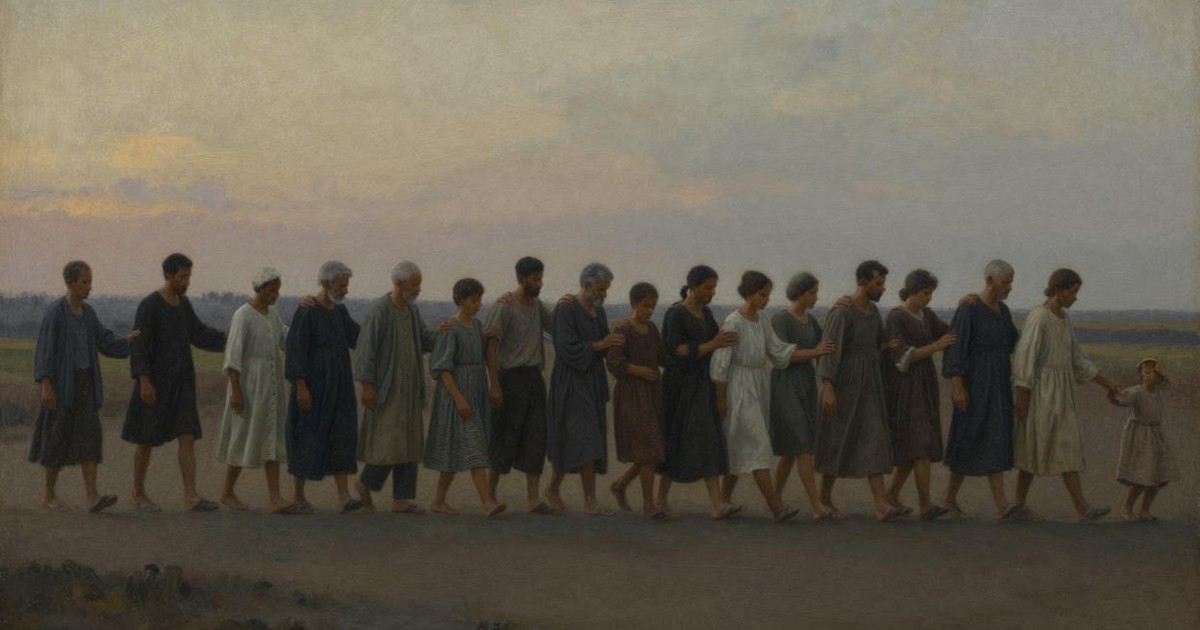
There is a sentence, spoken across southern Africa in a family of related languages, that runs roughly like this: umuntu ngumuntu ngabantu. Translated into English with the usual loss: a person is a person through other persons. Sometimes rendered with a beat of variation: I am because we are. Sometimes expanded into a maxim of conduct: I am what I am because of who we all are.
Sit with it for a moment before filing it under proverb, because it is not one. Proverbs advise. This sentence describes, and what it describes is a complete ontology, a theory of what a person fundamentally is, packed into five words. It says the self does not precede its relations. It says personhood is not a birthright conferred by existence but an achievement conferred by community, continuously, and revocable. It says the question "who am I, apart from everyone?" is not difficult to answer but malformed, like asking what a voice sounds like when no one can hear it.
The Nguni word at the root is ubuntu, and in the second half of the twentieth century it stepped out of the linguistic region where it had always lived and onto the stage of world history. Desmond Tutu invoked it as the theological engine of the Truth and Reconciliation Commission, the attempt, after apartheid fell, to process a century of atrocity without a bloodbath. Nelson Mandela's circle used it to explain what a post-apartheid citizen was supposed to be. Ubuntu appeared in South Africa's post-transition intellectual life, in speeches, in constitutional debates, in the preamble of the interim constitution, invoked as a store of value older and deeper than the legal codes imported from Europe. A word that had meant something like a person's full moral standing, earned through participation in the life of a community, became the name for a philosophy. And then, inevitably, it was noticed by the West, which had a problem the word seemed designed to name.
The problem was loneliness, and by the time the word arrived, the data had been accumulating for decades.
Part I: The loneliest civilization
Begin with the chronicle, because it is strange enough that an account of Western philosophy could start from it.
In 2023, the Surgeon General of the United States issued an advisory declaring loneliness an epidemic, and put a number on the health toll of disconnection, comparing its mortality effect to smoking fifteen cigarettes a day. The comparison travelled everywhere. Beneath it sat a stack of survey findings assembled over the preceding two decades: significant fractions of American adults reporting no close confidant at all, up steeply from decades prior; rates of solitary living across the West climbing decade over decade; friendship networks contracting; marriage rates falling; club membership collapsing; the sociologist Robert Putnam documenting the decline of American communal life a generation earlier in a book called Bowling Alone, whose title had already said everything. Britain, years before the American advisory, had appointed a Minister for Loneliness. Japan, facing a different demographic arithmetic, had a word, kodokushi, for people who die alone and are undiscovered for weeks, and had begun commissioning apartments designed so that the solitary dead are found sooner.
Whatever the precise figures, and researchers argue about them constantly, the direction is not disputed. The civilization that produced more techniques of the self than any in history, more therapy, more journaling, more mindfulness, more self-knowledge infrastructure per capita than any people has ever assembled, is measurably worse at being together than most civilizations have been, and is getting worse. The richest toolset for the care of the individual self coexists with an unprecedented scarcity of persons to be a self with.
The standard explanations are technological and economic. Screens displace conversation; remote work removes the ambient sociability of the office; gig labor dissolves workplaces; cities price out the communal spaces; mobility scatters families; the marketplace absorbs functions, childcare, cooking, entertainment, eldercare, that used to require other people. All of these are true, and all of them are downstream of something the technology and the economics merely served. A civilization that is structurally committed to the idea that the individual is the fundamental unit of human life will eventually produce conditions in which the individual is the only unit left. The loneliness epidemic is not an accident of the West. It is the West's ontology, faithfully executed, arriving at its logical housing stock.
Which makes it worth asking where that ontology came from, because it was invented, and the invention is documentable, and the documents are strange.
Part II: The invention of the isolated self
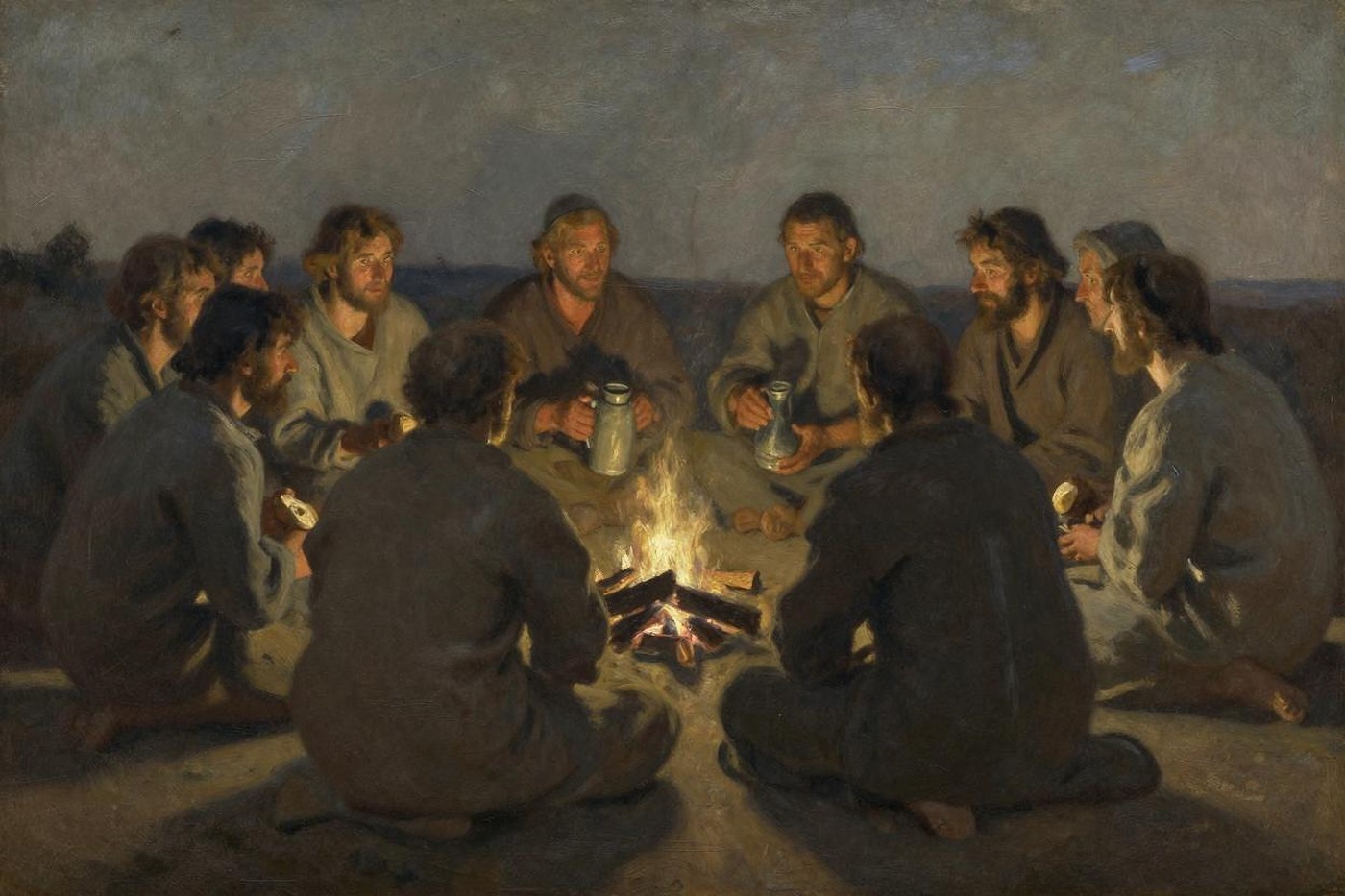
The story usually starts with Descartes, in 1637, sealing himself in a stove-heated room and resolving to doubt everything until something indubitable remained. What remained was the cogito: I think, therefore I am. A thinking thing, assured of its own existence first, in isolation, prior to any body, family, language, or world. Whatever else the meditations accomplished, they fixed an archetype: the self as fundamentally solitary, present to itself, ontologically prior to its relations. Everything social becomes, on this picture, a later addition, decoration on the primal unit, contractual and revocable. The community is a committee the individuals formed, and what committees form, committees dissolve.
The picture hardened as it traveled. Hobbes grounded the state in isolated individuals contracting out of a state of nature where each was fundamentally alone, at war with all. Locke refined the contract. Political economy built its models on a rational self-interest presumed to be the human atom. Kant, in a different register, made the moral agent an autonomous will, self-legislating, beholden to no relation it did not choose by pure practical reason. The individual became not just the unit of psychology and politics but the unit of moral worth. Rights theory organized the entire legal architecture of the modern West around one entity: the singular person, possessing, choosing, owning.
Defenders of the tradition should get their due, and will below, because this atomism produced emancipation as well as estrangement. It is hard to enslave a rights-bearing individual. The communitarian households and villages that westerners now romanticize were, for many of their members, for most of history, cages first and belonging second. The individual, abstracted from clan and parish and lineage, was portable, and portability is freedom for the person fleeing the village that would have buried them in its expectations. The isolated self did not stumble into history by accident. It was an escape from communities that had forgotten that their members were people, and every critique of atomism that forgets this should be read with one eyebrow raised.
But the costs compounded across the centuries, and they were theoretical before they were sociological. If the self is prior to its relations, then relations are optional equipment. Love, attachment, obligations of kin, duties of place, all become choices, and choices can be declined, and a civilization of selves trained to understand every bond as revocable will, over generations, revoke them, one at a time, each for defensible reasons, until the census of connection arrives at a person alone in an apartment with excellent psychological literacy. The self that was freed from the community was also deprived of the community's function in making it a self at all. That is the gap. That is the thing the sentence from southern Africa was pointing at, from the other side of the planet, the whole time.
Western philosophy noticed the gap eventually, and the noticing produced some of the best work of the late twentieth century. Alasdair MacIntyre, Charles Taylor, Michael Sandel, and a loose coalition of communitarians argued that the unencumbered self was a fiction, that identity is always constituted by unchosen attachments, languages, traditions, and debts, and that a politics built on the fiction would eventually starve the relations it pretended could be contracted. Feminist ethicists, chief among them Carol Gilligan and Nel Noddings, argued that the entire tradition had modeled morality on the isolated reasoner, the contractual bargainer, and had systematically missed the ethics of care that actual human development runs on. Heidegger, earlier and stranger, had already declared Dasein to be being-with, Mitsein, coexistential before existential. Levinas made the face of the other prior to the self's own freedom. The counter-tradition inside the West is real, distinguished, and thorough.
What is remarkable, viewed from the south of the continent that produced ubuntu, is that the counter-tradition reads like an elaborate rediscovery, by ladder, of a conclusion other traditions had simply lived at ground level. I am because we are. The Western canon had to exile the individual, observe the wreckage across three centuries, and climb back down through phenomenology and feminist ethics to arrive at the starting point. The journey produced irreplaceable knowledge about both endpoints, exile and home, and a tradition that has walked the full road knows things a tradition that never left can articulate only with effort. But the asymmetry is still worth noticing, because it sets the terms for what ubuntu can and cannot teach, which is the rest of this essay's business.
Part III: What ubuntu actually says
The philosophical literature on ubuntu, most of it from African philosophers and only recently gathering the international attention it warrants, is richer than the greeting-card version, and it deserves a careful statement, because the greeting-card version has been flattened twice over: once by Western wellness culture, which imports the word as a synonym for kindness, and once by nationalist rhetoric, which has occasionally wielded it as a club against individual rights.
The strongest reconstruction of the core claim runs as follows. Personhood is not a status but an achievement, and the field of achievement is relational. John Mbiti, the Kenyan philosopher of religion, gave the tradition its most quoted formulation in the academy: I am, because we are; and since we are, therefore I am. Kwasi Wiredu analyzed the Akan cognate of the concept and argued that the deeper grammar of these traditions rejects the atomic self not sentimentally but structurally: the community is constitutive, not merely cooperative. On these readings, an individual human organism exists the way a hand exists. Severed from the body, it is meat that once meant something. Its personhood, its full being as the kind of thing it is, is realized only in the living whole.
From the constitutive claim follows an ethics. If persons are made persons by persons, then the fundamental moral act is the maintenance and enlargement of personhood in others. Virtue is relational through and through: generosity, hospitality, truthfulness, patience with children, care for elders, the burial of the dead, the welcoming of the stranger. The visit, in many southern African cultures a semi-formal obligation, is a moral technology: the practice by which the self goes and is remade by the presence of others, and their being is confirmed. Hoarding, in this scheme, is not merely unkind but self-mutilating, since the wealth that isolates you from others amputates the relations that are you. And the ultimate sanction, remembered as communal memory longer than law remembers punishment, is exclusion: a person who damages the network of persons is withdrawn from it, and loses, in the full sense, standing.
Read against the Western tradition, the interesting divergences are not where the souvenir version locates them. Ubuntu is not warm feelings about community. It is a claim about the architecture of the self severe enough to have teeth. Two consequences in particular are worth extracting.
First, the ethics of ubuntu contains no natural home for rights, and this is not a deficiency to apologize for but the entire point. Rights are the moral currency of strangers: abstract, universal, and transactional, designed precisely for interactions between parties with no relation, no history, and no obligation except the non-interference kind. A rights framework presumes the atomic individual, protects it against the community, and defines harm as violation. Ubuntu presumes the constitutive community, protects the person through it, and defines harm as relational rupture. The two systems answer different questions. Rights answer "what may not be done to me by people who owe me nothing." Ubuntu answers "who am I becoming in the web of who we are to each other." A civilization of strangers needs the first question. A civilization of persons needs the second. The late Western condition is to possess only the first, executed superbly, at scale, in room after single-occupancy room.
Second, ubuntu dissolves the self-help economy by denying its premise. The entire Western infrastructure of self-improvement, therapy, meditation apps, fitness, journaling, self-care, optimization, is a heroic attempt to furnish the isolated self with the goods of relatedness without the relations. Self-care in the atomistic frame is a category containing an irony, since the self being cared for is the entity whose ontology guarantees it cannot be sufficient for itself, an entity attempting to give itself, alone, the sustenance that the philosophy says comes constitutionally from others. Ubuntu diagnoses the loneliness epidemic not as a mood disorder afflicting individuals but as an ontological emergency: persons, severed from their human source, starving, and prescribed solitude with better hydration and a gratitude journal. The prescription was never wrong because it was indulgent. It was wrong because it filled the wrong organ. The missing vitamin is not wellness. It is company.
Part IV: The critiques, which are serious
Now the hard part, because ubuntu has been romanticized most aggressively by people who do not have to live inside it, and the critiques of it are not Western squeamishness. They come from African philosophers, from feminists across the continent, and from the traditions of people for whom the constitutive community was the site of their oppression, and the essay would be worthless if it hid them.
The critique begins with a genealogical caution. What is called ubuntu is, in scholarly hands, a reconstruction: a distillation of practices that were hundreds of local, particular, contested lifeways, with variations across Zulu, Xhosa, Shona, Ndebele, and neighboring traditions, and with contested histories in the colonial record, which sometimes recorded African communal life through lenses shaped by exactly the stereotypes that needed African society to be pre-individual. The revival of ubuntu in the twentieth century was itself partly a political act, anti-colonial counter-theory, which is its strength and its liability. The strength: a tradition of self-understanding mobilized as resistance to a system that classified African persons as less than individual. The liability: the mobilization sometimes freezes the tradition as a museum piece, harmonious, egalitarian, and purified of the hierarchies that actual villages contained, which did not always treat women, foreigners, or cattle-poor men as full persons in the way the philosophy implies. Community, as every survivor of one knows, has membership requirements, and membership requirements have edges, and edges cut.
The internal philosophical debate is instructive here, and it deserves a fair hearing, because it is between African philosophers on African terms. Ifeanyi Menkiti defended the strong reading: personhood is genuinely earned through communal participation, and can be diminished or lost by exclusion from the moral community. Bernard Matubishi, and more prominently Kwame Gyekye, attacked exactly this feature. Gyekye's moderate communitarianism argued that the tradition's own resources imply a dignity to the individual person that is not wholly conferred and not wholly revocable, that a person expelled from every community does not cease to be a moral patient owed things, and that any philosophy that can licitly subtract personhood has licensed whatever authority controls the subtraction. The debate maps onto the Western one, Locke and the communitarians, but it is not a copy. It is a second tradition arriving independently at the same fault line, which suggests the fault line is not a Western artifact. It is in the problem.
The third critique is the sharpest: the constitutive community is where the exceptional are ground down. The person who is, in the village's judgment, the wrong kind, too ambitious, too unusual, queer, mouthy, touched by the wrong spirits, is made a person through other persons like everyone else, and the other persons, holding the franchise on being, decline to make them. The West's atomic individual, for all its desolation, contains an escape hatch that ubuntu does not: the individual can be exiled from every community and still possess rights, standing, a claim to existence that no membership committee controls. The communitarian ideal shelters the conformist and starves the outlier, and there are people alive, on every continent, who are alive specifically because individual rights exist as a floor beneath the communities they fled. Ubuntu without a floor is not an alternative to Western atomism. It is atomism's mirror image: a different amputation, removing the same limb from the other side.
Tutu's use of the concept at the Truth and Reconciliation Commission, worth returning to now that the critiques are on the table, was precisely an attempt to hold this tension open rather than resolve it. The commission insisted that perpetrators were persons whose personhood, in the ubuntu sense, was damaged by what they did, and whose rehabilitation, if any, lay through re-entry into relation, acknowledgment, testimony, and reconnection, rather than through elimination. And it faced, from all sides, the same objection: that the comfort of the community can become a lid on justice. The families of the dead asked why the killers were being offered personhood. The killers' defenders asked why the community's need for reconciliation was being permitted to set the price of murder. The commission's answer was that there was no other floor to build on, that a ruined country could rebuild from relation or not at all. History's verdict on the experiment is still being written, and honest assessments differ sharply.
Part V: The synthesis that is not available
So the question arrives in its final form. The West has the individual, fully developed, rights-armored, and dying of isolation. Southern African philosophy has the constitutive self, relationally nourished, and contested by its own best thinkers over what happens to the person the community will not hold. Each tradition possesses the missing organ of the other and calls it a deficiency. Can they be crossed? The obvious synthesis, individual rights as the floor, ubuntu as the structure built on it, sounds effortless in a sentence and is proving nearly impossible anywhere, because the two ontologies assign the burden of proof in opposite directions. The rights tradition makes every intrusion of relation into the individual's life require justification, and the ubuntu tradition makes every withdrawal of the individual from relation require it, and no constitution has yet been written that speaks both grammars without developing an accent.
That is the theoretical state. The practical state is more urgent, and it is where this essay has been traveling since the loneliness statistics opened it.
A person reading this is likely resident in the atomistic civilization, fluent in its inner technologies, self-aware, well-resourced in the vocabulary of the self, and probably short on visits. Not out of incapacity, but out of the settled, sensible, ontologically trained belief that relations are equipment, installable, declinable, and portable, to be taken up when they serve the project that is you. The tradition examined above says this is not a moral failure. It is a category error, visible only from outside the frame. You are not an individual experiencing a shortage of community, the way a house experiences a shortage of furniture. You are a relation experiencing a shortage of the other parties, the way a voice experiences an empty room. The loneliness is not your body informing you of a market opportunity for connection products. It is the ontological substrate reporting that its conditions of existence are failing.
And the prescriptions, in the ubuntu frame, are hilariously mundane, which is the mark of a real philosophy: go and be where other people are being. Visit somebody, not as a favor to them but as an act of self-preservation so primitive it should not have needed a philosophy to command it. Accept the standing invitation you have been declining for defensible reasons. Join the thing that meets regularly, and keep going after the novelty wears off, because personhood is not a weekend but a practice. Notice that none of this appears in the self-care catalog, because none of it can be consumed by a self alone, which was the entire diagnosis.
Whether the floor problem, the outlier problem, the Menkiti and Gyekye problem, can be solved by a civilization that runs on exit is a genuinely open question. But the sentence from the beginning was never an invitation to solve it, and it would be a fine joke of history if the most self-obsessed civilization ever assembled were the one to finally hear what the sentence is saying, five words long, spoken in a language most of its hearers never learned, meaning what it has always meant: that no one, reading this alone, is entirely a person yet, and that the room you are in is listening for the sound of the others, and that you are because they are, and that until you go, they are not entirely persons either.
The visit is the philosophy. It always was.
Simone Weil on attention as a gift, and the economy built to confiscate it.
Byung-Chul Han on the burnout society, where freedom itself becomes the boss.