Meaning & Mortality
What a life examined actually requires, and what it costs to live like it ends.
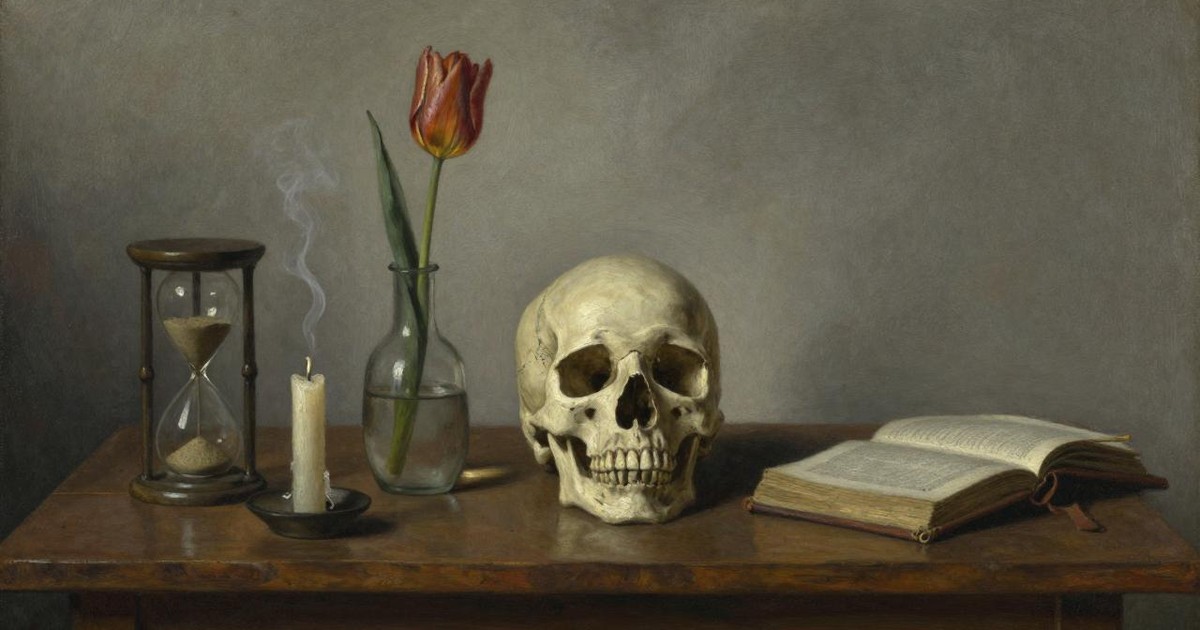
Every other question in philosophy can be postponed. This one cannot. You are going to die, everyone you know is going to die, and somewhere between now and then you have to decide what any of it was for. The topic is unavoidable by construction. Even refusing to think about it is a position on it, and not a stable one.
The old treatments of this question are among the most durable things ever written, precisely because they cannot be invalidated by new information. There is no technological update to the fact of death. Kierkegaard on despair is still clinically precise: the despair of not wanting to be oneself, the despair of wanting to be oneself in defiance, the despair hidden inside a life that is going perfectly well by every external measure. He described a condition that productivity culture now manufactures at scale and calls optimization. A life organized around achievement, with the self as the project being managed, is his textbook case. He just wrote it down a century and a half before the apps.
The mortality half of this topic is equally stubborn. Heidegger argued that being-toward-death is not morbid preoccupation but the thing that makes a life yours instead of anonymous: nobody else can die your death for you, and confronting that is what individualizes a life. Tolstoy's Ivan Ilyich is the literary version, a man who lived correctly by every convention and discovers on his deathbed that he had missed the point entirely. Epicurus worked the other direction, arguing that death is nothing to us because where death is, we are not. The argument has never fully quieted the fear it was designed to dissolve, which is itself informative. Two millennia of consolation and the species remains unconsoled.
What the present adds is not a new problem but a new pressure. The mortality rate is unchanged; the suppression machinery has industrialized. A culture built on engagement metrics has no revenue model for sitting with the fact of endings, so it buries the question under noise. Attention economy logic treats the finite span of a life as an engineering flaw: your remaining hours are inventory to be claimed. Meanwhile the marketplace for meaning has never been larger or emptier, with wellness, productivity, and self-improvement content promising purpose in the same breath as subscription tiers. The philosophers who wrote about meaning before the market got involved have rarely been more worth rereading, because they were diagnosing scarcity in a landscape that now claims abundance everywhere and delivers it nowhere.
This topic page collects the essays on the site where questions of meaning, death, and what a life requires are the engine rather than the backdrop. The methods vary by column, because this subject runs through all of them. An Objection piece steelmans the promise of the optimized life and then brings Kierkegaard's bill for it. A Deep Cut follows the thread of attention as a moral act and finds mortality inside it: attention is generous precisely because it is finite. The Reviews in this topic are novels that smuggled the question into fiction. Ishiguro's clones in Never Let Me Go are a bioethics scenario on the surface, but the book's real horror is existential, what a shortened, foreknown life does to the project of making it mean something. Vonnegut built an entire free-will position out of the death toll of Dresden and dared you to call it surrender.
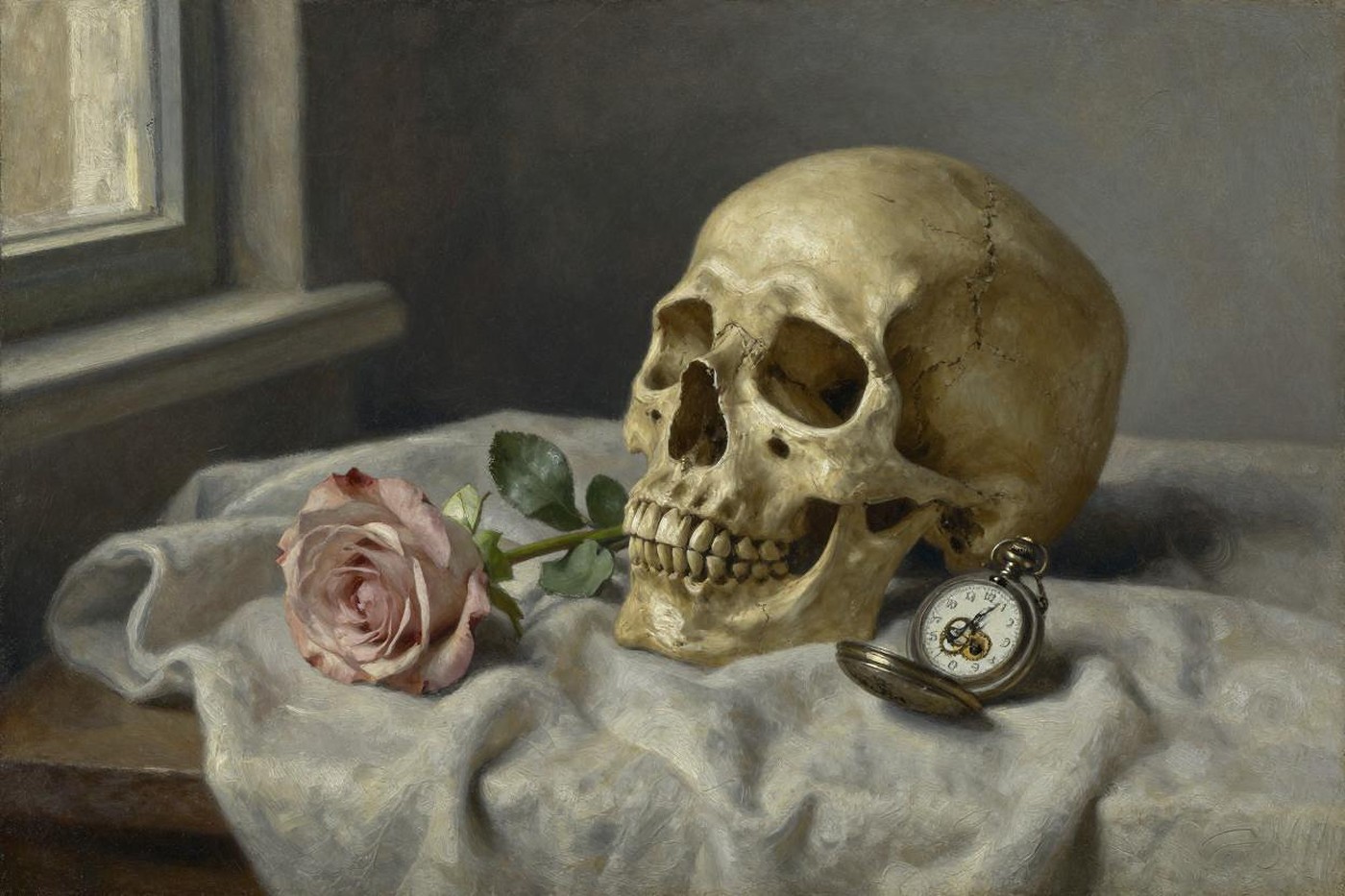
The overlap with other topics is structural rather than incidental. Meaning & Mortality crosses into Ethics whenever the question shifts from what a life means to what it is owed, which is the line Ishiguro's novel walks. It touches Religion & the Sacred because most meaning-systems historically have been deployed against death and secular ones must compete with that track record. It brushes Flourishing whenever the conversation turns from death to life, from the fact of endings to the quality of what precedes them. The difference is a matter of emphasis: this topic keeps the ending in frame. An essay about how to live well can forget death for a while; one about whether the living means anything cannot.
There is a failure mode in mortality writing that deserves naming, because the internet has produced an enormous amount of it and almost none of it is any good. The memento mori genre: death meditations flattened into lifestyle content, skull imagery sold as if contemplation were an aesthetic. It shares with the productivity genre it superficially opposes the same evasive core, treating death as an optimization input rather than the thing that will not negotiate. The essays here try to avoid that by keeping the question specific. Not "remember you will die" but "here is one philosopher's account of what that fact does, tested against one thing we are presently doing."
The opposite failure is the cosmic shrug: since the universe is vast and indifferent, nothing matters, done. The shrug is not wrong about the vastness; it is lazy about the conclusion. That our lives end is a fact. What follows from that fact is precisely the argument, and one theme running through this topic is that the philosophers and novelists who took mortality seriously found it generated more obligations than freedoms, not fewer. Facing the ending is what makes the middle urgent.
A note on the line of questioning you should expect from these essays. They do not aim at consolation, which distinguishes them from most of what is written about death and meaning. Consolation aims to make the anxiety smaller. A good essay on this subject aims to make the question clearer, which sometimes makes the anxiety larger before it makes it useful. Reader discretion is advised, in the old sense of discretion: you will have to exercise judgment about how much of this you want to sit with, and when.
The archive below is where this stands now. Three slots claimed toward a target of sixteen. The essays that follow will range across columns and methods, but they share one thing: the ending stays in frame.
In this topic:
The Case for Optimizing Everything — productivity culture, steelmanned, then answered by Kierkegaard
Never Let Me Go — Kazuo Ishiguro, through the lens of bioethics and what a life is owed
Slaughterhouse-Five — Kurt Vonnegut, taking 'so it goes' seriously as a position on free will