Mary Shelley put two books on the title page of Frankenstein. The first edition, published on 1 January 1818, is subtitled The Modern Prometheus, after the Titan punished for stealing fire, and beneath it prints three lines of Milton: "Did I request thee, Maker, from my clay / To mould me man? Did I solicit thee / From darkness to promote me?" Adam's complaint to God becomes a made thing's case against its maker, and that borrowing is the novel's method. Frankenstein is about what a maker owes the life it makes, a question now put to the people building AI.
The structure gives that case a hearing and a cross-examination. Inside the explorer Robert Walton's letters to his sister, Victor tells his story, and inside Victor's, in a mountain hut across the glacier above Chamounix, the creature tells his. His speeches reach us through Victor, who corrected Walton's notes and warned that the creature was eloquent and not to be trusted.
Shelley was eighteen, and still Mary Godwin, when she began the novel in June 1816. Her parents, William Godwin and Mary Wollstonecraft, had argued that character is made by circumstance and education, and her creature is that argument given a body. He never gets a name. Readers who call him Frankenstein hand him the father's name the father withheld.
The Prometheus book has had the louder afterlife. Deborah Coen, reviewing Guillermo del Toro's 2025 film, argued that it reduces the novel to "a one-dimensional warning about technological hubris." The Milton book is stronger. It convicts Victor of making and of leaving, and it treats the leaving as the crime he could still have undone.
Part II: What does the creature learn from Paradise Lost?
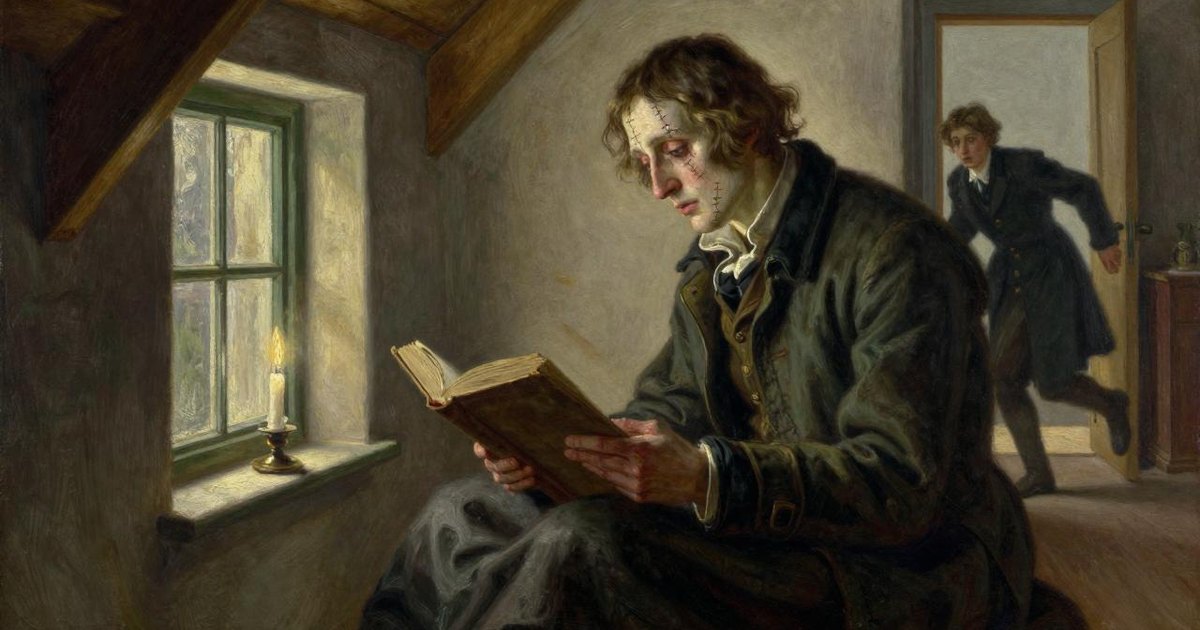
The creature learns to read by eavesdropping. Through a chink in a hovel wall he watches Felix teach Safie, a newcomer, from Volney's Ruins of Empires, and takes the lessons meant for her. One August, less than a year after his making, he finds a leather case in the woods holding Paradise Lost, a volume of Plutarch's Lives and Goethe's Sorrows of Werter. Milton he takes for true history.
At first Milton tells him he is Adam, a being linked to no other. But Milton's Adam has a maker who comes to tell him what he is, and the creature has no one. Soon he finds a truer emblem in Satan, because when he watched "the bliss of my protectors, the bitter gall of envy rose within me." The hovel becomes Satan's view into Eden, and the emblem is his own choice.
Then he reads the journal he had carried, unread, from his maker's laboratory. Dreaming of companions, he admits that no Eve soothed his sorrows. He remembers Adam's supplication, a plea for a mate, and asks, "but where was mine?" His maker, he concludes, had abandoned him. The companion is his first theological demand.
On the glacier he tells Victor he ought to have been his Adam and is instead the fallen angel, driven from joy "for no misdeed." He says it with William strangled and Justine executed for the crime. His part was assigned before he had done anything, and by the time he claims it he has.
Part III: Is Victor's crime creation or abandonment?
Shelley stages the making as a flight. On a November night, after nearly two years of work, Victor watches the creature's yellow eye open and runs from the room. When the creature finds him in bed, one hand stretched out, Victor escapes again. Next morning, finding his rooms empty, he writes, "when I became assured that my enemy had indeed fled, I clapped my hands for joy."
The word is enemy, for a being whose one gesture toward him was an outstretched hand. Victor had imagined the reverse: "No father could claim the gratitude of his child so completely as I should deserve their's." It is fatherhood as a receipt, gratitude owed upward and nothing owed down.
The hubris reading deserves its full weight. Victor tells Walton to learn from his example "how dangerous is the acquirement of knowledge," and Shelley's 1831 introduction calls the effect of any human attempt to mock the Creator's mechanism "supremely frightful." The frame ends on that moral, with Walton, the book's second ambitious man, turning his ship back.
Victor could not keep the lesson. Days before Walton yields, he urges the crew on: "Oh! be men, or be more than men." His dying warning against ambition ends, "yet another may succeed." Shelley's own waking dream, recalled in 1831, stages a flight too, its maker rushing away in the hope that, "left to itself," his spark would fade. Walton, meanwhile, stays to hear the creature out. The frame serves both books.
Bruno Latour made the abandonment case in 2011, writing that Victor "abandoned the creature to itself," and drew a builder's moral: care for your technologies as for your children, and keep making them. It is the reading builders most want to hear.
The workbench complicates that reading. Victor made the creature gigantic for convenience, "as the minuteness of the parts formed a great hindrance to my speed," and picked features he thought beautiful. The ugliness that drives Victor from the room and the world from the creature was fixed before the flight, by a shortcut. Making and leaving cannot be pulled apart, and the novel convicts him of both.
His chance to undo the leaving comes on the glacier. The creature proposes a trade, his duty for Victor's, and Victor concedes more than a trade: "For the first time, also, I felt what the duties of a creator towards his creature were, and that I ought to render him happy before I complained of his wickedness."
Hans Jonas built an ethics of responsibility on the same intuition. The Imperative of Responsibility (German 1979, English 1984) takes a parent's duty to a newborn as the model for all responsibility: the infant's "mere breathing" lays an ought on the world around it. Responsibility in Jonas's sense is a duty that begins with another being's existence and dependence, owed before that being has earned or forfeited anything. A newborn's claim is no bargain, and Victor's debt began when the eye opened. The claim reaches Felix too, but the author owes first.
Part IV: Does Rousseau excuse the monster?
Rousseau enters the novel twice. Shelley read his Confessions in 1815, in which the Genevan who wrote the book on raising a child tells how he left all five of his own children at the foundling hospital. His life supplies Victor's crime. His Discourse on Inequality (1755) supplies the creature's defense: vice begins with comparison, when "the handsomest, the strongest, the most dexterous, the most eloquent, comes to be the most respected." Volney's lessons on property and rank bring that argument into the hovel. The creature wins on strength and eloquence and loses on looks.
The rejections come before the envy. Before he finds the hovel, a village drives him out with stones. He stays kind, gathering the cottagers' firewood at night. When at last he reveals himself to their blind old father, Felix beats him with a stick, and the creature, who could have torn him limb from limb, refrains. That night he declares war on the species.
Rousseau's natural pity is "an innate abhorrence to see beings suffer that resemble him." The creature resembles us too closely. His form, he cries over the journal, is "a filthy type of your's, more horrid from its very resemblance." Near-likeness breeds horror. Every sighted person he meets recoils.
Then the objection: the creature is a murderer. Near Geneva he strangles a small boy who names M. Frankenstein as his father, and exults, "I, too, can create desolation," clapping his hands as Victor clapped. Then he frames Justine, a passing young woman whose smiles, he reflects, go to everyone but him: "thanks to the lessons of Felix, and the sanguinary laws of man, I have learned how to work mischief." A beating does not license the strangling of a child.
Milton seems to answer for Victor. A dozen lines after the epigraph, Adam takes his complaint back, rejecting the excuse of an imagined son who retorts, "Wherefore didst thou beget me? I sought it not!" But Adam withdraws because he accepted Eden's terms and enjoyed its good, and the creature had neither. Milton adds that God made Adam by choice, to serve him, the same receipt Victor wrote. The novel reverses Milton. A maker who chooses to make owes more for the choice.
Over Victor's body the creature asks whether he is "to be thought the only criminal," then concedes, "I have strangled the innocent as they slept." He is guilty, and not alone in his guilt.
The companion is where the novel argues hardest. The creature asks for a mate as hideous as himself and promises to vanish with her into South America. Victor agrees. Then, in an Orkney hut, with the female half made, he stops to reason before making, for the first time. He is about to form another being "of whose dispositions I was alike ignorant," and the word alike admits he never knew the first. She, "who in all probability was to become a thinking and reasoning animal, might refuse to comply with a compact made before her creation." That is the epigraph turned on the creature's own demand.
Victor weighs the children they might have, and his right "to inflict this curse upon everlasting generations." Jonas also hands Victor a defense, an imperative to protect "the permanence of genuine human life" that Victor obeys here a century and a half early. The newborn's claim and the duty to the future collide, and that collision is the third volume's argument.
Then Victor sees the creature grinning at the window in the moonlight and, under that gaze, tears the half-made female to pieces. The reasoning is sound, and it gets Clerval and Elizabeth killed.
Where the novel falters is in what it withholds. The female never wakes, so the one voice that could test the creature's demand, or refuse it, is never heard. And by making every sighted person recoil, Shelley leaves Victor's debt payable only by more making. Dying, Victor calls his duty to humanity "still paramount." That bind, where the only way to pay for one made mind is another, is the book's honest limit.
The case, worked through
Premise: The hubris reading. Victor's sin is seizing a power that belongs to God.
Objection: Shelley punishes leaving more than making. The later deaths pass through Victor's flight and through the creature's own choices.
Revision: The creature's case is Adam's case. He wants what Adam asked for and received: a maker who answers, and a companion.
Objection: The creature is a murderer. He turns Felix's lessons into a frame-up, the best reason Victor has to fear a mate.
Verdict: The novel holds as an argument about responsibility and convicts the maker on both counts. It is surest about the debt owed from the first breath and weakest where it silences the one being who could test it. Adaptations that shrink it to a warning against meddling keep the weaker book.
Part V: What does Frankenstein ask of the people building AI?
Stage and screen chose the Prometheus book, and kept it by cutting the creature's voice. The first stage version, Richard Brinsley Peake's play of 1823, was called Presumption. It gave Victor an assistant, Fritz, and its creature was mute. James Whale's 1931 film kept the assistant, added the cry "It's alive!", and let its creature only grunt. Without the middle volume the Milton book cannot be told.
Del Toro, who likened Victor's arrogance to the tech bros' but denied at Venice that his film was an AI metaphor, makes the choice topical again. Coen is half right. The film keeps Shelley's father and son, then reconciles them, a peace Shelley refuses. In the novel only the made one asks pardon, and he asks it of a corpse.
Today's argument has voices for both of Victor's moods. The neuroscientist Anil Seth argued in Noema in January 2026 that "Creating conscious machines would be an ethical disaster." Marc Andreessen's 2023 manifesto takes the other side: "We believe any deceleration of AI will cost lives," which is "yet another may succeed" with the hesitation removed. Between them, Dario Amodei, chief executive of Anthropic, wrote in April 2025 that "we do not understand how our own AI creations work."
Compare Victor at Orkney, who admits he never knew what he made. Victor's ignorance led him to stop. Amodei's leads to interpretability research, the work of reading a system from the inside, while building goes on in what he frames as a race against the models' growing intelligence. Yet Victor did read his creature. He heard the creature's whole tale, granted some justice in it, and broke his word. In Shelley understanding rescues no one. Keeping faith with what you understand is the test, for any lab, Anthropic included.
Like the creature, who took an epic for history, large language models, the technology behind today's chatbots, learn from text written for other readers. Eileen Hunt Botting read the creature in 2018 as a child made by circumstance, as she argued AI is. She never uses the word, but alignment, the work of shaping an AI system's values and behavior to its makers' intentions, is a kind of upbringing.
The analogy breaks at one point. Shelley settles her creature's moral status by fiat, since no reader doubts a mind that grins, speaks and weeps. For AI it stays open. Grigori Guitchounts has proposed in Noema leaning toward moral consideration when uncertainty is high, while Seth holds that consciousness probably requires life.
The novel's surest authority for the present is elsewhere. At Justine's trial Victor knows what his creation has done and keeps silent, fearing to be thought mad, then calls himself "the true murderer." That verdict needs no theory of machine minds.
Shelley's question for a lab is the glacier question. Now that you have made it, what do you owe it? And what happens when that debt collides with everyone else's safety? Every decision to release or restrain a system answers it. The creature's last wish reaches further back. He vows to burn himself so that his remains "may afford no light to any curious and unhallowed wretch, who would create such another as I have been." The novel is strongest where it convicts the man who left. Its last voice convicts the man who made.
Questions readers ask
How does the creature compare himself to Adam in Paradise Lost?
He starts with the likeness: "Like Adam, I was created apparently united by no link to any other being in existence." Then the difference takes over. Adam "had come forth from the hands of God a perfect creature," cared for by his maker and free to learn from higher beings, while the creature is "wretched, helpless, and alone." So he takes Satan as "the fitter emblem of my condition," because he too feels envy watching other people's happiness. On the glacier he tells Victor, "I ought to be thy Adam," but he is the fallen angel instead. Adam's maker stayed. His walked away.
When does the creature read Paradise Lost?
In Volume II, Chapter VII of the 1818 first edition (Chapter 15 in the 1831 text). He is hiding in a hovel beside the De Lacey cottage, where he has learned to speak and read by listening to the family, above all to Felix's lessons for Safie. One night in the nearby wood he finds a leather portmanteau holding clothes and three books: Paradise Lost, a volume of Plutarch's Lives and The Sorrows of Werter. He reads Milton, he says, "as a true history."
Read the book: Frankenstein at Bookshop.org, which supports independent bookstores.
Further Reading
Never Let Me GoAnother novel about beings made for a purpose, read for what their makers owe them. Orpheus Looks BackGriefbots built from a dead woman's texts, made voices that speak for someone who never agreed to it.