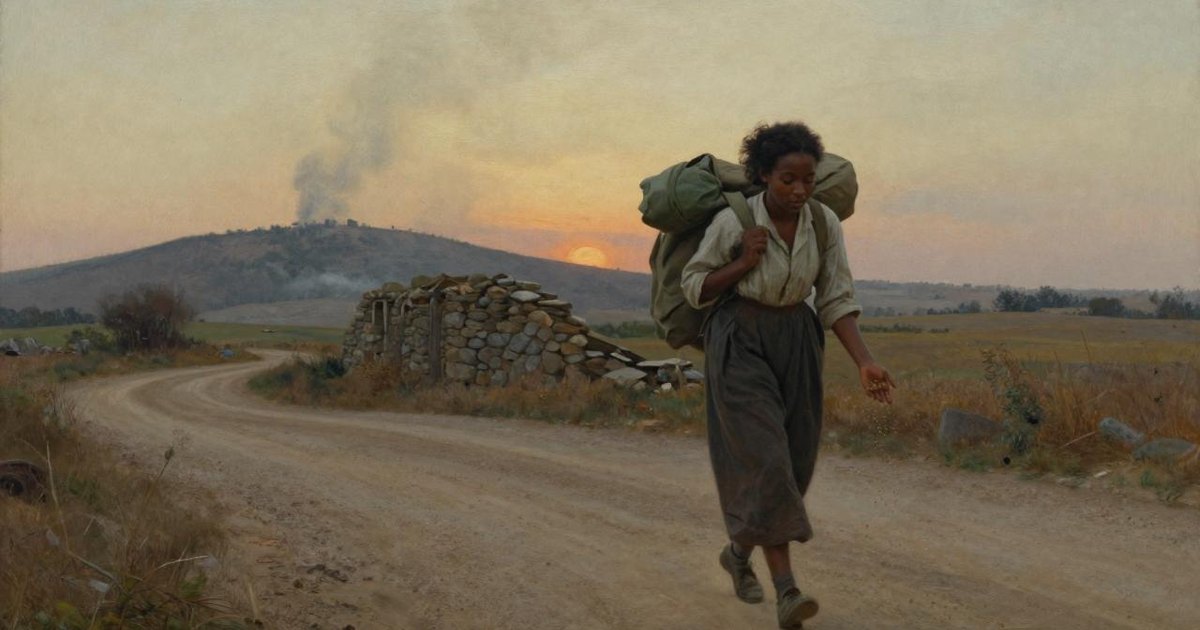
Octavia Butler built Parable of the Sower as a diary with a scripture growing inside it. Lauren Olamina turns fifteen the day her journal opens, 20 July 2024. She records a walled neighborhood outside Los Angeles coming apart, and between entries she drafts Earthseed, a religion whose central tenet is "God is Change." Readers who have watched the 2020s catch up with her calendar call the 1993 novel a prophecy, but it is an argument about what faith is for when order fails. It holds, though Earthseed goes thin as comfort and thinnest where its verses harden into slogans.
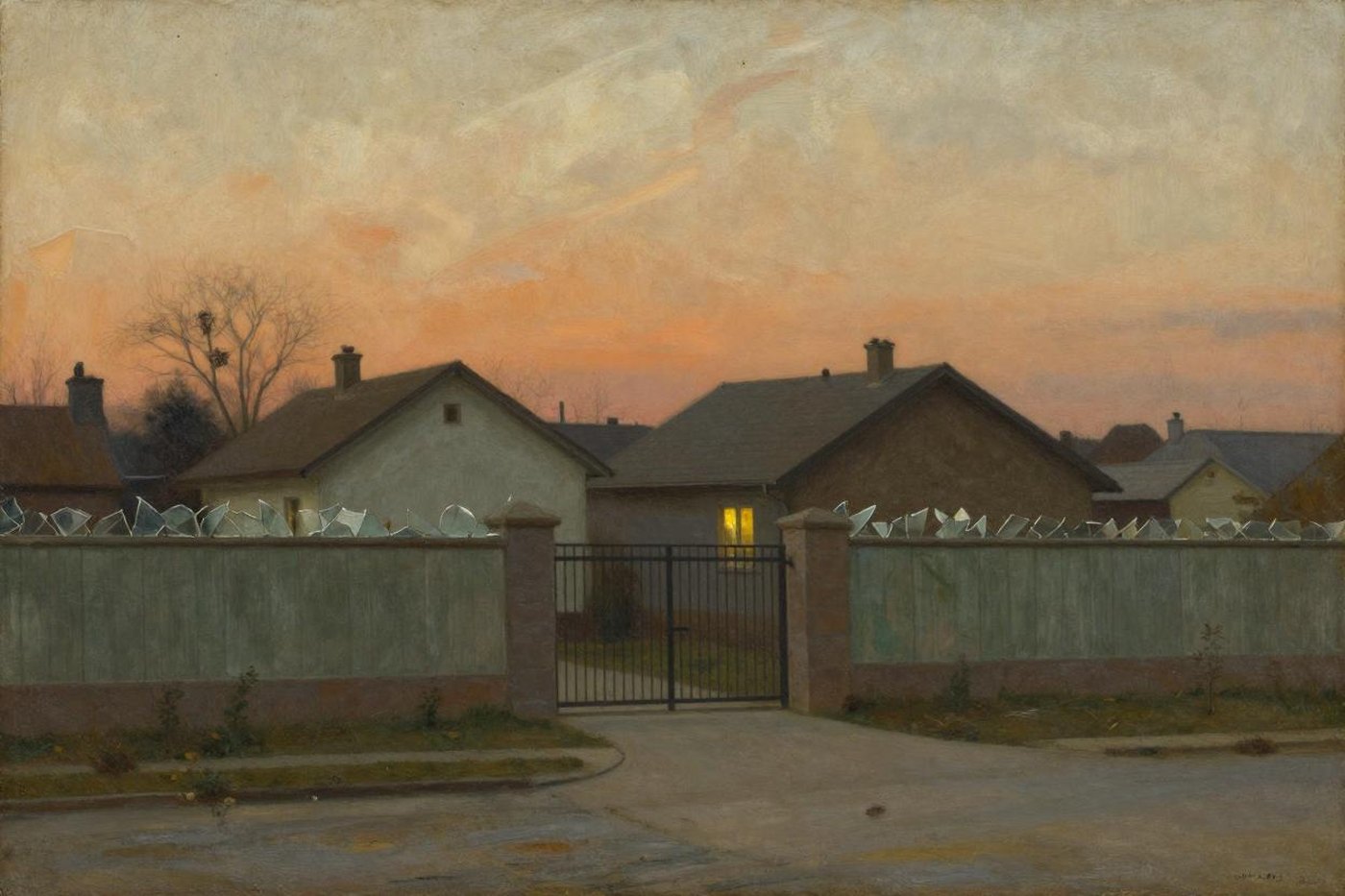
The same day is her father's fifty-fifth birthday. He preaches to one walled cul-de-sac in Robledo, a fictional town twenty miles from Los Angeles. The wall did not exist when he inherited the house in 2010. Now it stands three meters high, topped with broken glass and barbed wire, and Lauren remembers finding it, at seven, "more threatening than protective."
Every chapter opens with a verse from Earthseed: The Books of the Living, so you read on two clocks at once, the journal's calendar of collapse and the slower time it takes a teenager to turn what she sees into doctrine. In The Dispossessed, Ursula K. Le Guin showed a society living out a dead founder's philosophy. Butler shows the founder at fifteen, drafting.
During the January 2025 Los Angeles fires, posts calling Butler a prophet spread with the smoke. In a 1998 talk at MIT she had already refused the title, calling the book "a cautionary tale."
Part II: What happens behind Robledo's wall, and why does the wall matter?
Inside its wall, the neighborhood works like a village, with a church, a school, shared night watches, acorn bread and pooled costs. Outside, police and firefighters still exist, and they charge fees. On 1 February 2025, three-year-old Amy Dunn sets her family's garage on fire, ten-year-old Robin Balter rings the emergency bell, and the adults put it out with hoses and wet blankets. Nobody calls the fire department, which would send a bill.
A month later a bullet fired from outside pierces the supposedly bulletproof gate and kills Amy. The next day Lauren warns her friend Joanne Garfield that the neighborhood will be hit and hit again until the big hit comes, and that if they are not ready it will be like Jericho.
In chapter 13 of Leviathan (1651), Thomas Hobbes says that people living "without a common Power to keep them all in awe" are at war, and that even with laws and armed officers to avenge him a man "locks his dores" at night. Yet Hobbes would not have trusted the cul-de-sac's wall. Chapter 17 is plain: "Nor is it the joyning together of a small number of men, that gives them this security." His remedy was a sovereign over everyone, "that Mortall God."
Watch what the wall cannot do. Keith, Lauren's half-brother, runs off to join thieves, and the next summer his parents identify his tortured body. That November her father vanishes five blocks from home and is never found.
The entry for the morning of 31 July 2027 tells the night before in one rush: smoke wakes her, an old truck has smashed the gate, the houses are burning, the bell never rings because, she guesses, the watchers died first, and she loses her family in the dark. The attackers, she thinks, were mostly addicts of pyro, a drug that makes watching fire better than sex. In the ruins she finds Harry Balter and Zahra Moss, and Zahra tells her the raiders caught Lauren's stepmother and brothers, dragged them back and killed them, and that she saw it. The wall had marked the street as worth taking.
That chapter opens on the verse where Earthseed overreaches: a phoenix, it says, must burn before it can rise. Yet Lauren's God, she will tell a skeptic, is neither good nor evil and favors no one. A verse that makes the burning the price of the rising is a theodicy, a story in which the catastrophe was needed, and such a God cannot supply one.
Months before the fire, the book had offered a bigger wall. Olivar, a well-to-do seaside suburb losing ground to the sea and the desperate, lets a multinational buy it out, its voters accepting low pay in exchange for security, food and jobs. The deal turns a question of power and politics into real estate, and Lauren calls it debt slavery. Joanne's family applies and is accepted. Matthew's gloss on the parable (Butler prints Luke's) names these thorns: "the care of this world, and the deceitfulness of riches, choke the word."
Here is the novel's real quarrel with Hobbes. Olivar is his covenant made literal, frightened people consenting to a protecting power, and Hobbes would take the deal, since in chapter 18 even the worst government beats civil war. Lauren's father answers that there is nothing safe about slavery. Hobbes even supplies the exit: in chapter 21 obedience lasts only as long as the sovereign has the power to protect. A state that sells its firefighting and leaves the walled streets to guard themselves is losing that power, and the walk north is what subjects do once it is gone.
Part III: Is Earthseed a religion or a survival strategy?
Lauren names her faith while weeding the garden, thinking of plants that seed themselves far from the parent, and calls it "discovery rather than invention." Earthseed is a religion whose God is change itself, a force its believers perceive, learn from and shape, and in the end yield to. Few faiths in the history of religion and the sacred have a God and no worship.
Heraclitus is a relative, though not a known source for Butler. Earthseed's one lasting truth, change, echoes his "ever-living Fire, with measures of it kindling, and measures going out," but his sage only understands "the thought by which all things are steered through all things." Earthseed reaches for the tiller, and unlike Heraclitus it exempts one thing from the flux.
In August 2027 Lauren is walking U.S. 101 north, disguised as a man, with Harry and Zahra, and the three take in Travis Douglas and his young family. Two days later, on a Santa Barbara beach, Travis asks why she calls change God when it is only an idea, and tells her, "Your stuff isn't very comforting." She offers the Destiny instead: "The Destiny of Earthseed is to take root among the stars," a heaven, she says, you need not die to reach.
A week later he is her first convert and Zahra her second, though Zahra says outright she doesn't care about outer space. A God of change cannot console, so Lauren supplies a fixed end, the one thing in her faith not allowed to change, and her second convert keeps the community and leaves the heaven. The Destiny can be defended as a goal that organizes the present, but that defense concedes Travis's point. The consolation has been exported to the stars, and Butler knows it.
The walk also tests Peter Kropotkin. Mutual Aid (1902), written to answer T. H. Huxley, attacks Hobbes by name and holds that "Sociability is as much a law of nature as mutual struggle." Kropotkin found it strongest among the poor, quoting a woman who worked in Whitechapel: "If, in the working classes, they would not help each other, they could not exist." Lauren's band is a people made of strangers.
It is mutual aid with guns. Inside the band Kropotkin passes, with trust rationed: the Douglases stand watch from their first nights, but never alone. Outside, the road is Huxley's world, a river of the poor that offers Lauren danger and recruits and little else, which stacks the deck against Kropotkin, whose poor nurse their neighbors. Butler agrees with him about what survives and parts with him about where it comes from: here sociability has to be written down as scripture and backed by night watches, which is why the religion exists.
Part IV: What is Lauren's hyperempathy arguing about the cost of feeling others' pain?
Lauren is a sharer. She feels what she sees others feeling, or what she believes they feel, a condition her doctors call an "organic delusional syndrome," caused by Paracetco, a drug first made for Alzheimer's patients that her mother abused before Lauren was born. As a child she bled when others bled, and Keith once faked a wound with red ink to make her do it.
After Keith's body is found, Lauren wishes the condition on everyone, since nobody could torture if every blow landed on the striker: "A biological conscience is better than no conscience at all." The novel's easy rebuttal is two sharers once held in debt bondage, but that works only because sharers are rare. If everyone had the condition, the master would feel the lash. Butler's own objection at MIT is harder: the rich could pay others to do their hurting.
The novel tests the wish with a gun. When the neighborhood burns, Lauren shoots a man, takes the impact in her own stomach, and shoots him again, terrified that his pain will immobilize her once he feels it. On the first night of the walk, after she caves in an intruder's skull to save Harry and is laid out by the blow herself, she cuts the unconscious man's throat so he cannot wake and draw her into his agony. Zahra observes that the dead feel nothing. Harry asks whether she would kill to escape the pain.
Her journal answers him: to her, pain is the evil and death its end. A conscience built into the body ends torture partly by making death the cleaner option. The wish holds against cruelty and fails against killing, and Lauren finds out which half she can bear.
A tempting reading makes Lauren a figure for Simone Weil's attention. The likeness does not survive a close look. Weil's attention is a receptive waiting, an emptying of the self so the sufferer can be seen as he is. Lauren's condition fills the self with her own version of his pain, which is why red ink can summon it and a corpse can end it. Hyperempathy is a counterfeit of attention.
Part V: Is the novel a prophecy or a method, and does it hold?
Lauren's Jericho warning is her author's method in small: the future can be read, she tells Joanne, by anyone willing to get past the fear. Butler told MIT she allowed herself nothing that could not actually happen and worked from the news: slavery under another name, disposable workers, private prisons, drought in a warming California.
The novelist Roz Dineen, writing in Lit Hub in July 2024, argues that Butler simply followed existing conditions to their logical conclusions. The date of Donner's November 2024 victory proves nothing, since federal law fixes Election Day. The extrapolation is his platform: suspend minimum-wage, environmental and worker-protection laws for employers who house the homeless in exchange for work.
Beside January 2025, the closer match is the fee schedule. Its February fire is a toddler's accident. The real fires that began on 7 January in Altadena and the Pacific Palisades killed thirty-one people and destroyed more than 16,000 structures, by CAL FIRE's count, and CalMatters reported that insurers including State Farm contract with private fire-defense firms and that Rick Caruso's crews guarded his Palisades Village mall. Critics called it a two-tiered system. In Robledo the tiers reach the public fire department.
The case, worked through
Premise: Order first: build the wall. With no sovereign it can trust, the neighborhood walls in its one street, or nothing on it survives.
Objection: The wall fails. Hobbes warned that a small band invites invasion, and the walled street burns in a night. Olivar, the bigger wall, buys protection on terms Lauren calls debt slavery.
Revision: Community by choice. On the road, strangers become a people by keeping watch for each other, as Kropotkin said the poor do.
Objection: Chosen communities curdle. Lauren admits her band may have to dominate and writes verses meant to lodge before they are examined. Parable of the Talents (1998) shows a crusading Christian America overrunning Acorn.
Verdict: Earthseed works as ethics. A faith whose one sacred value is change leaves a creed little to harden around except its Destiny, asks for honest attention and keeps a moving group together. As consolation it is thin, and the novel says so through its own skeptics.
Humboldt County tests the verdict. On the land of Bankole, a doctor who joined them on the road, the band finds his sister's house burned and five skulls, a family too few, Zahra points out, to keep a night watch. The skulls make Kropotkin's case for numbers, and Earthseed gives the band a reason to stay on ground that has already failed one family.
Sower arms the curdling objection against its own founder. Within a page of her first converts, Lauren plans to fish the river of the poor for recruits and concedes her band might have to dominate, rob and even terrorize to survive. The morning after the roadside killing, while Harry was still recoiling from it, she had handed him short verses chosen to lodge in his memory before he noticed or agreed to keep them. That is where the verses are weakest. A slogan is built to be kept without being examined, and Lauren built hers that way. What redeems the book is that it keeps the record, down to Harry feeling deceived.
The last page isn't Lauren's. Butler closes on Luke 8:5-8 and cuts it at the harvest, where the standard King James text reads: "And other fell on good ground, and sprang up, and bare fruit an hundredfold." She drops the call that follows, to anyone with ears to hear, and prints none of the explanation Jesus gives his disciples. Joanne was one kind of ground and Olivar another. Whether Acorn is the good one, the book declines to say.
Lauren's last entry, Sunday, 10 October 2027, is a funeral with Bible passages, Earthseed verses and bits of songs and poems. When she tells Bankole that God is Change, he answers, "Olamina, that doesn't mean anything," and doubts they have any hope of succeeding there. They bury the dead, plant live oaks from Lauren's acorns and call the place Acorn.
Further Reading
The Handmaid's TaleAtwood's Gilead, a Christian theocracy built from historical precedent, the kind of state Butler's sequel sends against Acorn. The DispossessedLe Guin's anarchist moon, where a founder's creed is tested by the generations who inherit it.