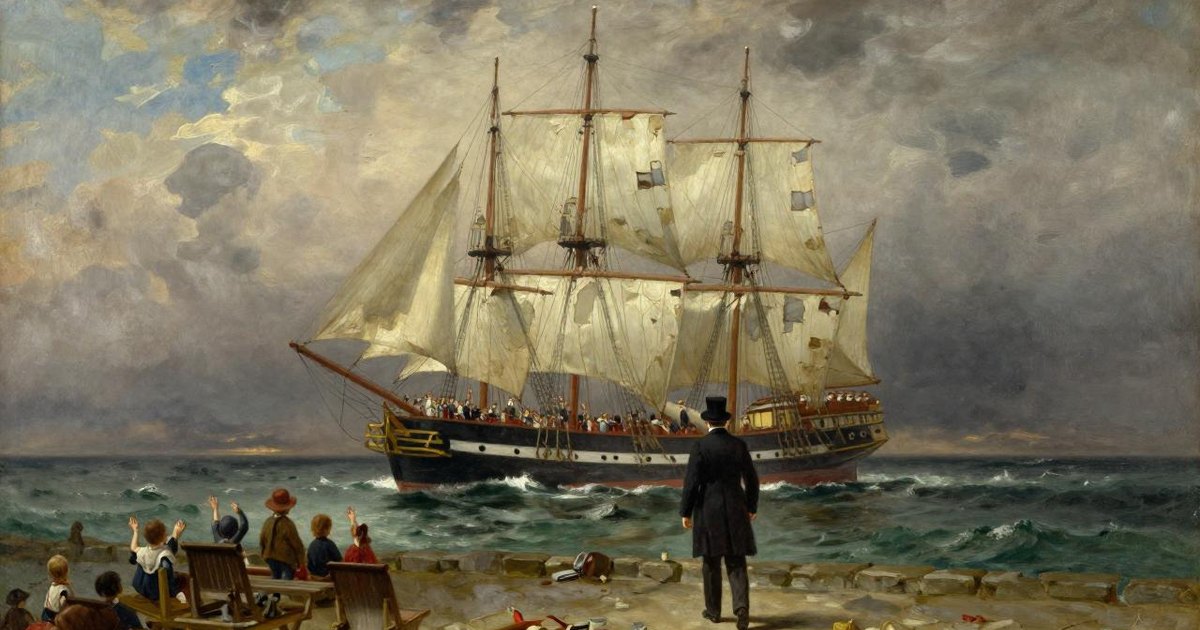
"The Ethics of Belief", the paper a thirty-year-old mathematician named William Kingdon Clifford read to the Metaphysical Society in April 1876, opens with a ship and arrives at a rule: believing anything on insufficient evidence is wrong, for anyone, anywhere. Twenty years later William James argued that it is sometimes rational to believe without enough evidence, and his case for faith earns a split verdict. Belief may go first only where a choice is live, forced, momentous and beyond evidence (James's tests), where believing helps make it true, and where the believer carries the risk. Everywhere else, Clifford's discipline holds.
Printed in January 1877, the essay begins: "A shipowner was about to send to sea an emigrant-ship. He knew that she was old, and not over-well built at the first." Others had raised doubts, but she had come through so many voyages. He put his trust in Providence and talked himself into a sincere, comfortable certainty that she was safe. Aboard were families leaving their fatherland, and he "got his insurance-money when she went down in mid-ocean and told no tales."
Clifford holds the owner guilty of their deaths, then alters the case. Suppose the ship had been sound after all. Is the owner any less guilty? "Not one jot," he answers. "The man would not have been innocent, he would only have been not found out." The wrong was done on the quay, when the owner chose comfort over inquiry.
Clifford died in Madeira in 1879, aged thirty-three. In 1896 James gave his fullest answer, an address to the philosophical clubs of Yale and Brown printed that June as "The Will to Believe". This column builds the strongest version of an idea before trying to break it. James's idea needs it more than most, because its caricature, manifesting, has become a mass creed.
Part II: What is Clifford's shipowner guilty of?
Not of lying. He believed what he told himself, and Clifford calls that sincerity no help at all. The owner had acquired his belief "not by honestly earning it in patient investigation, but by stifling his doubts." Right and wrong attach to how a belief was got. Whether it turned out true is beside the point.
The ethics of belief, the field that borrowed Clifford's title, asks whether we answer for what we let ourselves believe as well as for what we do. Clifford's answer was yes. Belief, he argued, is never private. We cannot always choose what to believe. We can choose where to look, and the duty is to look hard at the hull we would rather not see.
Clifford's rule descends from Hume's maxim, a cornerstone of logic and argument, that a wise man proportions his belief to the evidence. But Hume meant a dial, more belief or less as the testimony allows. Clifford made the dial a switch, and belief on the wrong side became a moral failure.
He allowed borrowed evidence: a trustworthy chemist's word is enough for a man who is no chemist. What he forbade was believing past your evidence because the belief is pleasant or pays. His first section builds to the sentence James spent years answering:
"To sum up: it is wrong always, everywhere, and for anyone, to believe anything upon insufficient evidence."
Part III: What is James's strongest case for believing first?
James's stated target was religion and the sacred, but his tools reach further. A choice, or option, is live when both answers seem real possibilities, forced when there is no standing ground outside the alternative, and momentous when the stakes are high. A fourth condition often vanishes in retellings: the option must be one that "cannot by its nature be decided on intellectual grounds." Then, James says, our passional nature not only may but must decide, since leaving the question open is itself a decision.
His best argument splits the knower's duty in two. We must know the truth, and we must avoid error, and the two duties can come apart. Clifford's rule, out of a horror of being duped, ranks avoiding error absolutely first. To James that was a general keeping his soldiers out of battle forever rather than risk a single wound. A rule that would stop us from acknowledging a kind of truth that was really there "would be an irrational rule."
Then come facts that do not yet exist. Take the question at the start of any friendship: do you like me or not? If I wait for proof before acting warmly, my wariness may keep the proof from ever coming. "The previous faith on my part in your liking's existence is in such cases what makes your liking come." A rule forbidding the belief forbids the fact with it.
Politics works the same way. In James's example, a few highwaymen loot a train of brave passengers because the robbers can count on one another, while each passenger waits for evidence of the others' courage that only courage could supply. A government, an army, a commercial system, a ship, a college and an athletic team, James wrote, all depend on the same trust. His summary: "faith in a fact can help create the fact."
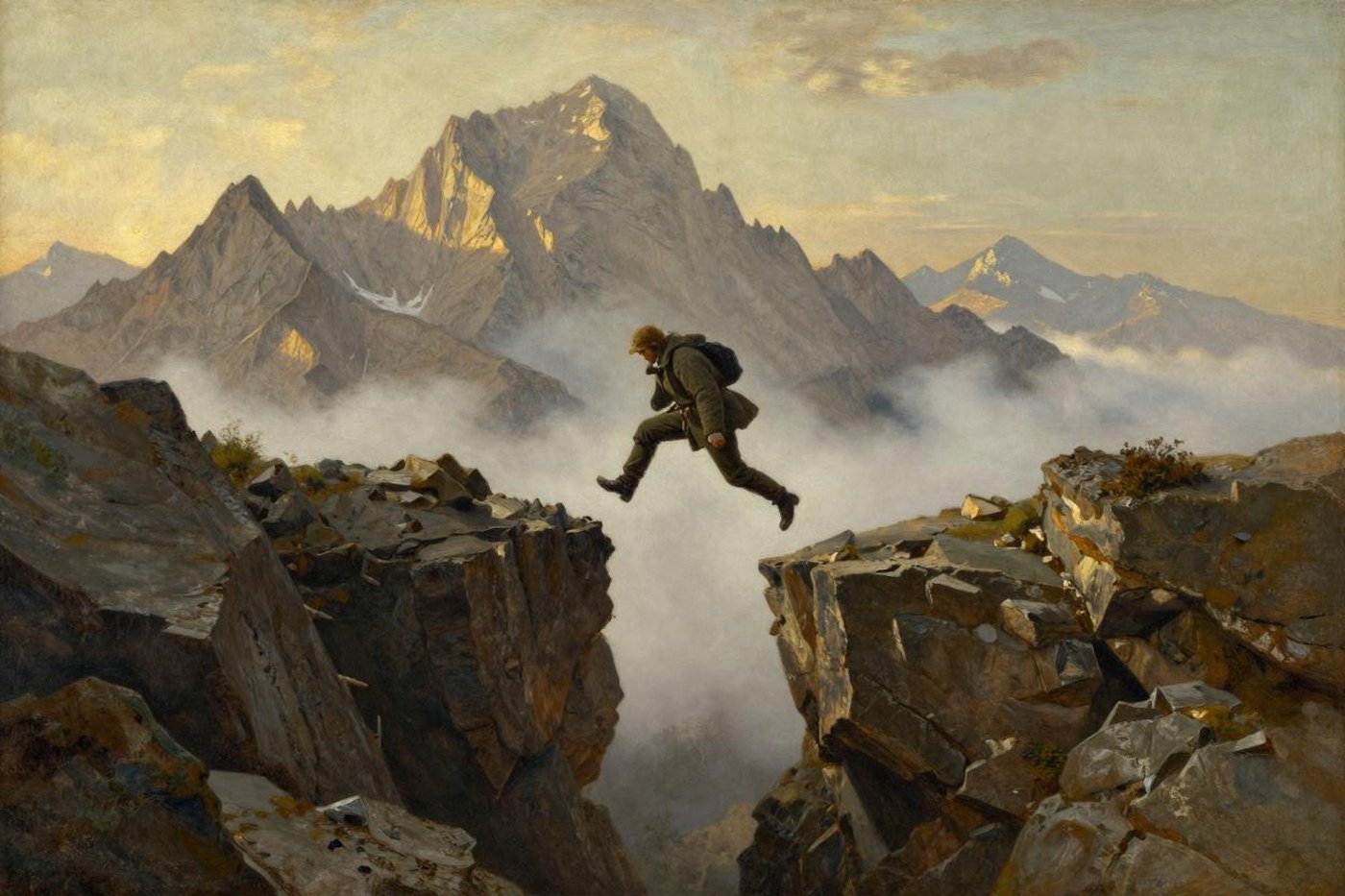
By 1880, the year after Clifford died, James was answering him by name. In an address later collected in "The Sentiment of Rationality," he pictures himself on an Alpine ledge whose only escape is a terrible leap. Hope and confidence would nerve his feet. But "having just read the Ethics of Belief," he might think it sinful to jump on an unverified assumption, hesitate too long, and fall.
The religious case, the one the address was written for, works differently. No one's belief makes God exist. James's claim is about access: we feel "as if evidence might be forever withheld from us unless we met the hypothesis half-way." His illustration: a man who demands proof before every concession forfeits all that a trusting spirit would earn.
Clifford's own second section has the answer: "there are many cases in which it is our duty to act upon probabilities, although the evidence is not such as to justify present belief," since acting gathers evidence. He kept Hume's dial for action and made it a switch only for belief. The friend can be met halfway, the passenger can rise and the climber can jump without believing anything. James's general is haranguing a Clifford who never existed.
James denies the split. "Since belief is measured by action," he wrote of religious faith, whoever forbids the belief forbids acting as a believer would. No probability estimate ever nerved anyone's feet. The crux, then: is the state that does the work belief, or something nearer hope and commitment? The temptation is to let the steelman answer in its own favor, until any hope passes for courage. A trend on TikTok already has.
Part IV: Does manifesting prove James right?
The resemblance is real but shallow. On the gentlest reading the trend is psychology (expect luck and you notice openings), and that version is James's. In The Varieties of Religious Experience (1902) he wrote warmly of the mind-cure movement, a forerunner of manifesting, reckoning it a real religious force for what it did through believers: better health, happier homes. The break is the claim that the universe delivers, and James drew that line himself: "The future movements of the stars or the facts of past history are determined now once for all, whether I like them or not."
Sander van der Linden, a Cambridge social psychologist, called manifesting "magical thinking." Positive thinking helps when people act on it, he said, but claims to bend reality by thought alone are pseudoscience. Experiments go further. In four 2011 studies, Heather Barry Kappes and Gabriele Oettingen found that positive fantasies about an idealized future left people with less energy. That tilts the crux toward James. What helps the climber is confidence about his own legs. A fantasy of the far side saps the energy to jump. The creed adds blame: the unlucky must not have believed hard enough.
Pascal's wager staked a finite life on an infinite reward: "It is not optional. You are embarked." For the doubter who could not believe, he prescribed habit, holy water and masses: "Even this will naturally make you believe, and deaden your acuteness." The technique transfers to affirmations. The logic does not. Pascal's habit served a wager he thought reason had already won, and he never claimed belief would make God exist. His listener voices Clifford's fear at once: "But this is what I am afraid of."
In 1981 Steve Jobs's Macintosh team named his effect on them a reality distortion field. At its best that is James's social organism. OceanGate found the edge. In 2018 an employee, David Lochridge, put his doubts about the Titan's carbon-fiber hull in writing and was soon fired. On 18 June 2023 the Titan imploded on a dive to the Titanic, killing all five aboard, among them the chief executive, Stockton Rush. His belief was sincere. He was inside the hull. A Coast Guard board called the loss "preventable." Morale is a friendship question. A carbon-fiber hull is a ship.
Some faiths are built to survive failure. "Trust the plan," the refrain of the QAnon movement that began on 4chan in October 2017, kept followers believing as predicted arrest dates came and went. Crypto's "HODL," a 2013 typo for "hold," asks the same of holders through every crash. Clifford knew where such faith leads: "The credulous man is father to the liar and the cheat."
James supplies the last objection himself. In the abstract, he wrote, "we have the right to believe at our own risk any hypothesis that is live enough to tempt our will." He narrowed it to options the intellect cannot resolve, then added that "living options never seem absurdities to him who has them to consider." Every fence is judged by the person whose hopes want through, and a feed keeps the broad sentence and drops the fence. His shrug, "Our errors are surely not such awfully solemn things," reads differently on that quay.
Part V: Where does the right to believe end?
James felt the problem in his title. In a 1904 letter to L. T. Hobhouse he wished he had used "the less unlucky title the Right to Believe," pointed to the essay's "signboards of danger," and said he had simply stressed the believer's right to run the risk. A will has no edges. A right does. It lapses where it loads the risk onto others. The shipowner had a will and no right. The families were the ones who would drown. Clifford overreaches the other way, leaping from an owner who staked other people's lives to always, everywhere, for anyone.
Coleridge drew one edge in 1817, when he said his supernatural poems for Lyrical Ballads sought "that willing suspension of disbelief for the moment, which constitutes poetic faith." Poetic faith is licensed because it fails James's tests on purpose: the reader can close the book, so it is neither forced nor momentous. The shipowner treated the quay as if it were a page.
Tennyson, Clifford's fellow member of the Metaphysical Society, found the other edge a quarter century before Clifford's paper. In Memoriam says of one doubter that "There lives more faith in honest doubt, / Believe me, than in half the creeds." He "fought his doubts," and the fight ended in a faith he could not prove: he came "To find a stronger faith his own." The route legitimates it: Clifford's own test, turned in James's favor.
The case, worked through
Steelman: Some beliefs make themselves true. Trust, friendship and courage need belief before their evidence can exist.
Steelman: Caution is a bet too. Clifford's rule trades every truth that needs belief first for safety from error, and nothing in logic forces that trade.
Objection: Belief is a public trust. An unearned belief passes to everyone who borrows it, and most beliefs concern hulls.
Objection: The fences are guarded by the believer. Whether an option is live, forced or beyond evidence is judged by the person whose hopes want the answer.
Outcome: James wins on principle and loses most of the territory. His four conditions: live, forced, momentous, beyond evidence. This essay adds two: belief must help make its object true through the believer's own action, and the believer must carry the risk. Inside all six, belief may go first.
James called the climber's case "one of an immense class," and in social life it is: morale, trust, markets. The class shrinks wherever a hull is involved or others bear the risk, and most of what we are asked to believe, about bridges and balance sheets, is hull.
The religious case falls outside the six fences, so on this essay's terms James loses the case he wrote the address for. His access argument has the shape of "trust the plan" and of every con that promises you will see once you believe. It is also how friendship works. Evidence cannot tell us which we face, and that was James's point.
The fences leak. On 9 March 2023 depositors pulled $42 billion from Silicon Valley Bank in a single day, and it failed the next. Their faith was the friendship half, the bonds it had sold the day before at a $1.8 billion loss the ship half, and James's list had included commercial systems. The hybrid is his problem too.
The same list included a ship. Its crew floats on trust. Its hull floats on timber, and timber does not care what anyone believes. Clifford's shipowner had hope and a comfortable conviction. He lacked a case James would recognize. The families had no say in the option he chose for them.
Further Reading
Butler Set It in 2024Octavia Butler's Earthseed, a new faith tested on the road by a skeptic who finds it no comfort.