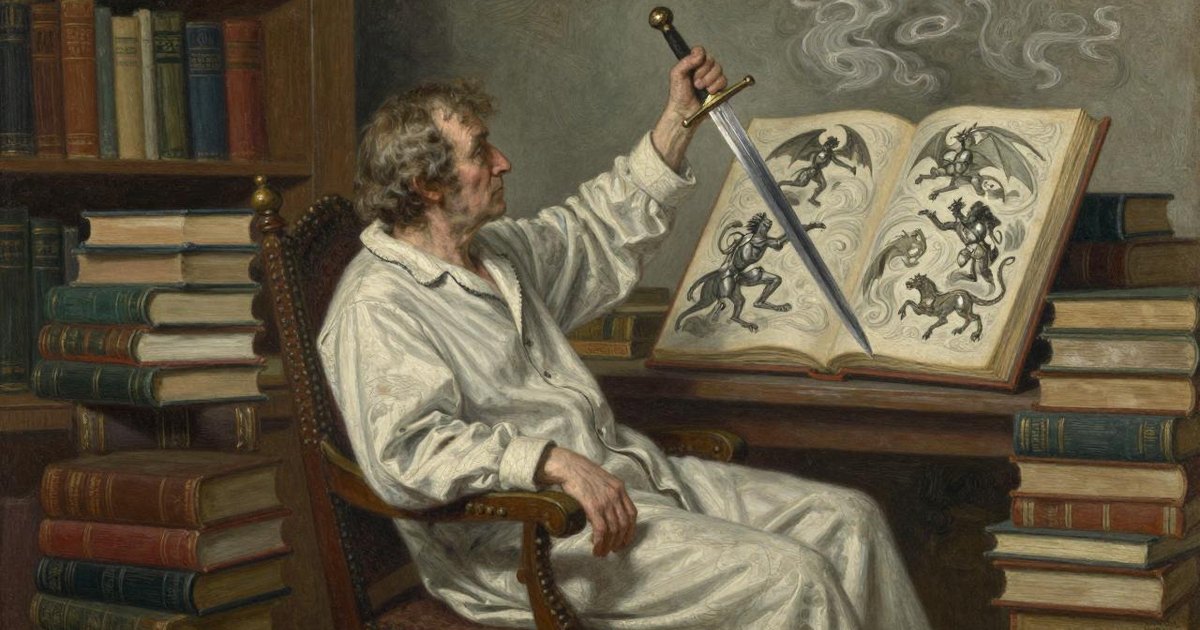
In 1605, Miguel de Cervantes, fifty-seven years old and a veteran of Lepanto, published a book about a country gentleman who read so many tales of knights that he came to believe them. Ten years later, in the second part, the gentleman finds he has become a character other people have read, and they start staging fictions to toy with him. What Don Quixote teaches about conspiracy rabbit holes and algorithmic radicalization is that capture has three authors. Cervantes blamed the books, he blamed the reader, and he blamed the audience that laughed and played along.
That triple verdict is the reason the novel still matters to anyone whose parent or old friend has disappeared into a world of hidden plots. Our arguments about online radicalization tend to pick one culprit: the platforms and their engagement-tuned recommendations, or the person and some prior hunger the internet merely fed. Cervantes refused to choose. Over a thousand pages, patient and often very funny, he built the case that a captured mind is made by what it reads, by its own appetite, and by the people who find its belief useful.
The book is often called the first modern novel, a claim scholars like to argue over. It is perhaps also the first great novel about a mind captured by content. Its hero is no lunatic from birth. He is a reader. His madness has a cause that the opening chapter names with clinical flatness, and a cure that the final chapter delivers with something close to grief. The novel follows him in order, from the books to the people who read him, and that order is itself part of the argument.
Part II: What happened to Alonso Quixano's mind?
Even his name is unstable. In the first chapter of John Ormsby's 1885 translation, the narrator offers Quixada, Quesada and a guess at Quexana, and shrugs that it hardly matters. Only on his deathbed, sane again, does the man settle into Alonso Quixano the Good. For a thousand pages the only name that holds is the one he took from his books.
The mechanism comes in that same chapter. The gentleman, who has more leisure than income, sells acres of tillage land to buy romances of chivalry. He reads late into the night and early into the morning. The narrator's diagnosis is almost physiological: "what with little sleep and much reading his brains got so dry that he lost his wits." Strip away the humoral medicine and the observation is modern. Sleep deprivation plus unbroken immersion in a single genre changes perception. Nobody forced Quixano to read. He went looking for the books, paid for them by selling his land, and arranged his days around them.
The second sentence of the diagnosis matters more. Cervantes writes that "it so possessed his mind that the whole fabric of invention and fancy he read of was true, that to him no history in the world had more reality in it." Quixano keeps his eloquence and his gift for argument, which he displays at length. What he loses is the boundary between one class of text and every other. The romances are promoted from fiction to history, and once promoted, they outrank everything else he knows.
A rabbit hole is the point at which one body of content is promoted from story to history and every other source begins to be read through it. It is rarely a collapse of intelligence. The people who fall furthest are often articulate, well read in their chosen material and quick in debate. What has changed is the ranking of sources. One shelf has been granted a reality no counter-evidence can touch.
The problem belongs to the territory of Mind & Knowledge: which testimony to trust. Most of what we believe comes from other people, and a healthy mind keeps a rough ledger of how much weight each source deserves. Quixano's ledger has been rewritten so that the most entertaining source carries the most weight. Plato pictured prisoners who mistake shadows for the world because the shadows are all they have been shown. Quixano had the whole world in front of him. He chose the reading. He did not choose the possession, and the distance between those two things is the question this novel never stops asking.
Part III: Why chivalric romances?
The romances were the bestsellers of sixteenth-century Spain. Long, serial, endlessly extended by sequels and imitators, they offered a world in which every encounter was charged with meaning. An inn was a castle, and a misfortune was the work of an enchanter with a name. Nothing in that world was random or merely ordinary. Every event belonged to a plot, and the reader always knew which side he was on.
That feature links the genre most directly to conspiracy thinking. A conspiracy theory is, among other things, a promise that the world is legible. The plane went down because someone wanted it down. The vaccine, the moon landing, the election that went the wrong way (whichever way that was for you): each turns into a design, authored by someone you can name, visible to the few who look. Much of the appeal lies in the relief of meaning, the hunger to be told what is true and who is behind it.
David Hume, writing in 1748, gave this appeal its classic diagnosis. In "Of Miracles" he argued that the evidence for wonders is weaker than it looks, partly because the wonders bend our judgment. "The passion of surprise and wonder, arising from miracles, being an agreeable emotion, gives a sensible tendency towards the belief of those events, from which it is derived." The pleasure of the astonishing story is itself a reason we believe it.
Hume's illustration could describe Quixano's library. "With what greediness are the miraculous accounts of travellers received, their descriptions of sea and land monsters, their relations of wonderful adventures, strange men, and uncouth manners?" Greediness is the right word. The romances supplied giants and enchanters in quantity, and the appetite they fed was an appetite for wonder. Hume found the problem in an ordinary passion available to anyone. Cervantes found it in an ordinary gentleman with too much time.
The two part company over the cure. Hume treats the love of wonder as a bias that better reasoning can correct. Cervantes is less optimistic. His hero reasons beautifully from false premises, and when the evidence goes against him he enlarges the story. Some faith is rational when evidence runs out. Quixano is the limiting case, a man whose faith has learned to digest the evidence itself.
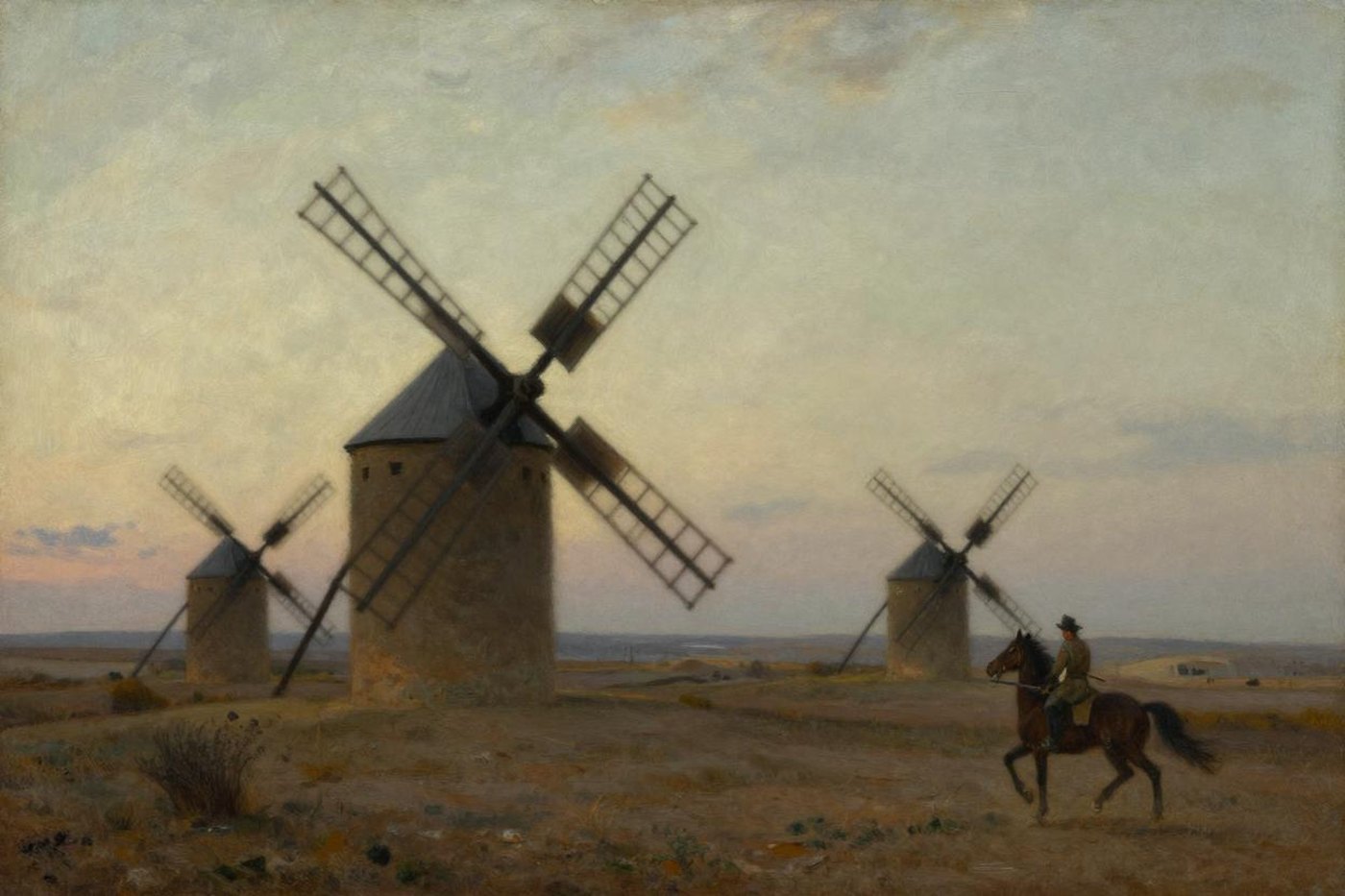
The clearest demonstration comes in chapter 8, on the plains of La Mancha, where knight and squire come upon thirty or forty windmills. Sancho Panza, the farmer Quixano has recruited with the promise of an island to govern, sees what is there: "what we see there are not giants but windmills, and what seem to be their arms are the sails that turned by the wind make the millstone go." His master's reply is the template for every argument with a true believer. "It is easy to see," he says, "that thou art not used to this business of adventures." And then, flatly, "those are giants."
The reply leaves Sancho's description standing and disqualifies Sancho as a witness. You see windmills because you lack the training, the years of reading that would let you see what is really there. The believer's knowledge of the genre becomes the credential that overrules everyone else's eyes. Anyone told to "do your own research" will recognize the move.
Then the sail catches the lance and flings horse and rider across the field. Picking himself up, Quixano announces that the enchanter Frestón, a villain from his books, turned the giants into windmills at the last moment to rob him of his victory. The refutation is absorbed into the theory. The windmills prove the giants, because only a powerful enemy could have arranged so convincing a disguise.
This is the self-sealing structure that students of Logic & Argument worry about: a belief system that treats every disconfirmation as evidence of a cover-up. Once it is in place, argument cannot reach the believer, because the act of arguing is folded into the plot. Sancho can be right about every windmill in La Mancha. He is only describing the disguise.
There is a great tradition that reads all this the other way, and it is not easily dismissed. The German Romantics, then Turgenev, and above all Miguel de Unamuno in his Vida de Don Quijote y Sancho of 1905, saw in the knight a hero of faith. His delusion makes him braver and kinder than the sane. He frees a chain of galley slaves because no man should be dragged off in irons, he defends the weak against the strong, and in Part Two Cervantes lets him stand morally above the Duke and Duchess who mock him. On this reading the windmills are the price of a nobler way of seeing.
The objection cuts at the whole analogy. Most conspiracy capture makes people suspicious and hostile. Quixano's makes him generous. The best answer may lie in what each story asks of its believer. The romances told him to protect widows and orphans. A conspiracy tells its believer to unmask the enemy hiding among his neighbors. Both are self-sealing, but they seal around different duties, and the difference will matter again at the deathbed.
Part IV: Was burning his library care or censorship?
After the first disastrous sally, Quixano is brought home bruised and asleep, and in chapter 6 his friends the curate and the barber go after the cause. With his niece and his housekeeper they begin what Cervantes calls a scrutiny of the books. It is one of the funniest chapters in the novel and one of the most morally interesting, because it stages the argument we are still having about removing harmful content.
The common memory is that the friends burn everything. The text is more careful. In Ormsby's version it is the niece and the housekeeper who want the whole collection thrown into the yard and set alight. The curate refuses, and the narrator reports that "the curate would not agree to it without first reading at any rate the titles." He wants to judge each book.
His judgments are discriminating and often surprising. Amadis of Gaul, the founding romance of the genre, is condemned at first as the root of the disease, then spared when the barber argues it is the best of all the books of its kind. Its sequel Esplandian goes into the yard. Palmerin of England is kept, and Tirant lo Blanch is kept with praise. The scrutiny is literary criticism performed with a bonfire waiting outside.
So which is it? The friends act from love. Their friend is ill, the illness has a visible cause, and the cause is on his shelves. A modern version would be the family that quietly unsubscribes an elderly relative from a run of channels, or the platform that removes a network of accounts after a riot. Our review of Fahrenheit 451 argued that the most effective suppression of reading needed no fire at all. Cervantes gives the opposite case, a fire lit with real affection and a curate trying hard to keep it small.
And it does not work. The friends wall up the library, and the niece and housekeeper tell him an enchanter carried it off. He accepts at once and supplies the enchanter's name himself, Frestón, because enchanters are exactly what carries off libraries in his books. The removal of content becomes new content, further proof of persecution. He stays home quietly for fifteen days, and then he recruits Sancho for the second sally.
By the time the friends act, Quixano carries the genre inside him. He has learned how to see, and that skill survives the loss of the library. The curate can choose which titles burn, but he cannot burn the reading.
Part V: Who profits from the believer in Part Two?
When Cervantes returned to his hero in 1615, he made a choice few writers before him had made. The characters of Part Two have read Part One. Don Quixote is famous. The people he meets on the road know his story, his squire, his horse and his lady. He has become a celebrity believer, and a celebrity believer is a resource.
The richest exploiters are a Duke and Duchess who receive knight and squire at their estate and spend roughly chapters 30 through 57 staging elaborate fictions for their own amusement. Servants play enchanters, and Sancho is given a sham island to govern. The Duke and Duchess are not deceived. They are the authors of the deception, and they spare no expense, because watching him believe is the best entertainment they have.
The most famous hoax is Clavileño, in chapters 40 and 41. The household stages the arrival of the Countess Trifaldi and her bearded duennas under an enchanter's curse that only a flight on a wooden horse can lift. Knight and squire mount blindfolded. Servants puff at them with a great pair of bellows to make the wind of flight, and warm their faces with burning tow on a cane to suggest the region of fire. Then they put a light to the horse's tail. It is full of squibs and crackers, and it blows up and drops both men on the ground, half singed.
The game designer Adrian Hon, writing in August 2020, offered a lens on the most elaborate modern case. In "What ARGs Can Teach Us About QAnon", Hon, who spent years building alternate reality games, was careful to say QAnon is not one. He argued it pushes the same buttons. Such games scatter clues across the web and the physical world and invite players to assemble them into a hidden story. They reward pattern-finding and collective research. The pleasure is seeing a design no one else can see.
Hon's key distinction is one Cervantes also draws. A well-run game has designers who watch the players and correct them when they chase a false lead. QAnon, in Hon's account, had no correcting hand. Apophenia, the tendency to see meaningful patterns in random data, became a team sport with no referee. The Duke and Duchess are designers who never correct. They watch the old man chase giants, and they build more giants.
They want amusement, not money, and the modern twist is that the two have merged. The livestreamer who sells supplements between apocalyptic forecasts runs a household of the same kind, with an estate that pays for itself, because each revelation lifts the sales and each sale funds the next revelation. Attention itself has become the commodity.
Cervantes's narrator, the invented Moorish historian Cide Hamete, delivers the verdict in chapter 70, after one final hoax staged by a maid of the household. He "considers the concocters of the joke as crazy as the victims of it, and that the duke and duchess were not two fingers' breadth removed from being something like fools themselves when they took such pains to make game of a pair of fools." The joke is turned on the jokers. The farmers of belief are judged as harshly as the believer, and arguably more harshly, because they knew better.
There is a third fiction-maker in Part Two, and he is the most unsettling, because he loves the man. In chapter 10 Quixano sends Sancho into El Toboso to find Dulcinea. Sancho, who has never seen her and knows there is nothing to find, sits under a tree and works out a plan. When three peasant girls come riding out of the village on donkeys, he drops to his knees before one of them and hails her as the peerless lady. Quixano sees only a country girl, rough-voiced and smelling of garlic. He concludes, as he must, that enchanters have disguised her.
Sancho has done what Frestón did, and what the Duke will do. Between the Duke who farms the fiction and the curate who tries to remove it stands the friend who manages the believer by feeding him the story, because the truth would cost him a beating and the fiction keeps the peace. Salvador de Madariaga called the slow change in the squire the quixotization of Sancho. The realist of the windmills is now an author.
Part VI: What does a fake sequel do to the man it describes?
While Cervantes was writing Part Two, someone else published one. In 1614, at Tarragona, a writer using the name Alonso Fernández de Avellaneda issued a spurious Second Part of Don Quixote. The name is a pseudonym, and the author's identity remains unknown. From chapter 59 Cervantes folds the counterfeit into the story. Quixote looks the book over and complains, among other faults, that its language is Aragonese.
The response is one of the strangest moves in literature. Cervantes makes his characters denounce the forgery from inside the fiction. In chapter 72, Don Álvaro Tarfe, a character lifted from Avellaneda's book, meets the real Quixote at an inn and is persuaded that the man he knew in the other book was an impostor. He then swears before the local magistrate that this Don Quixote "was not the one that was in print in a history entitled 'Second Part of Don Quixote of La Mancha, by one Avellaneda of Tordesillas.'"
There are now two Don Quixotes circulating in print, and only one of them is him. A man who lost his wits by failing to tell true histories from false ones must now prove which history of himself is true. He needs a sworn affidavit to establish his own authenticity against a counterfeit made by a stranger to profit from his fame. The man whose real name the narrator could never fix has to have his false name certified.
This is the part of Cervantes that has aged most uncannily. Our essay on Baudrillard argued that copies can come to feel more real than what they copy. The ordinary modern form is the person who wakes to find an account in her name, with her photographs, saying things she never said to people she has never met, and who must file report after report to prove she is the original. Tarfe's affidavit before the alcalde is her complaint form, four centuries early.
In Part One, Quixote consumes content. In Part Two he has become content, and other people now manufacture material about him in order to feed the readers who want more of him. Below the believer who consumes, there is a market that consumes the believer, and it will produce counterfeits if the real one is not producing fast enough.
Part VII: Is it the algorithm or the reader?
The modern argument over radicalization has been fought between two camps. The supply side has real evidence. In a 2020 study, "Auditing Radicalization Pathways on YouTube", Manoel Horta Ribeiro and colleagues traced millions of comments and found users migrating over time from milder channels to more extreme ones, the slide the phrase "rabbit hole" describes. On that account the platforms built machines that walk people from mild content to extreme content one recommendation at a time.
The demand side answers that the machines serve what people already want. In August 2023, Annie Y. Chen, Brendan Nyhan, Jason Reifler, Ronald E. Robertson and Christo Wilson published "Subscriptions and external links help drive resentful users to alternative and extremist YouTube channels" in Science Advances. They tracked the actual browsing of 1,181 American adults who installed a browser extension between July and December 2020. Exposure was heavily concentrated. Just 1.7 percent of participants accounted for 80 percent of the time spent on alternative channels.
Most views of these channels came from people who already subscribed to them, about 61 percent of alternative-channel views and about 55 percent of extremist-channel views. Roughly half arrived through links from elsewhere on the web. Recommendation chains of the feared kind were rare. Under the study's strict definition of a rabbit hole, such sequences made up about 0.01 percent of all video visits, and only about 3 percent of participants ever followed one. The heaviest consumers already scored high on measures of hostile sexism and resentment before the study began.
The limits matter. The data come from late 2020, after YouTube changed its recommendation system in 2019, and they cover desktop browsing by American adults. They say nothing about phones, autoplay, or feeds built like TikTok's, and nothing about the years Ribeiro's team studied. What they show is that in this period, on this platform, the engine drove less radicalization than many had feared, and the people who went deepest were mostly people who went looking. The evidence is mixed, and it leans Cervantes's way.
Nobody recommended Amadis of Gaul to Quixano. He sold farmland to buy it. He was the subscriber, the man who sought out the content and resisted every attempt to take it away. Cervantes's first cause is a reader with appetite and leisure, a man who consented to his cage. Nothing in the book lets him off.
Nor does the book let the supply off. In the first chapter the presses keep feeding him sequels and continuations, each romance promising another, an early engine of recommendation run by printers. And Cervantes's stated purpose, in the closing paragraph of Part Two, is aggressive. His desire, he says, "has been no other than to deliver over to the detestation of mankind the false and foolish tales of the books of chivalry." That is a writer who believed a genre could do real harm and set out to ridicule it out of existence. Then there is the audience, the Duke and Duchess, as foolish as the fool.
Vladimir Nabokov, lecturing at Harvard in the spring of 1952, found the spectacle hard to bear. In lectures published only in 1983, he read the novel as an encyclopedia of cruelty, cruel and crude, and kept a tally of the knight's victories and defeats that came out even. His complaint was with readers as much as with the book. Generations had laughed at an old man being beaten, mocked and deceived, and called it comedy.
Nabokov's reading asks what kind of attention we pay instead. Somewhere tonight a clip of a man explaining a conspiracy to his city council will cross a million phones, each viewer pausing on his face long enough to laugh before passing it along. Cide Hamete would have known which household to put them in.
Part VIII: Why does Sancho want him to ride out again?
At the end of Part Two, Quixote is defeated on the beach at Barcelona by the Knight of the White Moon, a neighbor from his village in disguise, trying to bring him home. The terms require him to give up arms for a year. He goes home and falls ill. Then, in chapter 74, he wakes from a long sleep and announces that he is cured. "My reason is now free and clear, rid of the dark shadows of ignorance that my unhappy constant study of those detestable books of chivalry cast over it."
He renounces the books and the name. He was Don Quixote of La Mancha, he says, and he is now Alonso Quixano the Good. He makes his will and asks Sancho's forgiveness for having led him to seem as mad as himself. By every measure the novel has offered, this is the happy ending. The deprogramming has worked.
And he is dying. The recovery and the death arrive together, and the novel offers no clean account of which causes which. It may be that the melancholy of defeat killed him and lucidity came with the end. It may be that he could live only as long as he believed. The text holds both open.
Then Sancho, the man who saw windmills first and later learned to stage enchantments of his own, begs his master to get up and live, even inside a new fiction. Weeping, he pleads with him not to die and to live many years, "for the foolishest thing a man can do in this life is to let himself die without rhyme or reason, without anybody killing him, or any hands but melancholy's making an end of him."
His proposal is concrete. After the defeat, knight and squire had agreed to spend their year of exile as shepherds, a pastoral fiction to replace the chivalric one. Sancho holds him to it. "Come, don't be lazy, but get up from your bed and let us take to the fields in shepherd's trim as we agreed." He offers to take the blame for the defeat, saying he had girthed Rocinante badly. He wants his master out under the sky, in a new story, rather than dying sane in bed.
Flaubert took up the problem two and a half centuries later. In Madame Bovary, serialized in 1856, Emma is another reader whose life is organized by romances, borrowed in secret from a convent seamstress. "And Emma tried to find out what one meant exactly in life by the words felicity, passion, rapture, that had seemed to her so beautiful in books." She searches the world for what the books promised and finds she has married a country doctor. Her disenchantment ends in arsenic. There is a man at her bedside who loves her, but he never once entered her story, and so he cannot call her back into it.
Sancho entered the story. He was dragged into it, beaten in it, and in the end wrote pages of it himself. The question the last chapter leaves on the table is not whether the giants were real, because they were not. It is whether a shepherd's life, a fiction chosen with open eyes and shared with a friend who knows it is one, might have kept the old man alive, and whether Sancho was wrong to ask.
Further Reading