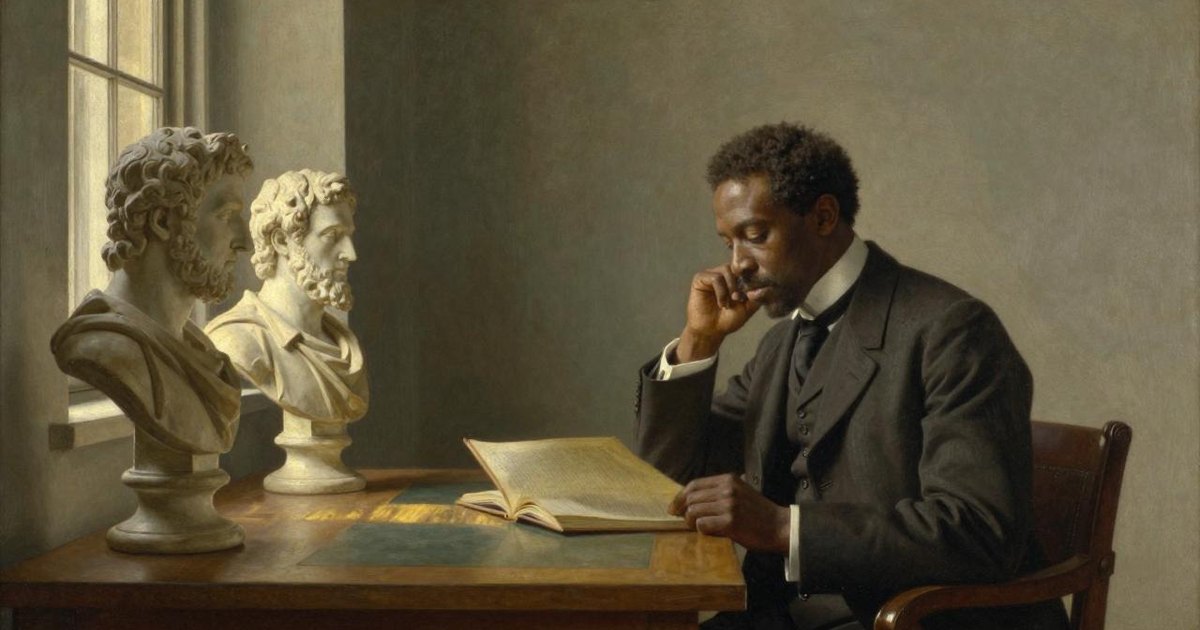
In 1903, in a country that segregated its railway cars by law, W. E. B. Du Bois ended a chapter of The Souls of Black Folk with a sentence that has been quoted ever since: "I sit with Shakespeare and he winces not." The question that sentence still forces is plain. Should we still read the classics, and whose classics are they? The answer argued here cuts the question in two. The canon as a closed, ranked list deserves to lose. The classics as a conversation anyone can enter deserve to survive, though that conversation still owes a debt it has not paid.
The terms need fixing first. A canon, in the sense under attack, is a ranked list of works presented as the measure of human achievement. The classics, in the sense worth keeping, are the books later readers keep arguing with. Much of the quarrel comes from treating these as one thing.
The case against the canon has to be met at its strongest, because it is an argument with serious authors and a long memory. The people who make it best were often formed by old books and know exactly what those books did to them.
The present gives the question weight. According to the American Academy of Arts and Sciences, the humanities accounted for 8.1 percent of American bachelor's degrees in 2025, down from 13.1 percent in 2012, the smallest share since 1987 (Humanities Indicators). In 2024 Rose Horowitch reported in The Atlantic that professors at elite colleges find students overwhelmed by the reading load (Education Next). Some students now meet Homer only through a summary that hands them the plot and spares them the poem. Meanwhile the old lists remain a political quarrel. If the canon is going to be defended, it has to be defended against people who stopped reading it for reasons.
Part II: Who built the canon, and for whom?
Start with the most famous definition of what the classics are for. In the Preface to Culture and Anarchy (1869), Matthew Arnold described culture as "a pursuit of our total perfection by means of getting to know, on all the matters which most concern us, the best which has been thought and said in the world." The phrase became a slogan for a century of syllabi.
Culture and Anarchy offers no list. The phrase describes an activity, and the sentence runs past the slogan: knowing the best was meant to turn "a stream of fresh and free thought upon our stock notions and habits." Arnold divided English society into Barbarians (the aristocracy), Philistines (the middle class) and the Populace, and he aimed his sharpest criticism at the Philistines, the class he himself came from. A fair reader has to grant that Arnold meant culture to unsettle the comfortable.
Yet the critics have a point that Arnold's generosity does not cancel. Someone has to decide what counts as "the best," and in practice the deciders were men of one class, one region and one set of languages, educated at a handful of institutions. "In the world" turned out to mean, mostly, Europe. In the History of Ideas, this is a familiar slide: a method hardened into an inventory, and the inventory looked very much like the library of the people who drew it up.
That hardening is the real target. A reading list compiled by a narrow group will reflect that group's sense of what matters. Once the list is presented as universal, the group's taste is laundered into humanity's judgment. Nobody serious claims Shakespeare is bad. The charge is that a curriculum which treats one tradition as the measure of all others teaches students to mistake a local inheritance for the human one, and to see everyone outside it as a footnote or an exotic elective.
Part III: What is the strongest case for leaving it behind?
The strongest version of this case was made by the Kenyan novelist Ngũgĩ wa Thiong'o in Decolonising the Mind (1986). Ngũgĩ described a colonial schooling in which children were punished for speaking Gikuyu, his mother tongue, while English literature was held up as the summit of expression. The arrangement did more than teach a language. It taught children that their own language was fit for the playground and the village, and that serious thought happened somewhere else, in someone else's words.
For Ngũgĩ, literature was never neutral cargo. A language carries a culture's memory and its picture of the world, and a schooling that elevates one language's literature while shaming another's colonizes the imagination as surely as soldiers colonize land. The book opens with a statement announcing that he would no longer write his fiction and drama in English. It is hard to imagine a costlier way to make an argument: a celebrated English-language novelist walking away from his own readership.
The case reaches well beyond Kenya. A curriculum has finite hours. Every semester spent on Paradise Lost is a semester not spent on something else, and the something else is usually the literature of the people the canon was built to impress or to rule. Every Milton read is a Gikuyu novel unread. The scarcity is real, and defenders who talk as if adding books costs nothing are not taking it seriously.
There is a quieter version of the steelman, and it bears on the present. If students arrive unable to finish long books, the rhetoric of "the best which has been thought and said" may do harm. It tells a nineteen-year-old from a family with no shelf of classics that the real conversation happened among people unlike her, in a register she cannot yet hear. Better, the argument runs, to teach her to read deeply in work that speaks to her, and let the old masters wait.
The steelman is formidable. The canon was assembled by a class, it passed that class's tradition off as humanity's, it was used in colonial schools to shame children out of their own languages, and it occupies hours that could go to the voices it excluded. A defender who answers only by praising Shakespeare's verse, as if Art & Beauty settled questions of power, has not answered at all. The question is whether any reply grants all of this and still finds something left.
Part IV: Why did Du Bois, Douglass and Morrison reach for it anyway?
Go back to Du Bois, and read the chapter as well as the quotation. Chapter VI, "Of the Training of Black Men," argues against the view that Black Americans should be trained mainly for industrial work. Du Bois insisted that Black students had as much claim to liberal learning as anyone, and that a people denied it would be denied leaders. The famous passage is the chapter's last movement (Project Gutenberg).
"Across the color line I move arm in arm with Balzac and Dumas," he wrote, and then: "I summon Aristotle and Aurelius and what soul I will, and they come all graciously with no scorn nor condescension." The dead were more hospitable than the living. The books admitted him where the society around them would not. Then comes the line that turns consolation into accusation: "Is this the life you grudge us, O knightly America?"
Here is the first objection, and it is strong. Du Bois experienced the canon as a commons that his oppressors were trying to fence. The people who denied Black students Aristotle were hoarding something they knew was valuable. If the canon were merely a class's self-portrait, there would have been nothing worth grudging.
Frederick Douglass makes the same point from a harder place. In chapter VI of his Narrative (1845), he overheard Hugh Auld, the Baltimore master he had been sent to serve, forbid his wife to keep teaching the boy, warning that reading would forever unfit him to be a slave. Douglass drew the lesson Auld feared: "From that moment, I understood the pathway from slavery to freedom" (Project Gutenberg).
At about twelve he got hold of The Columbian Orator, a schoolbook of speeches that included a dialogue in which an enslaved man argues his master into freeing him, and a speech by Sheridan on Catholic emancipation. The canon Douglass seized was already an argument about freedom. The speeches "gave tongue to interesting thoughts of my own soul, which had frequently flashed through my mind, and died away for want of utterance." Old rhetoric gave him words for what he already knew. "The more I read," he added, "the more I was led to abhor and detest my enslavers."
Chapter VII records the price. Reading showed him his condition without showing him a way out, and he came to envy fellow slaves who did not know what he now knew. The books gave him the words and the wound together. That cost is the best evidence the books were his and no longer his masters'. A text that only flattered its owners could not have hurt him like that.
This is the objection's core. The value of the classics never belonged to their gatekeepers. Arnold's class did not own Cicero any more than a slaveholder owned the logic of a dialogue in a schoolbook. Mary Shelley's creature reads Paradise Lost as a history, finds himself in Adam, and then decides Satan fits him better. Great books are dangerous in this way. They do not stay loyal.
A caution belongs here, and the essay should take it against itself. Writing in Aeon in July 2026, Takeshi Morisato discussed Tommy Curry's warning that the academy absorbs Black thinkers by softening them, turning Du Bois into a "Black Hegel" who confirms the Western tradition (The taming of Black thought). Using Du Bois as a mascot for the canon would commit that error. His passage is defiant. He claims the books as a right and indicts a nation for withholding them. He also wrote of the double vision the color line forced on him, which he counted as both gift and burden.
Toni Morrison took the argument a step further in her 1988 Tanner Lecture at the University of Michigan, "Unspeakable Things Unspoken: The Afro-American Presence in American Literature." She refused both sides as usually staged. She did not want the American canon abolished, and she did not want it worshipped. She argued that its classic works should be reread for the Black presence they press down and leave unnamed, with Moby-Dick as a central example. Cutting Melville would destroy the record that shows what American literature could not bring itself to say. Read against itself, the canon becomes testimony.
The case, worked through
Steelman: The canon was gatekeeping. Arnold's "best" was chosen by one class from one tradition, and the list passed that taste off as humanity's.
Steelman: The literature colonizes. Ngũgĩ showed colonial schooling using English literature to shame children out of their own languages, and every hour on Milton is an hour taken from literature in those languages.
Objection: Du Bois and Douglass seized it. Readers the canon was never built for claimed it as a commons and turned it against their oppressors.
Objection: Morrison read it against itself. The old books, reread for what they suppress, become evidence against the society that ranked them.
Outcome: Split. The ranking falls and the books stay. Ngũgĩ's language argument is not answered.
Part V: What survives the objection?
The verdict runs through the middle of the word "canon." If the canon means a fixed list of approved works, ranked by a narrow group, the steelman wins. Douglass's genius does not refute Ngũgĩ's account of colonial schooling. A system that works only for the rare child who can seize it is still a bad system.
The objection also leaves Ngũgĩ's deepest point standing. Du Bois, Douglass and Morrison answer the gatekeeping charge. They seized English and turned it. None of them answers the child shamed out of Gikuyu, because none of them was asked to give up a mother tongue to enter the library. On that point the defenders of the classics have nothing to say yet, and the conversation they praise still runs mostly in colonial languages.
If the classics mean a long conversation about justice and power, carried on across centuries by people who read each other and talked back, the objection holds. Du Bois and Douglass entered that conversation and changed it. A tradition that Douglass could argue with and Morrison could cross-examine is not a monument to one class but a resource for whoever shows up.
The real disagreement is narrower than the culture war suggests. It is whether a school can keep the old books without keeping their ranking, given finite hours and the prestige that clings to certain titles. I feel the pull of the steelman here and resist it in one place only. Keeping the books has a cost, and it should be named. Paradise Lost would lose its place as the required summit of a literature course and become one assigned voice among several, read beside work in other languages and in translation. Some familiar titles would drop to optional. Students who never read Shakespeare still inherit his assumptions secondhand, through phrases and films, and lose only the means to question him.
The quiet drift away from long reading sharpens the stakes. A summary of Paradise Lost cannot be argued with the way Douglass argued with The Columbian Orator.
Du Bois's sentence makes a claim on the canon against its gatekeepers. He sat with Shakespeare because he had a right to. The books, he wrote, let him dwell above the Veil. The country kept him behind it, and he thought the company in the library was better than the country outside.
Further Reading