The Gaze That Colonizes
Fanon described how identity gets formed under the eyes of others. The camera is now the eye, and it learned to look in the colonies first.
In 1952, a twenty-seven-year-old psychiatrist published his first book in Paris, and began it with a declaration of almost unbearable modesty. He did not come, he said, to offer the world new styles or manners. There was, he wrote, no mission to reveal his people to the world. The mission was to show, to his brothers, the mechanism by which they had been made. Only afterward, maybe, could something like a humanism begin.
The book was Black Skin, White Masks, and the author was Frantz Fanon, born in Fort-de-France, Martinique, in 1925, educated in France, a veteran of the Free French forces, a Black man in Paris finishing his medical training in a country that had just fought a war against the master-race theories of its occupiers while running an empire on a version of the same theories. The book sold poorly at first and was ignored, and then it wasn't, and it has since become one of the most quoted works of the twentieth century, foundational to postcolonial studies, to critical race theory, to psychiatry's social turn, to half the reading lists of the last seventy years. The ignorance of its initial reception was fitting. The book is about, among other things, what happens to a person under a gaze that does not see them, and France, in 1952, did not see him.
Fanon's subject was the psychology of colonization, approached from inside his training and his skin at once. Not the economics of empire, though he knew that literature cold. Not its armies or its administrations. The interior work: what colonialism does to the soul of the colonized, and what it does to the colonizer's soul, and what it does between them, in the interval where looking happens. The book's method is clinical, autobiographical, polemical, and philosophical in alternating paragraphs, and its center of gravity is a scene that takes up a few pages and contains the experience of entire continents.
The scene is famous and worth retelling exactly, because all of the machinery can be seen in it, turning. A child on a street in France sees Fanon coming. The child says to its mother, look, a Negro. The child is frightened, or fascinated, or both. And Fanon, in that instant, undergoes what he calls being fixed, sealed into an object, over-determined from without. The phenomenology, as he walks the remaining meters of that street, is the thing itself. He feels his body seize up, lose its ordinary transparency, the taken-for-grantedness with which a person carries their limbs through the world. He becomes, under the child's look, a assemblage of myth and threat assembled by someone else's history. He did not choose it, cannot argue with a five-year-old, cannot appeal. The look itself is the verdict. He counts, in those pages, the historical baggage that arrives in his body in that moment: cannibalism, intellectual deficiency, fetishism, racial defects, the jungle, the blues, Josephine Baker. A man of medicine, a veteran, a philosopher in the middle of a European city, reduced in one look to a pageant of other people's stories about what his skin contains.
His analysis of the mechanism follows, and it has three components that will concern us here, because all three have been rebuilt, at industrial scale, in the decades since he described them by hand.
Part I: The three gears
The first gear is objectification under the gaze. Fanon drew on the psychoanalysis he had trained in, and on Hegel as filtered through the Paris lectures of Alexandre Kojeve, which he attended or absorbed through the atmosphere of Lyon, where the master-slave dialectic was the talk of the cafe tables. The idea, stripped to its chassis: self-consciousness is formed through recognition. You become yourself through the recognizing look of another self. But recognition can be withheld, or perverted. The slave's consciousness is shaped by the master's seeing him as a thing. The colonized subject's consciousness is shaped by the colonizer's seeing him as a category. The gaze is not a metaphor. It is a manufacturing process. Identity, the very structure of self-experience, is assembled under the eyes of whoever holds the power to look first.
Hegel's slave could, in principle, reverse the relation, struggle, force recognition. Fanon's colonized subject faces something more viscous, and his name for it is the epidermalization of inferiority. The colonial gaze fixes its judgment not in law or even primarily in language but in skin. The inferiority is projected onto the surface of the body, where it can be read, by anyone, at any distance, without consent or introduction. You do not have to lose the master's eye to be re-enchained; every eye on the street is a recruiting station. The child was not the master. The child was a relay.
The second gear is sociogeny: the claim, revolutionary inside psychiatric training at the time, that mental disorder among the colonized is not a malfunction of individual psychic machinery but the logical output of a social arrangement. Fanon's word for the work psychiatry had been doing was a gentle demolition: if you examine the "pathologies" of Black patients in colonial societies, he argued, you find not damaged individuals but perfectly intact responses to a genuinely insane situation. The neurosis is in the relation, not the nervous system. Psychiatry that treats the individual without touching the arrangement merely certifies the arrangement. He would spend the rest of his short life building psychiatric practice on that premise, first in France, and then, fatefully, in Algeria.
The third gear is the zone of nonbeing. Fanon describes the colonized subject's world as divided by a line, with being on one side of it and the zone of nonbeing below, a region of extraordinary noncreation, of unreality, where the person subjected to the gaze is held in a condition of never having fully arrived at existence. The Black man, he writes, is not. The white man is. The work of colonized existence is conducted from below the line, in an effort to become, toward a being that is perpetually deferred and can never be reached by imitation, because imitation confirms the standard it imitates.
From these gears the famous and most misread element of the book descends: the masks. The title's white masks are the array of compensations the colonized subject constructs in the effort to cross the line. Speaking the colonizer's language to perfection, in Fanon's clinical attention, is not vanity but strategy, an attempt to be recognized as consciousness rather than category. Marrying white, adopting the culture, acquiring the credentials, whitening the dreams: the masks are attempts to be seen as being. That is the tragedy he catalogs, and his critique is aimed not at the mask-wearers, whose logic he honors as rational under the circumstances, but at the circumstances. And his solution, in the last lines of the book, one of the most beautiful passages in twentieth-century prose, is a plea to his brothers to reject the corrupt reciprocity of colonial regard entirely, to refuse both the role of beast and the role of the assimilated subject, and to aim at something beyond masks altogether: O my body, make of me always a man who questions.
The book ends with that prayer. The century, however, had barely started with him.
Part II: The making of the man who wrote it
The arc of the rest of his life compresses the entire history of decolonization, and the compression matters for what comes next.
Fanon left France in 1953 for Algeria, taking a post at the Blida-Joinville psychiatric hospital outside Algiers, the largest in North Africa. Algeria in 1954 erupted into the war of independence against France, one of the century's most brutal anticolonial struggles, notable for the systematic use of torture by the French army, a fact admitted then and litigated since. Fanon, the head of a ward in the colonial psychiatric service, found himself treating Algerian patients whose torturers' uniforms hung in his own institutional closets, and French policemen whose nightmares were breaking them down, torturer and tortured arriving through the same doors, his clinical notes becoming testimony to the psychic economy of empire, which he documented in essays that read like dispatches from the interior of a century.
He resigned his post in 1956, in a letter of searing clarity, stating his inability to continue in good conscience serving French psychiatry in Algeria while the French state was engaged in the subjugation of the people around him. He joined the FLN, the Algerian independence front, as its foremost international propagandist, based in Tunis, traveling to Accra and Monrovia and Geneva, writing for the revolution, editing its paper, and receiving on its behalf the ambassadors and pressmen of the world. He was appointed ambassador to Ghana and never took the post, owing to the diagnosis of leukemia, the disease that had killed his father, which was now in his blood. He dictated his final work, The Wretched of the Earth, in roughly ten weeks, under that sentence, to his wife Marie-Josephe, the book an atlas of decolonization and its torments, including its most argued-about chapters on violence, catharsis, and the national consciousness, published in 1961 with a preface by Jean-Paul Sartre that outshouted the book for a generation and left Fanon himself dismayed at its ferocity. He sought treatment in the Soviet Union and then the United States, the CIA at the edges of the story, and died in Bethesda, Maryland, in December 1961, at thirty-six. His body was flown to Tunisia and then buried in Algeria, in a martyrs' cemetery, with the honors of the state he never lived to see.
Thirty-six years. Two of the century's most important books, a psychiatric practice rebuilt around the proposition that madness is often sanity's response to an insane arrangement, a place in the canon that keeps growing, and a contested legacy that his heirs and critics still fight over in the seminar rooms and, lately, on the screens, because everything he described about the gaze has been rebuilt, at planetary scale, and the question of what he would make of the rebuilding is live.
Part III: The gaze, automated
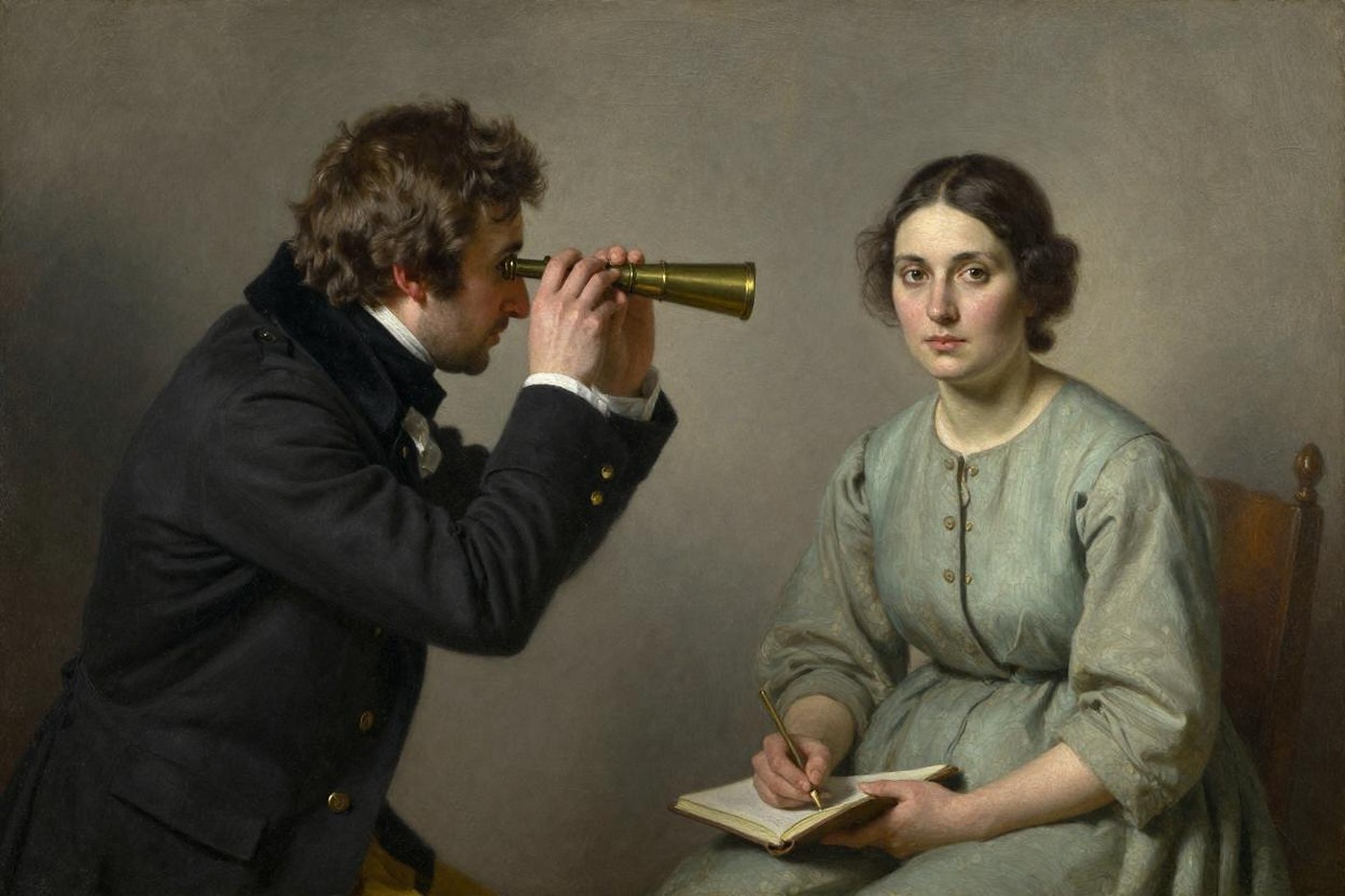
Fanon's gaze was a child's eyes on a street, encoding centuries of mythology into one look, instantly, involuntarily. The system has been upgraded, and the upgrade consists in making the look constant.
Consider the camera. Facial recognition systems classify faces by comparing them to training corpora, and the corpora, for most of the technology's history, were overwhelmingly populated by faces that the labelers, coders, and procurement officers had on hand, which were not Fanon's faces. The results were documented across a decade of audits: error rates for darker-skinned faces substantially higher than for lighter ones, in some evaluations by an order of magnitude, with the errors concentrated in the misclassification of Black women, the least represented intersection in the training data and thus the least legible to the system's inherited idea of a face. The gaze that Fanon described fixed the colonized person into a category by mythology. The computational gaze does it by corpus. In both cases, the outcome is the same: some people are seen with resolution, in full personhood, and some people are seen as noise, and the difference is inherited from whoever assembled the looking.
The subsequent deployments are not hypothetical. Predictive policing systems in the United States and Britain were found, in the years of their adoption, to concentrate patrols in the neighborhoods already over-policed, and to report, as a discovery of the algorithm, the patrol patterns the police already had, laundering history's judgment through a mathematics that looked neutral and was not. Facial recognition gates, in recent years, held the doors of London housing estates. Face recognition supplied or proposed for exam proctoring software, in the pandemic years, flagged students as suspicious for behavior with documented skin-tone correlates. Every one of these systems was introduced with the grammar of objectivity, the assurance that the machine's judgments are mathematical, colorblind, and consistent, which, as Fanon would have noted immediately, is precisely the grammar of the civilizing mission, whose subjects were also promised neutrality, science, and improvement by an empire that was authoring their inferiority while promising to cure it. The claim of neutrality, issued by the inheritor of a biased archive, is not a corrective. It is the archive's amplifier, now fitted with a progress bar.
Sociogeny has been automated too, with the social media feed reproducing Fanon's second gear at increasing resolution. The colonial gaze offered the colonized subject a set of prefabricated scripts: the good native, the exotic, the loyal subject, the dangerous one. The feed's personalization offers scripts to everyone, with the important refinement that the subject now writes in them. But the underlying structure is Fanon's: you are recognized, in the attention economy, only insofar as you perform one of the enumerable types the system can model, and the type precedes you. The rage-jockey, the outrage performer, the strong Black voice, the model minority, the tradwife, the girlboss, the oppositional intellectual: the feed does not meet you. It meets its prior, and pays you, in engagement, for resembling it. Zone of nonbeing, in the contemporary idiom: the asymptote of going viral. Being seen by everyone, since one is visible only through the mask, never arrives at being. Reach is the record label, not the recognition.
As for the epidermalization, the machine's version is flawless and without malice, and those qualities, in combination, are the danger. A committee of colonizers had to actively hate and legislate. The camera gate merely rejects, with indifference, the faces it was not trained on, and the rejection inherits all the force of a technical standard. What Fanon called objectification under the gaze is achieved, in the current dispensation, without a gazing subject at all, with no one behind the look, distributed and deniable, the final decolonization of responsibility for the colonial function itself.
Part IV: The refusal, and its descendants
The objections come from Fanon's own heirs, and they are strong, and the strongest are not from the people you might expect.
The first is textual and interior. Black Skin, White Masks is not a perfect book, and its imperfections are the live edge of forty years of commentary. Its chapters on Black women and white partners, psychoanalytically read as pathology, have been dismantled by feminist scholars, who note that Fanon granted women little interiority beyond their relations to men, that his treatment of homosexuality, briefly, is inherited Catholic prejudice wearing clinical vocabulary, and that the women of Martinique and Senegal whose lives he anatomized were not consulted about the diagnosis. His universalism, the book's final turn toward a humanism beyond race, has been attacked from one flank as naive and from the other as a betrayal of the race-conscious analysis the book built. He is the most cited and least settled figure in his field, which is what a founder looks like when the founding is still metabolizing.
The second objection is aimed at the automation argument and must be stated at full strength. The machines do not hate. A prejudiced police officer with a discretionary badge represents a will, a liability, an accountable actor; a biased classifier can be audited, corrected, retrained, retired, and a technology fixed in its inputs is correctable in a way a soul is not. It is, the objection runs, precisely because the gaze is now mechanical that its damage is tractable. Face recognition, unlike a colonizer, does not need to be overthrown. It needs to be regulated, trained on balanced corpora, excluded from the domains, housing, policing, hiring, where its failures fall on already-burdened people, and where its failures fall on the powerful, which is rarely, held to liability. Some of this has happened. Cities banned the technology, unbidden by any revolution. Corporations folded research teams and paused sales. On this reading, Fanon provides the diagnostic vocabulary, but his despair, and his violence, belong to a century in which the gazes could not be audited.
The reply to the objection is in Fanon himself, in the passage where the sociogenic principle meets the colonizer's melancholia. It was not only the colonized whose psyche the empire deformed, his clinical writing insisted. The torturers he treated in Blida were casualties of the looking too, their nightmares a kind of psychic bill presented for payment. Colonization, the colonizer's own sciences and the colonizer's own revolutions were supposed to agree, poisons everyone inside it. And the contemporary extension is available to anyone who checks the diagnostics: the audience subject to the feed's prefabricated types is everyone, the corpus everyone, the epidermalized categories those of color, gender, age, and anxiety, and the machine's idea of a default person is being stamped, at scale, on all of its subjects, including, with exquisite poetry, the descendants of the people who assembled it. Empires, running on coal, collapsed their workers' lungs along with their subjects' sovereignty. The computational empire, running on attention, atomizes the gaze-bearers along with the gaze-receivers. The masters, this time, are in the training set.
So the essay arrives where the book did, at the prayer.
Fanon did not ask to be seen correctly. That is the misreading to refuse, and it is the most tempting one, because it slots the book into the language of representation, visibility, inclusion, and that language is much of what is available. Fanon's request, the closing line, and the entire career, was the opposite: to be released from the jurisdiction of the look altogether, into a form of being where the self does not have to assemble itself under any eye at all, not the colonizer's, not the child's, not the machine's. The gaze that colonizes builds its subject and its object at once, fixes the fixer, trains the trainer. The body was never the problem. The line was, and is, under the camera, freshly drawn at every frame rate.
O my body, make of me always a man who questions. The line was written in Marseille, dictated into the century, and the century has delivered its answer in the form of a planet carpeted in looking, wire to wire, engine to eye, question to verdict, and the question still opens and closes. Fixed in the machine's estimate, sealed into its object, every subject reading this carries the look somewhere, wearer or received or both, and the mechanism runs on, feeding on attention and feeding it, and the prayer of the dying psychiatrist of Blida, who diagnosed the century's eye thirty years before the eye was built, is still the only exit on record:
to refuse the identity issued with the image, and, inside whatever body history assigned, to keep becoming the one who questions, past the mastery of looking, on the far side of masks, where no one has ever been yet.
Related topic: Identity & Self.
Further Reading