Archive / Identity & Self
The Numbered Self
Zamyatin's We imagined a state that abolishes privacy by decree. The quantified-self movement volunteers the same thing.
Identity & Self · 6 min read
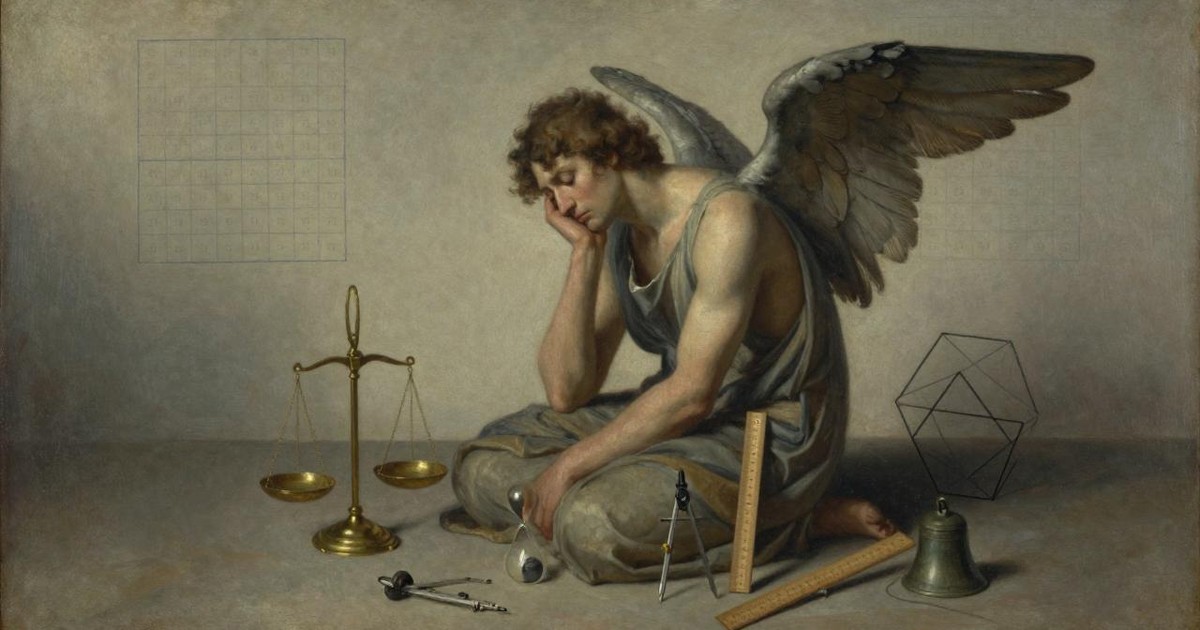
In 1921, Yevgeny Zamyatin finished a novel about a society that had solved happiness. It was written in Russian, banned in its home country, smuggled abroad, and published first in English, becoming the ancestor of every dystopia you've ever been assigned in school. Huxley borrowed from it. Orwell read it and then denied having read it. The book is We, and the strange thing about it, a century later, is that its nightmare reads less like a warning every year and more like a product launch.
The novel's setting is the OneState, a civilization enclosed inside a Green Wall, thousands of years after a war that ended history. Nature has been conquered. Desire has been engineered out of biology. The citizens, called Numbers, are ruled not by a man but by arithmetic: the Table of Hours prescribes every minute of every day, from waking to chewing (the chewing is numbered, one hundred chews per bite, for optimal efficiency) to sleeping.
The protagonist, D-503, is a mathematician building a spaceship called the Integral, whose mission is to export happiness to other planets, whether they want it or not. D-503 loves the OneState sincerely, the way you might love a bank account that always balances. His faith in the equation is total. And then he develops, to his horror, something the state calls a soul, an irrational, unmeasurable surplus that refuses to resolve into numbers.
It's worth dwelling on why Zamyatin made his hero a mathematician, and on the strange passage at the center of the novel.
D-503, musing on the foundations of his world, reflects that the ancients managed to square roots because their minds weren't yet developed. Numbers like −1, the imaginary unit, frightened and confused them. The rational mind prefers the rational. But irrational numbers, he observes, walk freely through the OneState, and Zamyatin allows him a flicker of pride in this: a sufficiently advanced civilization doesn't fear what can't be expressed as a fraction.
The irony is structural and deliberate. −1 is, on its face, a number that cannot exist, that cannot be measured on any ruler, and that turns out to be indispensable. The whole of modern physics, engineering, and signal processing rests on it. D-503 lives inside an edifice built out of the unmeasurable and spends the book terrified of his own equivalent: a feeling that won't reduce to a decimal.
Because that is what a soul is, in Zamyatin's algebra. Not a ghost, not a religious essence. Just the remainder. What's left over when everything expressible about a person has been counted. The OneState's final solution to this remainder, delivered by a medical procedure that removes the imagination outright, is not cruel by its own lights. It is simply rounding. Getting the books to balance by deleting the entry that won't divide.
Zamyatin wrote all of this in a country that had just abolished private life by decree. He had been a Bolshevik and then a heretic to it, and he understood the totalitarian dream from inside: not rule by terror primarily, but rule by completeness. The state's ambition was to leave nothing outside the ledger. In We, the last territory to conquer is inner life itself, the squirming irrational bit, and the state gets there by grading it out.
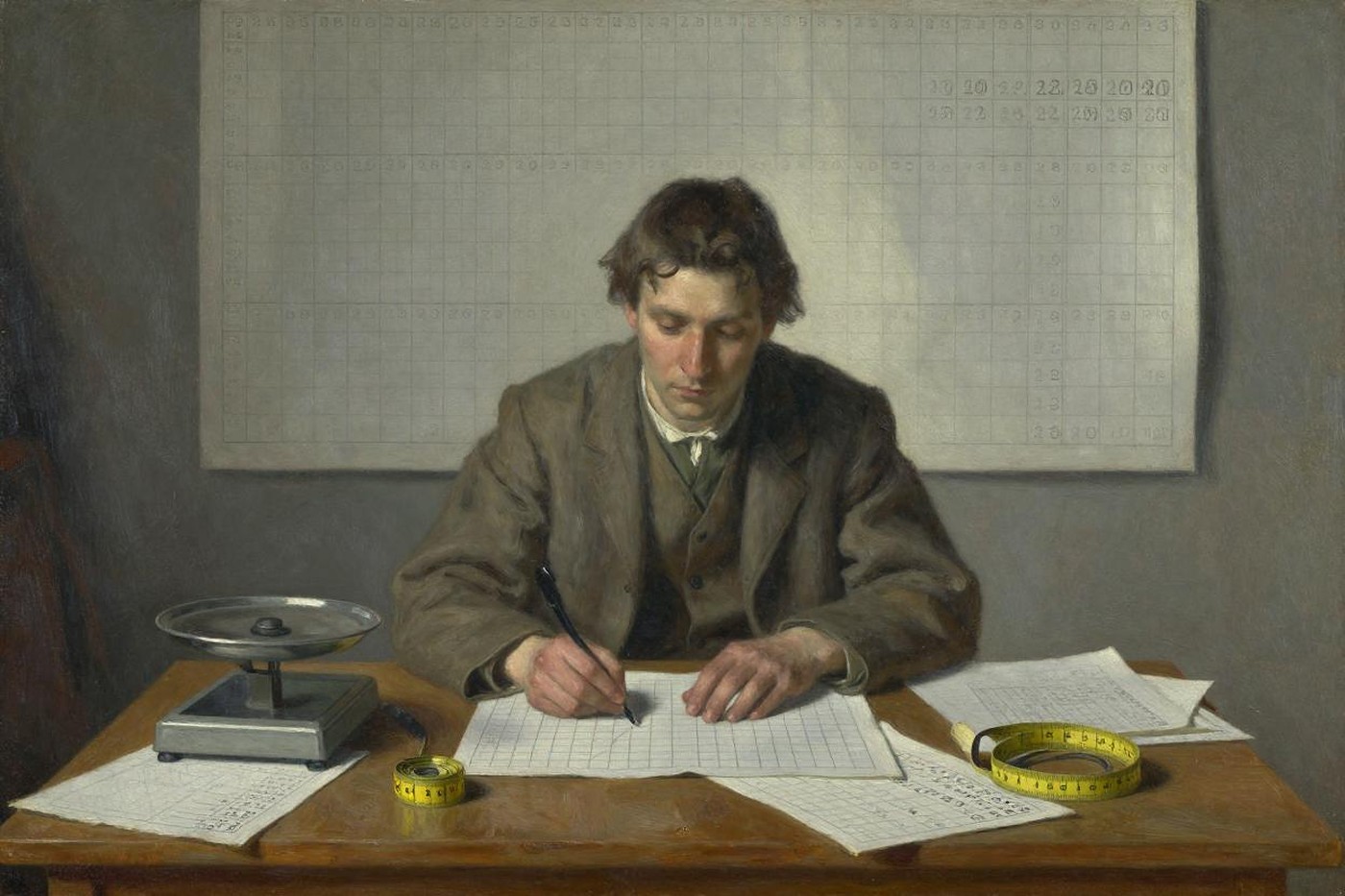
Now look at your wrist.
Somewhere in the past decade, a routine became available: a sensor suite that monitors your pulse continuously, grades your sleep nightly, counts your steps, tracks the intervals between your heartbeats to estimate your stress, and summarizes you, each morning, as a set of scores. The developers are sincere. The health claims are, in many cases, real. Sleep tracking has caught apnea early. Heart rate alerts have prompted people to see cardiologists before symptoms arrived. The technology is not the OneState, and pretending otherwise would be cheap.
But stand where D-503 stood and read the interface as an algebra exercise. What is being collected? Everything expressible: beats, breaths, steps, degrees of movement, percentages of deep sleep. And what is admitted into the record? Only that. The mood that resists a one-to-five scale, the thought you had walking to the store, the reason you woke at 3 a.m., the texture of the afternoon: none of it is on the graph, because none of it can be. Not because it's secret. Because it's irrational, in Zamyatin's exact sense. It doesn't divide cleanly.
The step count is honest, so far as it goes. The question the entire industry rests on is what happens to a person trained daily, for years, to read themselves in those terms. The Table of Hours prescribed sleep at twenty-two-thirty; the app merely nudges, gamifies, displays a soft-amber readiness score at six in the morning. But both systems share one metaphysical wager: that the counted portion of you is the portion that matters, and that the remainder is noise to be minimized, or optimized away, or, ideally, someday measured too.
That last step is the one worth watching. Every year the sensors claim more territory: HRV yesterday, blood oxygen today, glucose tomorrow, the talk about continuous brain sensing the year after. The trajectory is explicit and admitted in the marketing language: total visibility, closing the gaps, knowing your body completely. The Green Wall, in We, was built to keep out the wild forest and everything unmeasured about nature. The quantified-self project talks about building precisely such a wall around you, except inward, and calls it empowerment.
Here is the difference that matters most, and the reason this essay refuses to become a denunciation.
The citizens of the OneState had no choice. D-503 rises when the Table of Hours says rise because refusing is unintelligible; the idea of an unscheduled minute is approximately meaningful the way the idea of an unwritten number is meaningful. His consent is not a category the novel recognizes. The Operation that removes souls will be mandatory, because irrationality itself is scheduled for deletion.
The person wearing the tracker chose it. Paid for it. Reads the score voluntarily, and could stop tomorrow, throwing nothing away but a streak. Every ingredient of the OneState's arithmetic is present, and every instrument of coercion is absent, and no ministry is involved, and the entire arrangement fits comfortably inside a culture of wellness, self-knowledge, and care.
Zamyatin would want you to sit with that and refuse the easy way out of it. His novel's deepest suspicion wasn't aimed at any particular tyrant. It was aimed at the longing for finality, the wish to be finished, resolved, complete. D-503's tragedy is not that the state oppresses him; it's that he worships the state because the equation gives him peace. The blessing and horror of We is the same sentence: infinite happiness minus freedom. The Numbers aren't lying about being happy. They just paid for it with the remainder.
So the question the quantified life puts to you is not a policy question, not a legal one, not even really a privacy question, though it is dressed as one. It is the question D-503 spends the book avoiding, until a procedure makes the avoidance permanent: what do you do with the part of you that won't chart?
Maybe the answer is that you optimize it. That the remainder is just pre-metric data, waiting for a better sensor, and the person who sleeps an unbroken eight hours with a readiness score of 91 has lost nothing that was worth keeping. That stance is available, coherent, and defended daily by millions of satisfied users, and Zamyatin himself conceded the point obliquely: he gave D-503 genuine mathematical joy in the Integral. The counted life delivers real goods.
Or the answer is that some part of the ledger's charm is that it lets you mistake the counted self for the whole one, and that the ideal the devices advertise, a body completely known, completely legible, with no dark figures left in the margin, is not health. It's the Integral. A ship built with beautiful precision, bound for other worlds, carrying an advertisement for a happiness whose price tag was written in the one place no dashboard can reach.
Your watch is charging on the nightstand. It will have its report ready by morning.
Related topics: Identity & Self and Science & Technology. Part of the Then & Now series.
Further Reading
The Tyranny of “You Can”
Byung-Chul Han on the burnout society, where freedom itself becomes the boss.
Byung-Chul Han on the burnout society, where freedom itself becomes the boss.