Archive / Power & Politics
Two Ways to Read a Panopticon
Bentham designed a prison you police yourself inside. Foucault noticed you'd built one at home.
Power & Politics · 7 min read
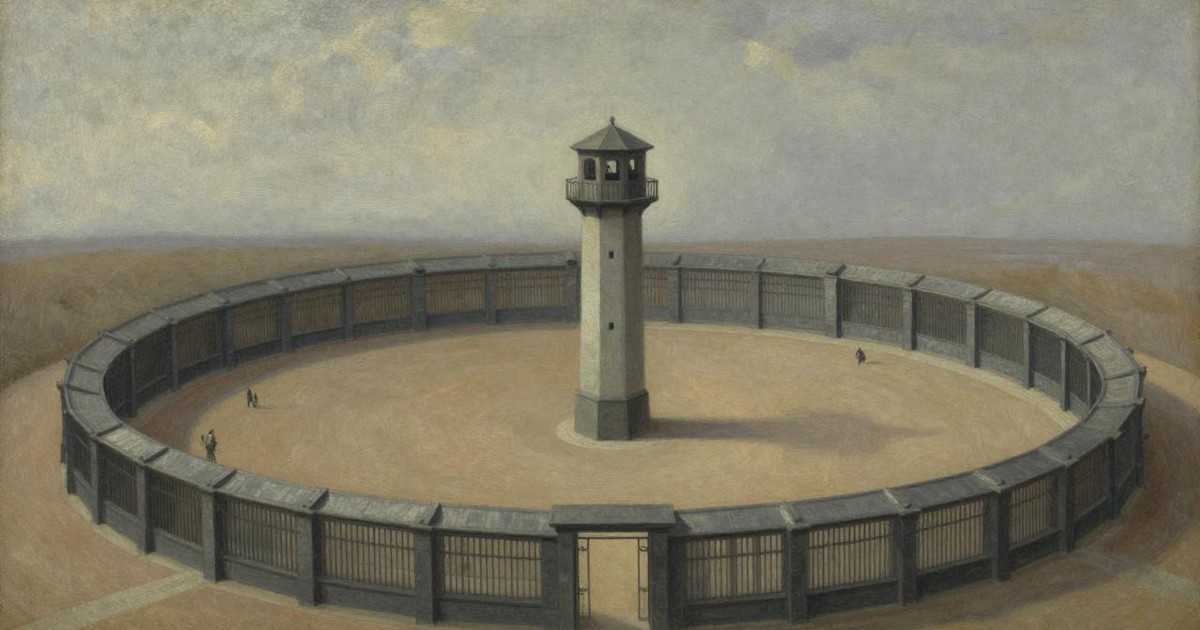
In 1785, Jeremy Bentham had a clever idea about prisons. His brother Samuel had been managing a workshop in Russia and had hit on a labor-saving arrangement: a central observation post from which a single supervisor could watch every worker without the workers knowing when they were being watched. Jeremy looked at this factory trick and saw something much bigger. He saw a way to run any institution (a school, a hospital, a factory, a prison) with almost no staff at all.
He called it the Panopticon, and he spent decades trying, unsuccessfully, to convince someone to build one.
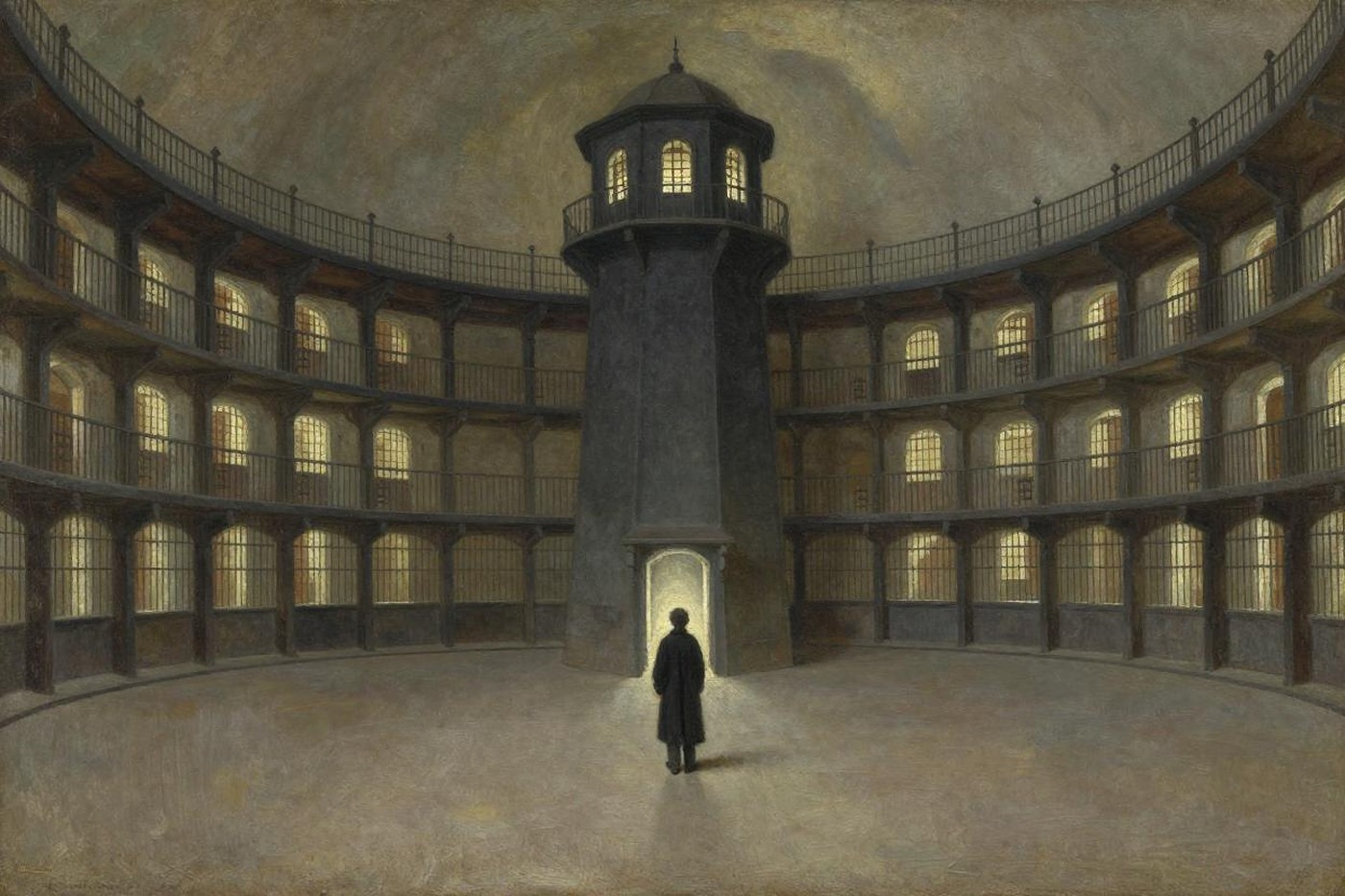
The design is simple enough to describe in a breath. A circular ring of cells wrapped around a central tower. Light pours through the cells from the outside, so anyone in the tower can see every occupant of every cell as a silhouette. But the tower's windows are shuttered and blinds angled so the occupants can never see in. They can never confirm whether anyone is watching at any given moment. They only know that anyone could be.
Bentham was delighted with the economics of this. One guard, in principle, could do the work of many, because the prisoners would discipline themselves. The inspector's possibility did the work the inspector's presence used to do. He described it as "a new mode of obtaining power of mind over mind" and pitched it with the cheerful pragmatism of a man selling a labor-saving device. Morals reformed, health preserved, industry invigorated. All at bargain infrastructure costs.
It's worth pausing on what Bentham did not claim. He didn't claim the prison would be full of cameras or spies. The genius was that it didn't need them. The mechanism that replaced the guard was internal. The prisoner looking at the shuttered tower eventually stops asking am I being watched? because the question is unanswerable, and starts acting on the safer assumption: always. The guard's job migrates into the prisoner's own head, and the prisoner pays the salary.
Bentham was a utilitarian reformer, genuinely. He opposed flogging, wanted prisoner education, argued against the pointlessness of purely punitive confinement. The Panopticon was, in his telling, a humane invention. No whips, no dungeons, no cruelty. Just architecture.
Nearly two hundred years later, Michel Foucault came across the design in the French National Library and read it the other way.
Foucault wasn't interested in Bentham the prison reformer. He was interested in the fact that the Panopticon seemed to explain things that hadn't happened yet. In Discipline and Punish (1975), he argued that the Panopticon was not a clever prison design that mostly never got built. It was a diagram of a whole new way power had learned to operate, one that had quietly spread out of the prison and into schools, barracks, factories, hospitals, and offices. He called it a "diagram of a power situation": less a blueprint for buildings than a template for a kind of power that works by visibility rather than force.
The old model, the one the Panopticon replaced, worked through spectacle. The public execution, the throne, the demonstration of overwhelming force in front of a crowd. It needed chains, crowds, and a stage. The new model works through surveillance: cheap, continuous, unverifiable observation. It needs a shuttered tower and an internalized audience. Power, Foucault argued, had discovered it was more efficient when it became invisible and made its subjects permanently visible instead.
Hence his famous, unsettling formulation: the Panopticon "automatizes and disindividualizes power." The tower doesn't need the king in it, or indeed anyone. The arrangement itself does the governing. And its real product isn't captured bodies but docile ones, people who have taken the watching inside and now regulate themselves without ever seeing a guard.
Two readings, then. Bentham reads his own invention as an efficiency win for humane institutions. Foucault reads it as the founding sketch of modern disciplinary society, in which we all occupy cells, and the tower stays dark, and it doesn't matter, because we behave as though lit anyway.
Where that leaves us is the question of whether either reading has an expiry date, and, more to the point, which of them better describes the room you're sitting in.
Consider the object most people spend roughly a third of their waking hours attending to.
The phone doesn't resemble a prison, and no one designed it as one. The guards aren't people. There's no tower with shuttered blinds. Instead, the machine logs, continuously, silently, and mostly invisibly, where you go, what you pause on, how long your thumb hovered, what you came back to, what you closed. Somewhere behind this, models assemble a portrait of your habits finer-grained than any prison register kept of any inmate Bentham imagined. The point is not that someone watches you in real time. Most of your minutes will never be looked at by a human being ever. The point is that the record exists, and the record can be consulted, and you don't know which moments will be.
Turn the Benthamite machinery over in your hands. Architecture replaces guards: the phone's structure, the timestamp, the session log, the engagement metric, is the building. Unverifiable observation: you can't check the log, and the log can't tell you it's logging. Self-discipline without supervision: nobody orders you to produce a steady stream of legible behavior. You volunteer it, at a pace and volume no nineteenth-century warden could have dreamed of monitoring, let alone one with a staff budget.
Foucault has been dead since 1984, and the tower he described now fits in a jacket pocket. Or rather (this is where the analogy begins to wobble) the tower isn't in your pocket. The cell is. You carry the cell everywhere and press it lovingly, dozens of times a day, of your own free will, because it also holds your photographs, your correspondence, your music, your maps, and the address of every restaurant you've ever wanted to try.
So which is the dominant fact? That the machinery of permanent, unverifiable observation is everywhere? Or that nobody compelled any of it? Bentham's prisoner had no choice about occupying his cell, and Foucault's subjects were placed under the gaze by institutions that owned the building. Neither described a world in which people line up overnight outside stores to buy the latest model of the observing apparatus.
Consider the plainest case, the one where the mechanics are easiest to inspect: self-tracking. Sleep scores, step counts, streaks, calories, resting heart rate, hours of screen time, weekly activity rings, badges for not breaking the chain. None of this is coercive in the ordinary sense. The health app has no authority over you. It issues report cards, not sentences.
But notice what the tools encourage you to become. A body that counts its steps has, in Foucault's terms, accepted the production of its own visibility. Better than visibility: legibility. You are invited to translate yourself into numbers, and then to govern yourself by them. Take the stairs because the ring isn't closed yet. Decline the invitation to stay out late because the sleep score will suffer and the morning app will display the judgment in red and amber. Correct your posture for the camera, your sleep hygiene for the sensor, your workouts for the record.
This is the part of Bentham's invention that would have surprised him most: that self-surveillance would arrive not as an imposition on prisoners but as an aspiration for consumers. Nobody demanded that the wearable make its way onto the market through legislation. Its adoption proceeded by desire, through marketing campaigns that never once used the words discipline, compliance, or register, preferring instead insight, optimization, achievement.
And consider the endpoint implied by even the most charitable reading of the marketing material. A person sleeps, and is graded. A person exercises, and is validated. A person fails to maintain a streak, and feels, in a quiet, unremarkable, unmistakable way, that someone is disappointed in them. Some tower-shaped absence behind the green checkmark that did or did not appear today.
But there is a counter-reading, and it deserves a fair hearing. Maybe the tower never has anyone in it at all. Maybe a sleep score is simply an instrument, like a thermometer, that takes a measurement without exercising coercion, and a person using it responsibly is no more disciplined by a shard of glass and silicon than they are by a bathroom mirror. Bentham's prisoner wanted out. A great many people who track their sleep would tell you, sincerely, that they feel better observed, steadier, more aware, more themselves, and that they'd rather not give the practice up. Whether that sounds like genuine flourishing or like the most successful prison ever built depends on which philosopher you're reading.
So, one more time, two readings.
Bentham's: an efficient, humane arrangement in which the burden of constant supervision is lifted from institutions and shared with, or quietly transferred to, the supervised, for their own good, at low cost, and with measurable benefits to health, order, and wellbeing.
Foucault's: a mechanism by which a population learns to watch itself, and to like it, and to call the watching by gentler names (insight, habit, achievement, streak), while the tower stands conveniently unstaffed, because it doesn't need staffing anymore.
The old question was whether anyone was in the tower. The question now, as your device prepares tonight's report on your day, which it will grade and which you will read before breakfast tomorrow, is which of those two sentences you'd use to describe the person reading it.
No conclusion is being handed to you. The cell lights are on. Have a look around
Related topic: Power & Politics. Part of the Then & Now series.
Further Reading
The Cage You’d Choose
La Boétie on voluntary servitude, and the cage that advertises itself as liberation.
La Boétie on voluntary servitude, and the cage that advertises itself as liberation.