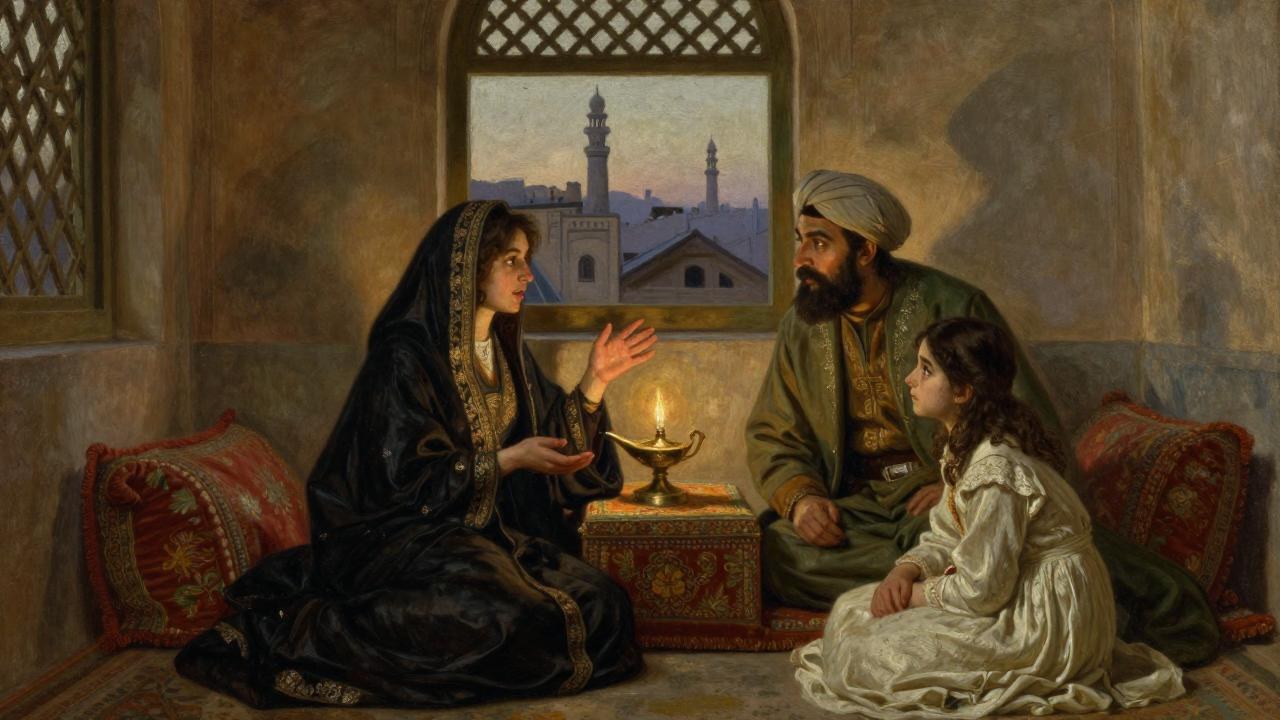
Can a story keep you alive? The Thousand and One Nights gives the oldest and clearest answer we have, and the answer is yes. A king named Shahriyar learns that his wife has betrayed him, has her put to death, and adopts a custom: he marries a young woman every night and has her killed in the morning. Shahrazad, the daughter of his chief minister, walks into this arrangement on purpose, armed with nothing but stories. Each night she stops before dawn, and each morning the king puts off the execution because he wants the rest. The harder question is what that kind of listening costs, and what it buys.
It costs sleep and attention. In her case it buys a human being. Shahrazad's suspense served a purpose beyond itself. It stopped a killing, and night by night it changed the man listening. In modern terms, she invented the retention machine and gave it its best defense. Every cliffhanger you have fallen for, every countdown before the next episode loads, runs on her design, and she built it for one urgent reason. Autoplay needs the same thing from you and offers more of itself in return. That difference gives you a fair question to bring to any serial story: what does the teller want from your staying? The Nights pass that test better than anything else in the form. Edward William Lane's English version, published in monthly parts from 1838 to 1841, passes too, with scars of its own.
Part II: What is Shahrazad's plan?
The Nights is a collection of stories gathered in Arabic over centuries, with roots in Persian, Indian and Arabic storytelling, and nearly every version opens with the same frame. Lane spells the principal names Shahriyár and Shahrazád, and his spellings remind you where you stand: in Victorian England, reading through a scholar with firm views about what an English reader should be given.
Shahriyar's response to his wife's betrayal is murder as policy. Lane puts it flatly and terribly: "thenceforth he made it his regular custom, every time that he took a virgin to his bed, to kill her at the expiration of the night." The book counts it out. Three years pass. Families flee with their daughters, until no young woman of marriageable age is left in the city, and the minister, ordered to find the king another bride, comes home afraid.
His elder daughter steps into that gap, and the text tells you what she brings. "She had collected together a thousand books of histories, relating to preceding generations and kings, and works of the poets." Her plan comes out of that library, and she announces it to her father with a resolve he cannot argue down: "By Allah, O my father, give me in marriage to this King: either I shall die, and be a ransom for one of the daughters of the Muslims, or I shall live, and be the cause of their deliverance from him." She counts the city's daughters before she counts her own odds.
Then comes the detail that shows her craft. Before the wedding she tells her younger sister, Dunyázád, exactly what to do, and why: "I will relate to thee a story that shall, if it be the will of God, be the means of procuring deliverance." On the wedding night, at the arranged moment, Dunyázád says the line the whole book hangs on: "By Allah! O my sister, relate to us a story to beguile the waking hour of our night." And Shahrazad answers with words that put the decision in the king's hands: "Most willingly, answered Shahrazád, if this virtuous King permit me."
Each move lowers the pressure. The request comes from the sister, so the king is granting a small favor to a guest instead of bargaining with his bride. Permission is asked of him, so his first act in the marriage is to allow something. And the story is offered to pass a sleepless hour, which makes yes the easiest answer in the world. None of it is improvised. She has married a killer and built him a door he can walk through.
Part III: Why does a story stopped at dawn work?
The plan works because of where she stops. Each night she breaks off before dawn with the outcome still hanging. The king has already decided her death, and he postpones it. Dawn was his deadline. She turns it into the point where the story pauses.
In 1927 the psychologist Bluma Zeigarnik reported that people remember interrupted tasks better than finished ones. A 2025 meta-analysis by Romain Ghibellini and Beat Meier found no general memory advantage for unfinished tasks. What it did find serves Shahrazad better anyway: a general tendency to go back and resume them. The king does not need to remember the tale in the morning. He needs to want the rest of it more than he wants his custom, and the break at dawn produces that want every night.
Look at what the design reverses. The morning, the executioner's hour, becomes the hour that binds him. If he wants the ending, he must pay for it with her life, one day at a time, and every payment weakens the habit that made the payments necessary. The sentence becomes a series of postponements, the postponements become attention, and the attention works on him.
That makes her suspense the strongest answer to the charge that suspense serves only itself. Here it exists to stop a killing, and the stopping has to be renewed every night, so the suspense does too. The frame also has a quieter and larger aim. In the ending most versions share, the king gives up his custom and spares her. Something happened to him over those nights besides appetite. She keeps him listening, the listening keeps him from killing, and months of that loop undo the rage he began with. The frame proposes that steady attention to another person's voice can heal a man, and it puts the mechanism in plain view.
Take the dawn breaks away and you have a bundle of good stories. Keep them and you have a count of nights, each one a life spared.
Part IV: What did Lane cut, and why does it matter?
Lane translated the Nights into careful English, with long scholarly notes on Arab customs, and he shaped the text to his own standards. He left out stories he judged improper, a filter you can weigh and partly forgive. His notes sometimes generalize harshly about Muslims, which a modern reader should notice and weigh against what the notes otherwise preserve.
His strangest decision is announced in the preface as a service to the reader: "To avoid the tedious interruptions which occur in the original at the close of each Night, I have divided the translation into chapters." Read that twice. Lane met the night breaks, the moments where Shahrazad stops and a life is extended, and filed them under tedium. He cut the device that kept her alive, from a book whose subject is staying alive by the clock.
To be fair to him, the breaks do interrupt. That is their job. Each one is a dawn survived and a promise renewed. Replace "Night" with "Chapter" and the threat disappears, and the promise becomes a bookmark. The reader gains comfort and loses the steady dread that makes the frame work. Lane's chapters suit a reader at a desk. The nights suit a woman counting mornings.
So the loss is real, and it is a loss of rhythm. Reading Lane, you have to put the breaks back yourself, picture the pause at each dawn and remember what each pause was worth. Few readers will. The book that reaches them is flatter than the one Lane was given, even after you credit him for making it easier to follow.
Part V: What does the listener pay, and what does he get?
The king pays in sleep, since every story takes the hours he would have slept. He pays in attention, the currency of the whole arrangement. And he pays in control, a little at a time, since a man who schedules his vengeance around someone else's plot is no longer entirely the author of his days. The repayment is the strangest bargain in literature. He is paid back with his own cure. The listening that costs him his authority returns him to himself, able to trust again, and the frame closes with his custom abandoned.
Compare the modern arrangement. YouTube turned on autoplay by default in 2015, so the next video starts before you ask for it. Netflix plays the next episode after a short countdown, and only in February 2020 did it let viewers stop the previews that play while they browse. The form is Shahrazad's: stop at the height of wanting, and resume before the wanting cools. Autoplay removes the one step the king always kept. Each morning, he chose to spare her. The countdown makes the choice for you.
That is why the frame story belongs at the head of any argument about serial entertainment. The Nights remain the best case for serial storytelling ever made, because they are the one case where the teller's need for your attention is her life, and the listener is repaid with his own repair. Every lesser cliffhanger borrows her urgency and owes you an account of itself. When the countdown starts, ask what the teller wants from your staying. If the answer is a life and a changed man, stay. If the answer is only your hour, the remote is in your hand, which is more than the king's brides ever had.
As for the edition, read Lane for his range and learning, and keep his preface beside you. His notes are documents of their age, and his chapters flattened a rhythm he mistook for an interruption. Pause where the Nights pause, and count each dawn as what it was in the story, a morning someone lived to see.
Questions readers ask
What is the story of Shahrazad?
King Shahriyar, after his wife's betrayal, marries a new bride each night and kills her in the morning. Shahrazad, his minister's daughter, marries him by choice and tells him a story each night, stopping before dawn so that he spares her to hear the rest. In the ending most versions share, he gives up his custom.
Why did Lane remove the nights?
In his preface Lane says he divided the translation into chapters "to avoid the tedious interruptions which occur in the original at the close of each Night." The result reads more smoothly and loses the cliffhangers that drive the frame story.
Is Lane's translation of The Thousand and One Nights complete?
No. Lane left out tales he considered improper, and his long notes reflect the views of a Victorian scholar.
What is The Thousand and One Nights about?
A frame story holds hundreds of tales: Shahrazad tells them night after night to a king who has vowed to kill each new wife at dawn. The tales were gathered in Arabic over centuries from Persian, Indian and Arabic storytelling.
Further Reading