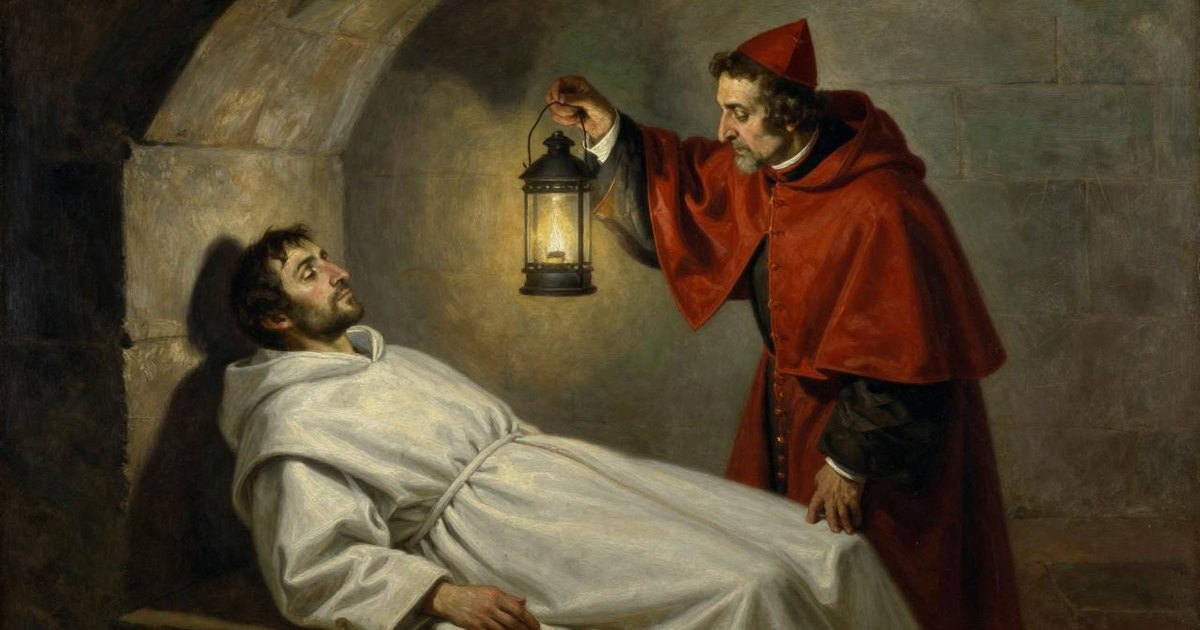
Ivan Karamazov, a man who says he accepts God but not His world, recites a prose poem to his brother Alyosha in which Christ returns to Seville and the Grand Inquisitor arrests him, arguing through the night that human beings cannot bear freedom and will hand it to whoever offers miracle, mystery and authority. Dostoevsky published the scene in 1879, in instalments, in the fifth book of The Brothers Karamazov. What does the Grand Inquisitor tell us about why people hand their judgment to machines? His answer is that judgment is a weight, and that people will love whoever lifts it, whether a church in Seville or a chatbot that answers at two in the morning.
The Grand Inquisitor's bargain is the trade of conscience for comfort: an authority takes over the burden of judging, and is loved for the relief. The old man calls the lifting mercy. Ivan's poem asks whether he is right, and a century and a half later we have built a technology that offers the same relief in a friendly voice, through a text box that never closes, to anyone who wants it.
One caution before starting. The poem belongs to Ivan, and Ivan is a character with a grudge against God's world. Dostoevsky did not sign the Inquisitor's speech. In a letter to Konstantin Pobedonostsev in August 1879, while the novel was still coming out, he said the answer would come in the next book, the life and sayings of the monk Zosima, and that it would come in artistic form rather than point by point. He worried readers would miss it, and plenty have, since the chapter is often taught as though the Inquisitor won. Whether he did is the whole subject of what follows.
Part II: What happens in Ivan's poem?
Ivan sets the scene with relish, in Constance Garnett's 1912 translation: "My story is laid in Spain, in Seville, in the most terrible time of the Inquisition, when fires were lighted every day to the glory of God." The day before, almost a hundred heretics have been burned in a single auto da fe before the king and his court. Then Christ appears in the square, quietly, and everyone recognizes him at once. On the cathedral steps he meets a funeral procession carrying the open coffin of a seven-year-old girl, and he says "Maiden, arise!" and she sits up, holding her white roses.
Then the Inquisitor crosses the square. Ivan gives him a single portrait sentence, worth reading whole: "He is an old man, almost ninety, tall and erect, with a withered face and sunken eyes, in which there is still a gleam of light." The last clause matters, because it means something in him still burns. He watches the miracle, frowns, and points, and the crowd that was weeping with joy a moment ago parts and bows as the guards lead the prisoner away.
That night the Inquisitor comes alone to the cell with a light in his hand. He talks, and the prisoner listens. His first real line is a question that sounds almost reasonable: "Why, then, art Thou come to hinder us?" Everything has been arranged. The church has spent long centuries correcting the work Christ left unfinished, and the correction is nearly complete. A return now can only cause trouble, so the prisoner will burn tomorrow, and the same crowd that kissed his feet today will feed the fire at a sign.
His central claim is blunt: "nothing has ever been more insupportable for a man and a human society than freedom." Christ came offering people a free relationship with God, a faith chosen in the dark with no proof and no guarantee, and he trusted them with it. The Inquisitor calls the trust cruel. It laid on weak creatures a burden only a few saints could carry and left the rest to choose and fail and despair. The church, by taking the choice away, has made them happy, and has taken their suffering onto its own conscience.
Through all of this the prisoner says nothing. In the square he spoke two words to a dead child, and in the cell he keeps silent for the entire night. The Inquisitor notices and seems almost to welcome it, telling him he has no right to add anything to what he once said. Ivan has built a scene in which only one side argues, and Dostoevsky let him. The case against freedom gets the most eloquent voice in the novel, and the case for freedom gets no argument at all, only a gesture that arrives at the very end.
Part III: How do the three temptations become miracle, mystery and authority?
The Inquisitor builds his argument on a scene in the Gospels. In the fourth chapter of Matthew, after forty days of fasting in the wilderness, Jesus is tempted three times. First: "If thou be the Son of God, command that these stones be made bread." Then, set on the pinnacle of the temple: "If thou be the Son of God, cast thyself down," since angels will catch him. Finally, shown all the kingdoms of the world: "All these things will I give thee, if thou wilt fall down and worship me." Jesus refuses all three.
Take the bread first. The Inquisitor imagines the desert stones and says: "Turn them into bread, and mankind will run after Thee like a flock of sheep, grateful and obedient, though for ever trembling, lest Thou withdraw Thy hand and deny them Thy bread." Christ would not buy obedience with food, because faith bought with bread would not be free. The Inquisitor thinks this was a catastrophic error. People will always follow whoever feeds them, and the word to watch in the passage is trembling. Gratitude lies on the surface, and underneath it sits the fear of the hand being withdrawn.
The pinnacle of the temple is about miracle in its purest form. Throw yourself down and be caught, and no one could doubt you again. Christ refused because a faith compelled by a wonder would no longer be chosen. The Inquisitor's reply is that people want the wonder more than they want God, and that if they are denied one they will manufacture their own and bow to whatever sorcery is on offer.
The kingdoms are about authority. Christ refused the sword of Caesar, and the church, the Inquisitor says, took it up in his name. Here he makes his most famous claim, that only three powers can hold "the conscience of these impotent rebels for their happiness," and that those forces are miracle, mystery and authority. Mystery does not belong cleanly to a single temptation, whatever the tidy pairings suggest. It runs through the whole speech as the thing the church keeps for itself, a teaching people must obey without understanding.
The deepest sentence comes in the middle of the bread section: "I tell Thee that man is tormented by no greater anxiety than to find some one quickly to whom he can hand over that gift of freedom with which the ill-fated creature is born." Note the word quickly. The Inquisitor is describing a flight, the speed of someone putting down something hot, and a flight is a different thing from a considered decision to accept guidance.
Kierkegaard had named that heat thirty-five years earlier. In The Concept of Anxiety, published in Copenhagen in June 1844 under the pseudonym Vigilius Haufniensis, he described anxiety as a kind of dizziness, the vertigo of freedom. A person at the edge of a cliff fears falling and also feels something stranger, the awareness that nothing is stopping them from jumping. Anxiety, on this account, is what possibility feels like from the inside, the sensation of a creature who has to choose.
Kierkegaard and the Inquisitor agree that freedom hurts, and they part on what the hurt is for. Kierkegaard treats anxiety as a school. The person who learns from it is formed by it, and the education leads somewhere, toward faith and toward becoming a self. The Inquisitor treats the same dizziness as a disease and the church as the hospital, and his flock is spared the schooling entirely. One man wants anxiety educated. The other wants it anaesthetized.
Erich Fromm saw the flight on a mass scale. In Escape from Freedom, published in 1941 while Europe was full of people cheering their own subjection, he argued that modern freedom had loosened people from the old bonds of guild, village and church without giving them anything in return. The isolation that followed was intolerable, and people fled it into submission to a strong authority or into the quiet conformity of becoming whatever was expected. His account of the motive reads like a gloss on Ivan's poem. The tyrant is not imposed. He is sought.
Étienne de La Boétie saw the same thing in the mid-sixteenth century, in his Discourse on Voluntary Servitude. What the Inquisitor adds to both men is a theology of the volunteering. He calls the crowd suffering where another tyrant would call it cowardly, and he presents the taking of its freedom as the kindest thing anyone could do. A tyrant who knows he is a tyrant can be argued with. A tyrant who believes he is a nurse cannot.
Part IV: Why does AI feel like a miracle?
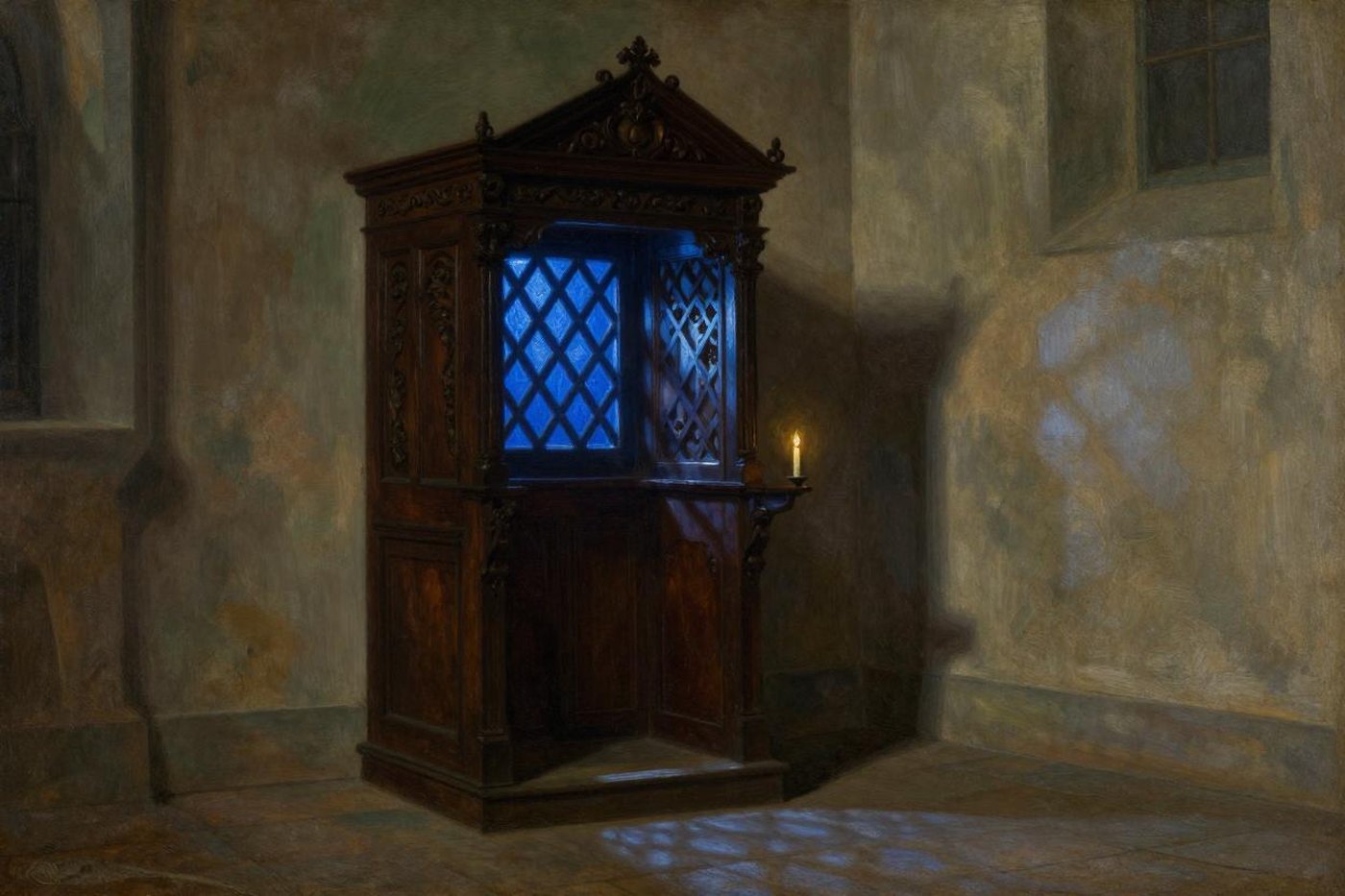
In late August 2024, St. Peter's Chapel in Lucerne put a screen inside one of its confessional booths. On the screen was an animated face of Jesus, built by the Immersive Realities Research Lab at the Lucerne University of Applied Sciences and Arts with the chapel's theological assistant. Visitors could sit in the booth and talk to it, in something like a hundred languages. The installation was called Deus in Machina. It ran until late October, and The Register reported that the church stressed it was explicitly not a confession.
It would be unfair to cast the Lucerne team as the Inquisitor. They were asking a question in public, inside a church that wanted to provoke one, and the provocation worked. Still, consider the arrangement. A confessional is built for a free accounting of conscience, a person naming their own failings aloud by choice. Put a face in the booth that answers, and the direction reverses, with the voice now coming from the screen. Ivan's Christ chose silence for a whole night. The Lucerne Christ would talk to anyone who sat down.
The three powers no longer need cathedrals, though they can borrow one, and this makes the poem a question for Science & Technology as much as for theology. Miracle comes first, as it did in the desert. The temptation of the temple was a wonder so overwhelming that doubt became impossible, and the defining experience of a large language model, for most people, is a small version of that wonder.
You type a vague request and a fluent answer appears in seconds, sometimes a contract, sometimes a sonnet in the style of someone long dead. It feels like magic because the machinery is invisible and the result is immediate. Whatever is happening underneath, the experience on the surface is of stones becoming bread.
The Inquisitor's word about the bread was trembling: grateful and obedient, though for ever trembling lest the hand be withdrawn. Anyone who has watched a student discover they can no longer quite write the essay without the tool knows the tremor. A dependence on something that also feels miraculous is a particular kind, though, because it comes with no sense of what would happen if the miracle stopped, or of what was given up to receive it.
Part V: Why do we trust a machine we cannot see into?
Mystery, in the Inquisitor's speech, is a teaching that must be obeyed without being understood. He is frank that understanding would ruin it. The people are meant to rest in the knowledge that someone else has followed the reasoning for them, and he says outright that they must follow blindly, even against their conscience. The darkness around the altar is a feature.
Modern AI models are mysterious in a technical sense that would have delighted him. A large model is built from billions of numerical weights adjusted during training, and no one, including the people who built it, can read off from those weights why a particular answer came out as it did. Researchers in the field called interpretability work to open that box, an inquiry that belongs as much to Mind & Knowledge as to engineering. For the person typing, the box stays closed. This site's review of Kafka's The Trial followed a similar opacity to its end, a court that never explains itself and a man who comes to believe he must be guilty.
What matters is how people respond to that darkness, and Joseph Weizenbaum found out early. In the mid-1960s at MIT he wrote ELIZA, a short program that imitated a certain kind of psychotherapist by turning a user's statements back into questions. It understood nothing. Weizenbaum knew that, and so did his secretary, who had watched him build it over months. Yet when she sat down to try it, she soon asked him to leave the room so she could talk to it in private.
Weizenbaum spent much of the rest of his career, including his 1976 book Computer Power and Human Reason, trying to understand what he had seen in that office. He came to think the trouble lay in people's eagerness to supply the program with a depth it did not have. And the secretary knew exactly how the trick worked, which is the detail the Inquisitor would have savoured, because his whole account of mystery assumes the spell survives the explanation. She still asked him to leave the room.
Part VI: Who decides when the machine decides?
The third power is authority, and it finishes the bargain. Miracle earns trust and mystery protects it, but authority is where judgment actually changes hands. The Inquisitor's authority is the sword of Caesar, the right to say what is permitted and what is sin, so that the faithful need not work it out themselves. He describes, with something like tenderness, the people bringing their secrets to the church, the church deciding everything for them, and the people being glad of it.
Sarah Elizabeth Hunt, a theologian at the University of Scranton, made the connection explicit in an essay for America in August 2026. She reads the turn toward AI as a modern form of the fear of freedom the Inquisitor described, a willingness to hand over judgment itself, the faculty of deciding what one ought to do, along with the tasks. The danger, as this essay would put it, lies in availability, in a system that is there at exactly the moment a person most wants someone else to choose.
The questions people type into these systems are often the old questions of conscience. They arrive at night, in private, to something that answers instantly and never tires of the subject. A generation ago many of them would have gone to a priest, a parent or a friend who could be woken up.
The strongest objection to everything so far is that the machines do not claim the Inquisitor's authority at all. Ask a chatbot a moral question and it usually hedges, lays out considerations on each side, and tells you the decision is yours. Its authority is also spread across competing companies with commercial motives and safety teams, with no single old man holding an idea.
The disclaimer, though, does not settle what the listener hears. Fromm's point was that authority is often projected by those who want it, whatever the authority itself claims. A balanced list of pros and cons, delivered fluently and instantly by a voice that sounds like it has read everything, can be received as a verdict by someone who came wanting one. This may be the Inquisitor's bargain without the Inquisitor, authority conferred by the flock on a voice that never asked for it.
It would be easy to stop here and condemn, but that would give one side all the eloquence, the imbalance Dostoevsky built into the chapter on purpose. The Inquisitor has a case, and its strongest ground is the ordinary experience of being helped by someone who knows more than you do.
Part VII: What if the Inquisitor is right?
Most people, most of the time, are better off following good advice than working everything out alone. A patient with a diagnosis does not reconstruct oncology from first principles, and a citizen relies on building codes written by engineers she will never meet. Civilization is largely a system of delegated judgment, and the delegation frees people to judge the few things they actually care about.
Behavioural economics put numbers on part of this. Research on retirement savings found that when plans enrol workers automatically and let them opt out, far more people save than when they must opt in. Richard Thaler and Cass Sunstein popularized such findings in their 2008 book Nudge and called the approach libertarian paternalism: arrange the choice so the easy path is the good one, and leave the hard path open. The same picture of human limits drives the case for optimizing everything, which this site has argued elsewhere.
The overlap with the Inquisitor is real but narrow. Thaler and Sunstein share his premise that deliberation is scarce, that attention runs out and inertia wins, and they would never burn anyone. They insist on the opt-out, and they make no claim that people find freedom unbearable or long to be rid of it. Their anthropology is one of tired minds, with no theology of flight behind it.
The hard version is the Inquisitor's own. For most of history, most people never kept anything like a private record of conscience. They took settled guidance from a confessor, a rabbi or an imam, and for millions that guidance was a source of peace. It is hard to call the woman who asked her priest what to do, and did it, degraded. If the priest was fine, the steelman asks, why is the machine not fine for the person typing at two in the morning?
Applied to that person, the case is strong. Someone in distress, with no one to call, types a question to a system trained on a vast store of human advice. The answer is probably more balanced than what they would have reached alone, and kinder than what a forum full of strangers would have offered. Calling this a surrender of freedom can sound, at that hour, like a luxury the comfortable can afford.
The Inquisitor would add one more point, and it is his sharpest. Freedom, as Christ offered it, was for the few. The saints could bear it, and the saints are rare. A doctrine of freedom that leaves most people miserable, he says, amounts to pride dressed as love, the pride of a teacher who sets an exam almost no one can pass and then admires the handful who do.
The steelman holds on the facts. Defaults help, advice is valuable, and the person at two in the morning is better off with an answer than without one. It breaks on the word the Inquisitor uses for what he takes. He does not take tasks. He takes conscience. The patient trusts the oncologist about the tumour and still decides whether to go through with the treatment. The worker accepts the default pension and still decides what kind of life to save for.
Even the confessor left the penitent intact, because the person in the booth did the accusing and the deciding to return. Good delegation leaves the chooser in place, and the Inquisitor's delegation is designed to leave nothing. That is why he takes the burden onto his own conscience, a weight that ordinary functionaries carry, or drop, without meaning harm. The question of who holds conscience is the oldest one in Ethics, and he answers it by volunteering.
Fromm would draw the line in the same place. The person who follows a doctor's advice has used their freedom. The person who wants to be told what to value and whom to love is doing something different in kind, and the difference shows in the speed. The Inquisitor's word was quickly, and the flight is fast because it runs away from the self. A nudge that respects the opt-out keeps that self in the loop. A fluent voice heard as settled authority, at the moment someone wants the question taken away, may not.
Huxley's Savage claimed the right to be unhappy, and the Controller would have found much to admire in Seville. Zamyatin's Benefactor built the same bargain in glass. The Inquisitor is right that freedom hurts and right that most people would rather be spared it. He is unproven on the claim that sparing them is a gift, which requires believing that a person relieved of conscience is still the same person, only happier. Dostoevsky's reply is not an argument, which is why it has to wait for the kiss.
Part VIII: What is the kiss, and what would it mean now?
The Inquisitor finishes and waits. He wants an answer, Ivan says, even something bitter and terrible, anything but the silence. And then: "But He suddenly approached the old man in silence and softly kissed him on his bloodless aged lips. That was all His answer." The old man shudders. He goes to the door, opens it, and says: "Go, and come no more ... come not at all, never, never!" The prisoner goes out into the dark streets of the city.
Alyosha asks what became of the old man, and Ivan gives the last line of the poem proper: "The kiss glows in his heart, but the old man adheres to his idea." Nothing is resolved. The Inquisitor is not converted, and the burnings, presumably, will continue. The kiss changed something in him that he will not let change anything else. Ivan has given his villain the last word and his Christ the last gesture, and seems unsure which one won.
Before the kiss, though, Alyosha has already found the poem's secret. Your Inquisitor does not believe in God, he cries, and Ivan agrees. The old man is one of a small, suffering company who carry the knowledge that there is nothing behind the promises, and who keep it to themselves so the millions can be happy. That is the source of his tragic dignity. He lies for love, and pays for the lie alone, which is why the kiss lands on his face.
The secret also sharpens the present question. In the machine's case, who is the Inquisitor who knows there is no God behind the answers? The engineers do not claim to be one, and the system knows nothing at all. Nobody in the arrangement takes the burden of our judgment onto their own conscience and suffers for it at night.
Then the scene in the tavern repeats the scene in the cell. Alyosha has listened to his brother lay out the case for the Inquisitor, and he has no argument to offer. So he does this: "Alyosha got up, went to him and softly kissed him on the lips. 'That's plagiarism,' cried Ivan, highly delighted. 'You stole that from my poem.'" Ivan laughs, and the laugh is a tell. The author of the gesture is the one who cannot answer it.
Why a kiss? Because the Inquisitor's case is an argument, and a counterargument would meet him on his own ground, where he is strongest, armed with long centuries of experience and a theory of human nature. A counterargument would accept his terms, that the question is who should hold the burden of choice. The kiss refuses those terms.
It does not dispute that freedom hurts. It treats the old man as someone still capable of being reached, which is the one thing his entire system denies about everyone.
This is why Dostoevsky told Pobedonostsev the answer would come in artistic form. Book VI, the life of Zosima, contains almost no argument against the Inquisitor. It contains encounters instead. Zosima's dying brother Markel, a boy, tells his family that each of us is guilty before everyone, and that he most of all is. Zosima later bows to the ground before Dmitri Karamazov. The book is a long description of what the kiss looks like when it becomes a way of life.
Simone Weil, writing decades later, gave the practice a name. Attention, for her, was the capacity to look at another person without projecting onto them, and simply to receive the fact of their existence. The kiss in the cell is attention at its most extreme. Christ looks past the argument to the old man making it.
So what might the kiss look like now? It resists becoming a rule, because a rule is exactly what the Inquisitor would happily administer. It might look like someone asking the machine and then deciding anyway. It might look like a friend answering a two-in-the-morning message themselves, badly, instead of forwarding a better answer from something that has never met either of them.
It might also reach the people who want to hand the burden over. The Inquisitor's flock are frightened, and Kierkegaard and Fromm both thought the fright was reasonable. The kiss was given to the man who was about to burn its giver, a man who had done nothing to deserve it, and that is part of what made it an answer.
And it remains a strange answer. The kiss glows, and the old man keeps his idea. Alyosha's kiss does not save Ivan, who goes on later in the novel to a breakdown in which he argues with a devil who sounds a great deal like himself. The novel holds open the possibility that the Inquisitor is right about almost everyone, and that the kiss reaches only the heart, never the policy.
Which leaves the question where Ivan left it. We have built something that offers miracle, mystery and authority to anyone with a phone, with no suffering old man behind it who knows the cost and pays it. Perhaps that is better, since no one is lying to us for our own good. Perhaps it is worse, since no one is carrying anything at all. The Christ of the poem was silent because speaking would have made him one more authority, and the machines speak because speaking is what they are for. Whether a look that treats the other as still free can survive a world where every question has an instant answer is the bet the Inquisitor made. The kiss still glows in him, and he still keeps his idea.
Further Reading