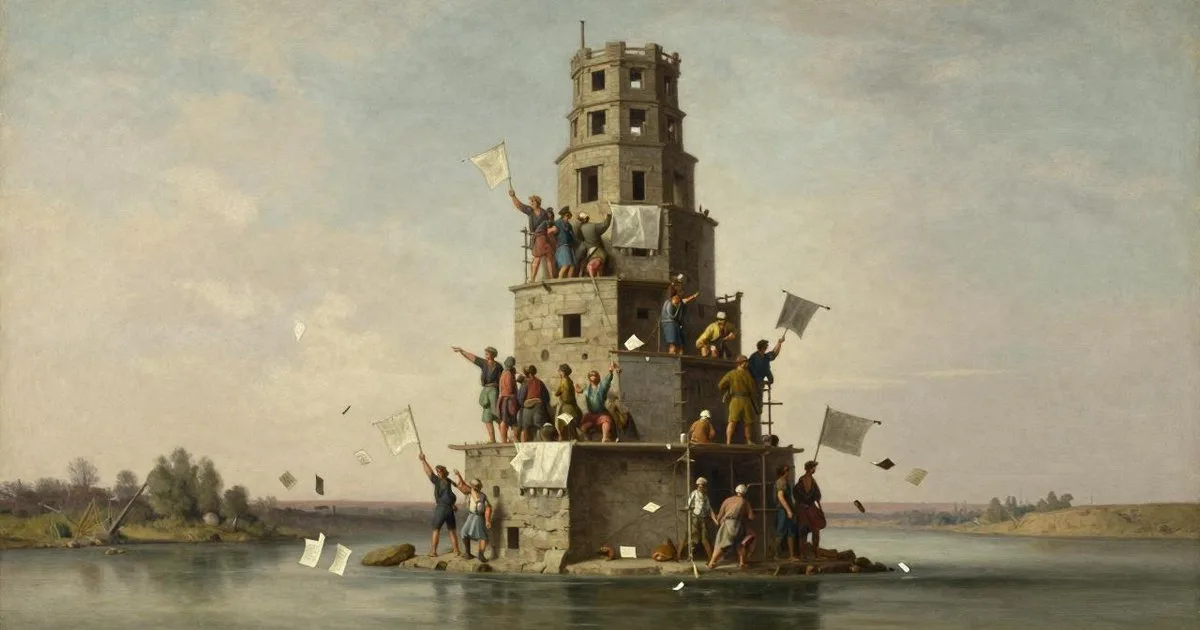
In 427 BCE, during the Peloponnesian War, the Greek island city of Corcyra turned on itself. For seven days, while the Athenian commander Eurymedon stayed with sixty ships, Corcyraeans butchered their fellow citizens and walled some up in the temple of Dionysus. Thucydides, the war's historian, watched its vocabulary go to war as well. Political crises so often become fights over what words mean because whoever decides which deeds earn which words decides which arguments can still be made. Whether that fight starts the crisis or only announces it, and whether it is language changing or something worse, is the harder question.
Thucydides treated Corcyra as a specimen of stasis, the Greek word for civil strife inside a single city, and broke off his story to describe the revolutions that spread from it across Greece. Such sufferings, he wrote, "have occurred and always will occur, as long as the nature of mankind remains the same."
Genesis opens the story of Babel with a whole earth "of one language, and of one speech." Corcyra kept the one language and lost the one speech. Set Thucydides beside the Analects of Confucius and a Florida statute that went by three names in March 2022, and the old argument stops looking old. A fight over what a word means is usually a fight over what may be done to the people it describes.
Part II: What did Thucydides see happen to words in the civil wars that began at Corcyra?
In Richard Crawley's 1874 translation, the central sentence of Thucydides 3.82 is blunt: "Words had to change their ordinary meaning and to take that which was now given them." Reckless audacity came to count as loyal courage. Prudent hesitation became cowardice with an excuse. Moderation "was held to be a cloak for unmanliness."
The classicist John Wilson argued in 1982 that the Greek claims less than Crawley does, speaking only of how names were customarily matched to deeds. On that reading the dictionary held, and the words went on praising and damning, now on behalf of a side.
Courage still meant courage. What changed was who got called courageous.
Follow that one step further and the moderate's position drops out of the language. If caution is cowardice, the person arguing for caution convicts himself in the act of arguing. Thucydides records where this ended. The moderate citizens "perished between the two, either for not joining in the quarrel, or because envy would not suffer them to escape."
Yet in Thucydides the words did not go first. War, he writes, "proves a rough master, that brings most men's characters to a level with their fortunes," and he traces all these evils to an appetite for power fed by greed and ambition. The words were symptoms and weapons. What was left were armed camps where no one trusted anyone.
Moderate has had other owners. In April 1963, eight white Alabama clergymen called Martin Luther King Jr.'s Birmingham protests unwise and untimely. Writing from the city jail, King answered that the white moderate, who cared more for order than for justice, was a greater obstacle to Black freedom than the Klansman. Moderation can itself be a captured word, used against anyone who arrives angry.
Mary Astell, whom the political theorist Geertje Bol recovers for asking who shall judge civility, complicates the picture. In Moderation Truly Stated (1704) she answered a minister who praised Dissenters as men of moderation for taking Anglican communion now and then to qualify for office. She called it hypocrisy, and made Corcyra's move from the outsider's side.
Part III: What did Confucius mean by "rectifying names"?
At the other end of Eurasia, in a scene set nearly sixty years earlier, the disciple Zilu told Confucius that the ruler of Wei was waiting to employ him and asked what he would do first. In the Analects, passage 13.3, the answer is plain: "What is necessary is to rectify names."
Zilu said he was off the mark. Confucius answered with a chain: "If names be not correct, language is not in accordance with the truth of things." From there it runs through failed affairs, ritual and music to misplaced punishments, until the people no longer know how to act.
Zhengming, the rectification of names, is the idea that order begins when words match the things and roles they name. The correction runs one way. People are brought to fit their names. The ruler of Wei held his throne against his own father, and on Legge's reading the advice meant: give it back, and be what the name of son requires.
Another passage makes the point with a pun. Govern, zheng 政, is defined by correct, zheng 正: "To govern means to rectify." The same passage says who starts. A ruler who leads with correctness will find no one daring to be incorrect.
The two texts part here. Confucius's chain runs from names to disorder, so the words go first. Thucydides runs from greed to violence to words, so fixing the words would treat a symptom. The phrase zhengming appears only once in the Analects. Arthur Waley in 1938 suspected 13.3 was a later addition, perhaps from the school of Xunzi, a third-century BCE Confucian who turned the ruler's self-correction into enforcement. Herrlee Creel doubted the passage too, though he looked to the Legalist Shen Buhai.
Part IV: Is today's vocabulary war the same thing, or just language changing?

The case for calm comes from Ludwig Wittgenstein's Philosophical Investigations, published posthumously in 1953. For many cases, though he did not claim all, the book holds that "the meaning of a word is its use in the language." Uses change, and on this view drift is what meaning looks like over time.
The same book supplies a test. A shared language, Wittgenstein argued, needs agreement in judgments as well as definitions, in how speakers apply words to cases. On Wilson's reading, that is what the warring cities lost: the definitions held and the judgments split.
Call that capture. A word is captured when its verdict depends on which side did the deed.
In 2016 the Melbourne psychologist Nick Haslam named one kind of drift in a paper, "Concept Creep." Concept creep is the gradual stretching of harm-related concepts, outward to new kinds of cases and downward to milder ones. His six cases included bullying, which in the 1970s meant repeated, intentional aggression by a stronger child against a weaker one. Haslam granted that conceptual change is "inevitable and often well motivated," but warned that this kind risks pathologizing ordinary life. He traced it mainly to a rising sensitivity to harm, which in his view reflects a liberal moral agenda.
The stretch runs past Haslam's list, and past one side of politics. In 2022 the psychologist Craig Harper and colleagues found conservatives defining the categories they care about, such as sexual deviance and terrorism, about as broadly as liberals define theirs, with some exceptions. Gaslighting, once a sustained campaign to make someone doubt their own mind, became Merriam-Webster's word of the year for 2022, its headline sense widened to gross deception for personal advantage.
Epithets stretch too. In 1946 George Orwell complained that fascism "has now no meaning except in so far as it signifies 'something not desirable'," and he found the same habits in every party. Woke, African American English for alertness, turns up in a spoken warning to stay woke on a recording of Lead Belly's 1938 song about the Scottsboro Boys. Black Lives Matter made it a rallying cry, and the right made it a sneer.
Groomer, a name for an abuser who wins a child's trust to exploit it, went mainstream as a political charge in 2022, reviving a smear with roots in 1970s anti-gay campaigns. Florida's Parental Rights in Education act, signed that March, barred classroom instruction on sexual orientation or gender identity through third grade, and in any grade where it was not age-appropriate. Opponents and most headlines called it "Don't Say Gay." On 4 March the governor's press secretary, Christina Pushaw, had tweeted: "If you're against the Anti-Grooming Bill, you are probably a groomer or at least you don't denounce the grooming of 4-8 year old children."
One statute carried three names, and each delivered a verdict before anyone read the text.
Institutions stretch words the other way, toward comfort. Rightsizing, first recorded in the late 1980s, means cutting jobs while implying the new size is correct. Hannah Arendt found the colder version in the Nazi bureaucracy's language rules, which kept officials from equating their work with what they had always known as murder.
The capture test asks whether a word would land the same way if the other side had done the deed. It has a price. It gives up Confucius's claim that some names are right whoever uses them, and it cannot settle what the philosopher W. B. Gallie in 1956 called essentially contested concepts, such as democracy, where the sides disagree about which deeds belong under the word at all. Florida's quarrel over which deeds grooming may touch was of that kind.
Where the test bites is censorship. In October 2020 Twitter locked the New York Post's account over its Hunter Biden laptop story. The right called it censorship, and the platform's defenders called it moderation. When Florida districts pulled hundreds of titles from school libraries in 2022 and 2023, critics called them book bans, and the governor's office called the charge a hoax. Each camp reaches for censorship when the other camp removes.
Part V: Who gets to fix what a word means?
Deciding which meaning counts is an exercise of power, and the sharpest warning comes from inside Confucianism. Xunzi gives the fixing and enforcing of names to the king alone. His king is the true king, one who has earned the office, and his names must answer to reality, but the power to name is his. Unauthorized distinctions that confuse the correct names were, for Xunzi, "a crime like that of using false credentials or false measures."
Xunzi knew names were conventions, fixed by agreement. He also left the tradition's best diagnosis of word trouble, three fallacies: using names to confuse names, using facts to confuse names, and using names to confuse facts. It fits concept creep and the stretched epithet uncomfortably well. And he conceded that with the sage-kings dead and no one able to compel or punish, what remains is explanation and argument.
Orwell offered a modern version of that concession in 1946. Bad language and bad politics feed each other, he argued, so repair can start with words. Three years later he imagined the state's version, Newspeak, in which free survives only as in a dog free from lice, so political freedom cannot be said. In April 2022 the Department of Homeland Security announced a Disinformation Governance Board. Critics called it a Ministry of Truth, and it was gone by August.
The Zhuangzi, a Daoist book whose earliest chapters date to the fourth century BCE, objects from another side. Its target is the Confucians and their Mohist rivals, each school calling right what the other called wrong. In one parable a keeper offers his monkeys three chestnuts in the morning and four at night. They rage. He offers four and three, and they rejoice, though the number never changed. The monkeys stand for the wrangling schools. The keeper is the sage, who treats contraries as one and walks two roads at once.
The Inner Chapters close on a darker image. Shu and Hu, wanting to repay the kindness of Hun Tun, or Chaos, drilled openings into him, one a day, so he could see and hear like everyone else, and "on the seventh day Hun Tun died." Beside Xunzi's king, the parable reads as a warning against well-meant correction. Carve fixed distinctions into something whole and you may kill it.
The case, worked through
Premise: Meanings drift, and drift is normal. Meaning lives in shared use, and a changing vocabulary is a practice revising itself.
Objection: Drift under pressure is disarmament. In the civil wars that began at Corcyra, once moderation meant cowardice, no one could argue for it.
Revision: The problem is capture, not change. A name is correct when it fits the thing and the role, and a word that flips with the speaker has stopped naming. Thucydides would call the flip a symptom.
Objection: Who gets to rectify? Xunzi gives the job to the king, a road toward Newspeak, and Hun Tun, read this way, suggests fixed names kill what they carve.
Reply: Rectification as a personal discipline. Analects 13.3 was aimed at a ruler, but its last lines put the burden on the speaker. In modern terms: use words an opponent could check. It binds only whoever practices it.
That Reply rests on the close of 13.3, where the superior man (junzi) "considers it necessary that the names he uses may be spoken appropriately, and also that what he speaks may be carried out appropriately." That is a hard discipline on a platform built for the quote-post and the ratio.
The next contested word on your feed will arrive with a verdict packed inside it. In Thucydides' civil wars the ability to see all sides of a question was renamed "inaptness to act on any," and those who kept it perished between the camps. The Zhuangzi gives the same capacity to the sage. When you stop to unpack the word, are you the moderate between the camps or the sage on two roads?
Further Reading