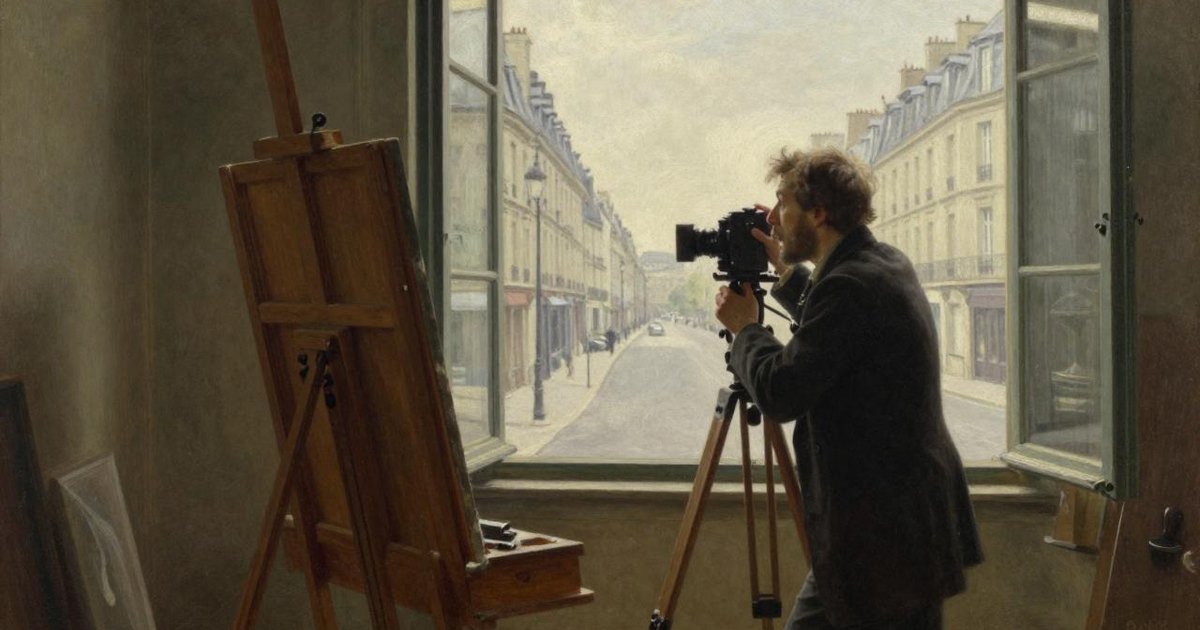
In the summer of 1859, in the pages of the Revue française, Charles Baudelaire reviewed the Paris Salon and stopped to attack a machine. The photographic industry, he wrote, was the refuge of every failed painter, and industry, bursting into art, had become its most mortal enemy. By 1940 the Museum of Modern Art in New York had a department of photography. When people now say AI-generated images cannot be art, are they simply Baudelaire again? My answer is split. The tool can serve art, but most generated images fall below the line, because almost nothing was felt or spent in making them.
That verdict has to be earned, and the column's rule is that the other side goes first. The case for AI art comes from history. It rests on a long and mostly embarrassing record of critics who looked at a new instrument and mistook their own habits for the definition of art.
The present case is concrete. In 2022, Jason M. Allen won first prize in the digital arts category of the Colorado State Fair fine art competition with Théâtre D'opéra Spatial, an image made with Midjourney. He had disclosed the Midjourney credit on his entry. He generated more than 900 iterations and printed three. The prize was a blue ribbon and $300, and the uproar was far out of proportion to both. When he later sought copyright for the image, the Copyright Office refused it.
By 2025 the argument had moved from a state fair to an auction house. Christie's ran Augmented Intelligence, its first auction devoted entirely to AI art, online from February 20 to March 5, 2025. The sale made $728,784, according to The Art Newspaper. More than 6,000 people signed a letter asking Christie's to cancel it, calling the sale mass theft of human artists' work. Between the ribbon and the gavel sits the question this essay has to answer.
Part II: Why did Baudelaire hate photography?
Baudelaire's complaint is subtler than its reputation. His target was the public as much as the machine. He thought the French public of his day had come to believe that art meant the exact copy of nature, and that the camera flattered this belief by producing exact copies on demand. Anyone too poorly gifted or too lazy to master painting, he said in effect, could now take refuge in a device that did the copying for them.
He did not want the camera destroyed. He wanted it kept in its place. Photography should be the servant of the sciences and the arts, he wrote, "mais la très-humble servante," the very humble servant, like printing and shorthand. It could preserve ruins, record specimens, help the astronomer and the naturalist. What it must never do was trespass on the domain of the imagination, which for Baudelaire was the queen of the faculties and the whole point of art. His quarrel belongs to a long argument in Art & Beauty about whether a copy can ever carry what the original carried.
This is why the passage reads so badly now. The poet of Les Fleurs du mal, who found beauty in rot and in the city's back streets, could not imagine that a machine's eye might become an instrument of the imagination. Within a century, photographers had shown that framing, timing, light and the choice of what to leave out were acts of vision as demanding as brushwork. The servant turned out to have a mind, and the mind belonged to the person holding it.
Walter Benjamin, in "The Work of Art in the Age of Mechanical Reproduction" (1935 to 1936), drew a larger lesson from the same defeat. He argued that reproduction withers the aura of the unique original, the sense of an object's presence in one place and one history. He was ambivalent about the loss, but he tied it to freeing art from its old basis in ritual, and to a new political function. For Benjamin, whether photography was art mattered less than how photography had changed what art is.
Part III: What is the strongest case that AI art is art?
Every new medium has been told it was not art. Photography was not art until it was. Film was a fairground novelty before it was a medium. Recorded sound was widely said to threaten music. Each time, the objection had the same shape: the machine does the work, so no one is doing art. Each time, the objection confused a new division of labor with the absence of an artist. The strongest defenders of AI image-making say we are watching the same confusion one more time.
The second part of the steelman is about authorship. Allen did not type one sentence and walk away. He produced more than 900 variations, discarded nearly all of them, and chose three to print. That is curation, and curation has been an artistic act for at least a century. Marcel Duchamp's Fountain of 1917, a urinal signed and submitted to an exhibition, is usually cited as the moment selection itself became art. Choosing what counts can be a creative act, and a model that proposes and a person who disposes is, on this view, a camera with a very wide lens.
Add Benjamin, read generously, and the steelman gains a moral edge. If aura was always partly a matter of privilege, of who could afford lessons, studios, materials and years of training, then a tool that lets a person with no training produce a striking image looks less like theft and more like the next widening of the franchise. That extension is the steelman's, not Benjamin's, but it follows his line. The camera let people who could not paint make pictures of the people they loved, and its images soon filled a world that came to be experienced mostly as pictures. The model, on this view, lets people who cannot draw show what they see in their heads.
I will admit the pull of this case. It knows its history better than its critics do. And it has on its side every critic who was wrong about photography, which is nearly all of them.
Part IV: What does Tolstoy's "infection" test require?
The strongest objection does not come from a critic who feared machines. It comes from Leo Tolstoy, who in 1897 tried to say what art is without reference to beauty, taste or technique. His answer, in the Aylmer Maude translation of What Is Art?, is precise: "Art is a human activity, consisting in this, that one man consciously, by means of certain external signs, hands on to others feelings he has lived through, and that other people are infected by these feelings, and also experience them."
Put plainly, on Tolstoy's test an image is art when a person who felt something uses it to make a stranger feel it too. Art is human and conscious. It works through external signs, such as lines, colors, sounds and words. The artist first evokes in himself a feeling once experienced, then transmits it so that others may feel the same. The viewer's response completes a circuit that started in someone else's life.
Tolstoy's full theory is harsher and stranger than this definition. He ranked art by the religious perception of its age and condemned much canonical art, his own fiction included. Nobody needs to follow him that far. But in a later chapter he names what makes infection work, and the chief condition, above individuality and clearness, is sincerity: the force with which the artist himself feels the emotion he transmits. That test does not care what instrument is used. It asks how much the maker felt, and it asks by degree.
Apply it to the camera and the camera passes. The photographer stands in a place, sees something, feels something, and frames it so we can see and feel it too. The machine records light, but the feeling is the photographer's. Baudelaire's mistake was to look at the lens and miss the person behind it.
The steelman has a sharp reply. If Tolstoy's test is the definition of art, it proves too much. Duchamp's urinal transmits no lived feeling in Tolstoy's sense, and neither does a great deal of conceptual art that the steelman just cited with approval. That reply is right as far as it goes. Tolstoy does not own the word art. What he describes, more narrowly, is the kind of art that moves us: the picture or song that reaches a stranger because someone meant it. That is the ground this objection stands on, and it is the ground most people mean when they ask whether AI images are art.
Part V: Can a prompt be authorship, and what survives the objection?
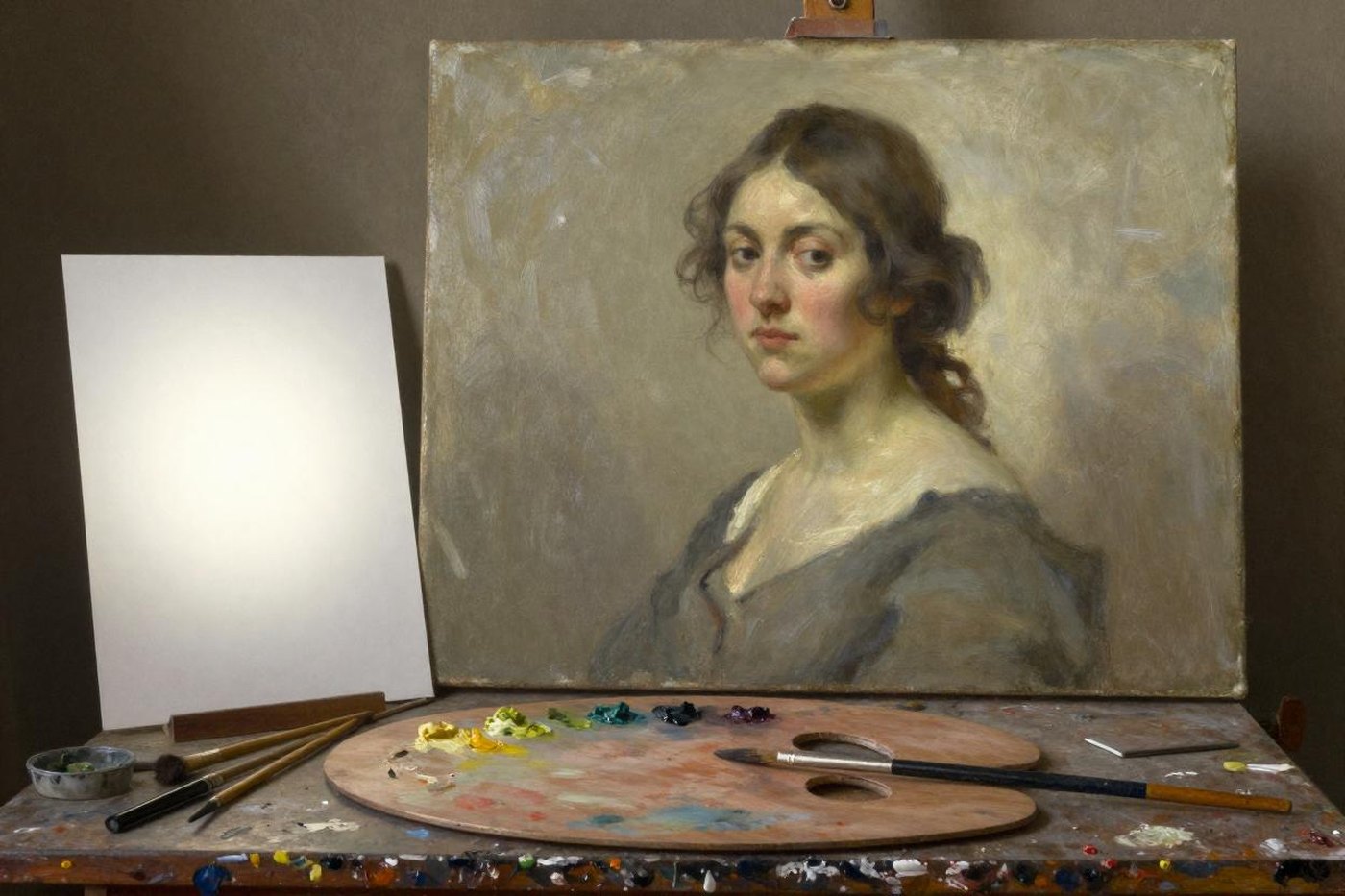
So run the test on Allen, not on the model. Nobody claims Midjourney is the artist. The claim is that Allen, choosing among more than 900 outputs, did what a photographer does with a contact sheet. Allen steered the image toward something he had in mind. That wanting, the reply goes, is the feeling, and selection carries it the way framing carries the photographer's.
Part of that holds. The photographer's frame is cut from a world she stood in, and the choice is inseparable from the seeing. Allen's choice was made among pictures that already existed, generated from a sentence. The feeling passed on, if any, is a preference among finished options. Tolstoy grades sincerity by force, and a preference is weak force. Allen's loop is closer to an editor's than to a painter's, and an editor can be an artist, but a slighter one than the steelman claims.
Kant complicates the picture from another side. In section 46 of the Critique of Judgment, he wrote that "genius is a talent for producing that for which no definite rule can be given," and that "originality must be its first property." The Kantian point that matters is originality and exemplarity, work that becomes a model for others. A model trained to predict the likely next image is built to land in the statistical middle of what it has seen. My gloss, not Kant's: averaged output is by design non-exemplary. It can be competent and smooth, and it rarely surprises, because surprise would count as an error in the model's terms.
L. M. Sacasas made a related point from the viewer's side. In "The Cat in the Tree", he describes one of his children spotting a painted cat on an old oak, in the place where a limb had once been. It moved them in a way a technically slick AI music video he had watched that day had not. His argument is that the charge comes from human intention, from knowing a person meant it. The quality of the image was the least of it.
The case, worked through
Steelman: Every new medium was accused. Photography, film and recorded sound were all called threats to art once, and the accusers were wrong each time.
Steelman: Selection is authorship. Iterating and choosing is curation, and read generously, Benjamin suggests losing aura frees art from ritual and, by extension, from privilege.
Objection: Tolstoy's test. Art passes on a feeling someone lived through, graded by sincerity. Choosing among 900 outputs carries only a weak charge.
Objection: Kant's originality. Genius makes work that becomes a model for others, and averaged output is built not to.
Outcome: The analogy holds for the tool and fails for most of the output. Work that carries a strongly felt intention can be art. Images that cost their maker almost nothing fall below Tolstoy's line, however lovely.
Hawthorne saw a harder version of the problem in 1844. In "The Artist of the Beautiful," the watchmaker Owen Warland spends years building a mechanical butterfly so delicate it seems alive. The infant son of Annie and Robert Danforth crushes it, and Owen looks on placidly. "He had caught a far other butterfly than this," Hawthorne writes. The feeling was real and the making was costly. What failed was transmission. The people he made it for, Annie, her husband the blacksmith and her scornful father Peter Hovenden, could not receive it.
That scene is the mirror image of generated output. Owen has the feeling and no circuit. A generated portrait has the circuit and no feeling, or very little. Tolstoy needs both, felt and infectious, and Hawthorne shows that either can fail alone. The story also shows why a moving image with nothing behind it is not the same thing as a moving work of art.
The objection wins against most of what the machines produce. The feed of frictionless fantasy portraits, the stock illustration generated for an article no one will finish, the image made because making it cost nothing: someone wanted each of them, but barely. They are not bad art. They are not art at all under Tolstoy's test, any more than frost on a window is, however lovely.
Baudelaire was wrong because he could not see the photographer. Today's skeptics are right when there is little to see. The hard case is an illustrator who trains a model only on her own drawings and steers it for months toward a picture of her mother's last house. On Tolstoy's test that tips toward art, because the feeling is hers and the cost is real. What remains uncertain is whether a stranger, knowing how it was made, will be infected by it. Tolstoy's circuit needs a receiver, and the receivers have not decided.
Further Reading
Dorian Gray Has a FilterWilde's portrait and the made-up image of the self, the other Art & Beauty piece in this series.