Archive / Religion & the Sacred
A Palace in Time
Before rest was a wellness trend it was a law, and in Deuteronomy a law grounded in the memory of slavery. What happens to that idea in a culture that cannot stop?
Religion & the Sacred · 10 min read
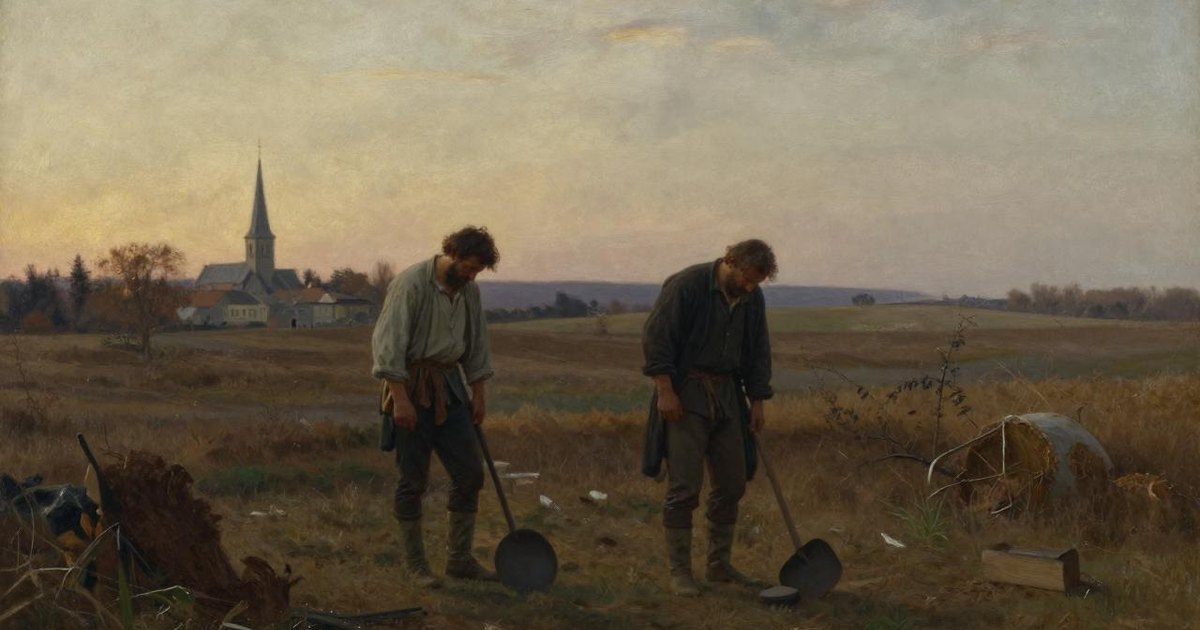
In 1951, a rabbi teaching in New York published a slim book arguing that Judaism's great architecture was made of time, not stone. Abraham Joshua Heschel called the Sabbath "a palace in time," a structure built of hours. His readers lived in the most productive economy the world had ever seen. The question he put to them is still open, and sharper now: what can the Sabbath teach a culture that can't stop working? The old commandment names the servant. It names the ox.
That detail is roughly three thousand years older than Heschel, and it arrives in two versions: the commandment appears once in Exodus and once in Deuteronomy, and the two passages give different reasons for the same day.
Heschel's contribution was to take those reasons seriously as a way of living. He described Jewish ritual as an "architecture of time," a discipline that builds holiness out of hours rather than places. Most human effort, in his account, goes into conquering space, into acquiring land and the things that fill it. The Sabbath asks for a different achievement, one that cannot be owned or stored.
Set against that are two present facts. The first is a booming market for rest, sold as retreats and as boxes that lock your phone away. The second is the 2022 UK four-day-week pilot, in which 61 companies cut their staff's hours and kept paying them in full.
Part II: Why does the Bible give two different reasons to rest?
Exodus (20:8-11, KJV) grounds the day in creation. "Remember the sabbath day, to keep it holy," it begins, and then explains: "For in six days the LORD made heaven and earth, the sea, and all that in them is, and rested the seventh day: wherefore the LORD blessed the sabbath day, and hallowed it." Rest here is imitation. God stopped, so you stop. The week has a shape because the world has a shape.
Deuteronomy (5:12-15, KJV) repeats the commandment and changes its footing. It opens with "Keep" where Exodus says "Remember," names the ox and the ass among those who rest, and closes the thought with a pointed clause: "that thy manservant and thy maidservant may rest as well as thou." Then comes the reason: "And remember that thou wast a servant in the land of Egypt, and that the LORD thy God brought thee out thence through a mighty hand and by a stretched out arm: therefore the LORD thy God commanded thee to keep the sabbath day." Modern translations render "servant" as "slave," which is closer to the sense. Think of what that memory held: bricks counted at the end of every day, and no day that belonged to the one who made them.
You were a slave. So nobody in your house works today.
Traditional Jewish commentary does not treat the two passages as rival accounts. The Talmud teaches that "Remember" and "Keep" were spoken in a single utterance, and the Friday-night hymn Lekhah Dodi still sings it. But the halves do different work. Exodus looks up at the heavens, and Deuteronomy looks back at Egypt and around at the household. It says that a people once made to produce without end must never become the kind of people who make others do the same.
In Deuteronomy, then, the Sabbath is a weekly limit on anyone's power to command another person's time, grounded in the memory of having been a slave. The commandment covers the son and the daughter, the servants, the animals and, in both versions, "thy stranger that is within thy gates." One day in seven, nobody in the household can be made to work.
That is a strange thing to find in an ancient law code. Hesiod, writing in Greece around 700 BCE by the usual dating, gives the other view of labor plainly. "For the gods keep hidden from men the means of life," he warns his brother in Works and Days, and elsewhere: "Work is no disgrace: it is idleness which is a disgrace." In Hesiod, toil is the price the gods set on survival, and the good man pays it without complaint. The Sabbath does not deny that work is necessary. It denies that work gets the last word.
Part III: What did Heschel mean by "a palace in time"?
Heschel's image turns the usual picture of religion inside out. We tend to think of the sacred as a place, a temple or a mountain you travel to. Heschel pointed out that the first thing the Bible calls holy is a day: God blessed the seventh day and sanctified it, in Genesis 2:3. The Sabbath is holiness you cannot visit. It comes to you, every seventh evening, whether you have earned it or not.
The practical meaning of the palace is that its walls are rules. On the Sabbath, observant Jews do not cook, write, spend money or build. To an outsider the list looks like restriction. Heschel read it as construction. The prohibitions carve out a space the market cannot enter, and inside it a person can be something other than a producer.
Aristotle seems at first to agree. In Book X of the Nicomachean Ethics he wrote that "we are busy that we may have leisure, and make war that we may live in peace" (Ross translation, MIT Classics). Leisure, for him, was the point of the whole enterprise, the condition in which contemplation and friendship become possible. But Aristotle's leisure belonged to free male citizens, and it rested on the labor of slaves, whose place he defended elsewhere in his writing. Deuteronomy runs the other way. Aristotle's citizen rests because the slave works. Deuteronomy's household rests with the slave in it, and the stranger, and the ox.
Josef Pieper, a German Catholic philosopher writing in 1948 amid the ruins of his country, thought his own century had forgotten even Aristotle's ordering. In Leisure: The Basis of Culture he warned of a world of "total work," in which every activity must justify itself by its usefulness and even rest has to pay its way. For Pieper leisure was receptivity, a way of letting the world be given rather than seized. Its root, he argued, was worship and festival: the celebration of the world as good, which is more than the mere absence of work.
So the three do not quite line up, and the seams matter as much as the agreement. They share a claim that belongs as much to Flourishing as to Religion & the Sacred: rest is what the productive week is for, and remove that ordering and work has no purpose beyond itself. They split on who gets to rest. Picture the inbox at six on a Friday evening. Nothing in it is holy, and nothing in it stops.
Part IV: Why is resting in order to be productive a trap?
The market for rest is easy to find: weekend retreats where you surrender your phone at the door, apps that block other apps, programs that promise a "digital Sabbath." The language comes from religion, and the pitch comes from the office. Unplug, the ads say, and come back sharper.
The four-day week makes the same pitch with better data. In the UK pilot, run from June to December 2022 by 4 Day Week Global with the Autonomy Institute and researchers at Cambridge and Boston College, about 2,900 employees at 61 companies worked a shorter week, typically four days, on full pay (results, Autonomy Institute). When results were published in February 2023, 56 of the 61 were continuing and 18 had made the change permanent. The number of staff leaving fell 57 percent. Seventy-one percent of employees reported less burnout.
Across the trial itself, revenue rose about 1.4 percent on average. The firms did not report losses from giving time away, which is a real finding, though the group was voluntary and self-selected. The number that traveled, a 35 percent rise, came from firms comparing the trial months with a similar period in earlier years.
That is the trap Pieper saw coming. Once rest has to justify itself by output, it has already been absorbed into the thing it was meant to limit. A day off that exists because it raises productivity can be withdrawn the moment it stops raising productivity. It is Hesiod's economy with a spa attached.
Byung-Chul Han, the Korean-born philosopher based in Berlin, pushes the diagnosis further. In The Burnout Society (2010, in English 2015) he argues that the modern worker is an "achievement-subject" who no longer needs a boss to drive him. He drives himself, in the name of freedom and self-realization, and collapses from it. Nobody forbids him rest. He simply cannot find a reason to take it that is not another form of work. Han does not stop at diagnosis. His book closes on a different tiredness, one shared rather than private, a kind of idleness people fall into together.
The case, worked through
Premise: Rest as repair. We rest to work better, and the restored worker performs.
Objection: Rest as servant. That makes rest work's instrument, and Pieper warned that total work swallows even the break.
Revision: Rest as freedom. Deuteronomy's day is one on which no one in the household can be made to produce, justified by memory, not output.
Objection: No master to stop. Han's achievement-subject drives himself, so where would a commandment come from?
Reply: A shared calendar. Perhaps what binds is not a master but a day everyone keeps at once, though a shared calendar must be enforced by someone.
Part V: Can you keep a Sabbath alone?
Here the two halves of the argument meet, and they do not fit neatly. The Deuteronomy Sabbath is enforced from outside the self. It binds the master as much as the servant, and it holds because everyone stops at once. A shop that stays open on the Sabbath has broken the rule, whatever it gains. The rule protects the weak by refusing to be optional.
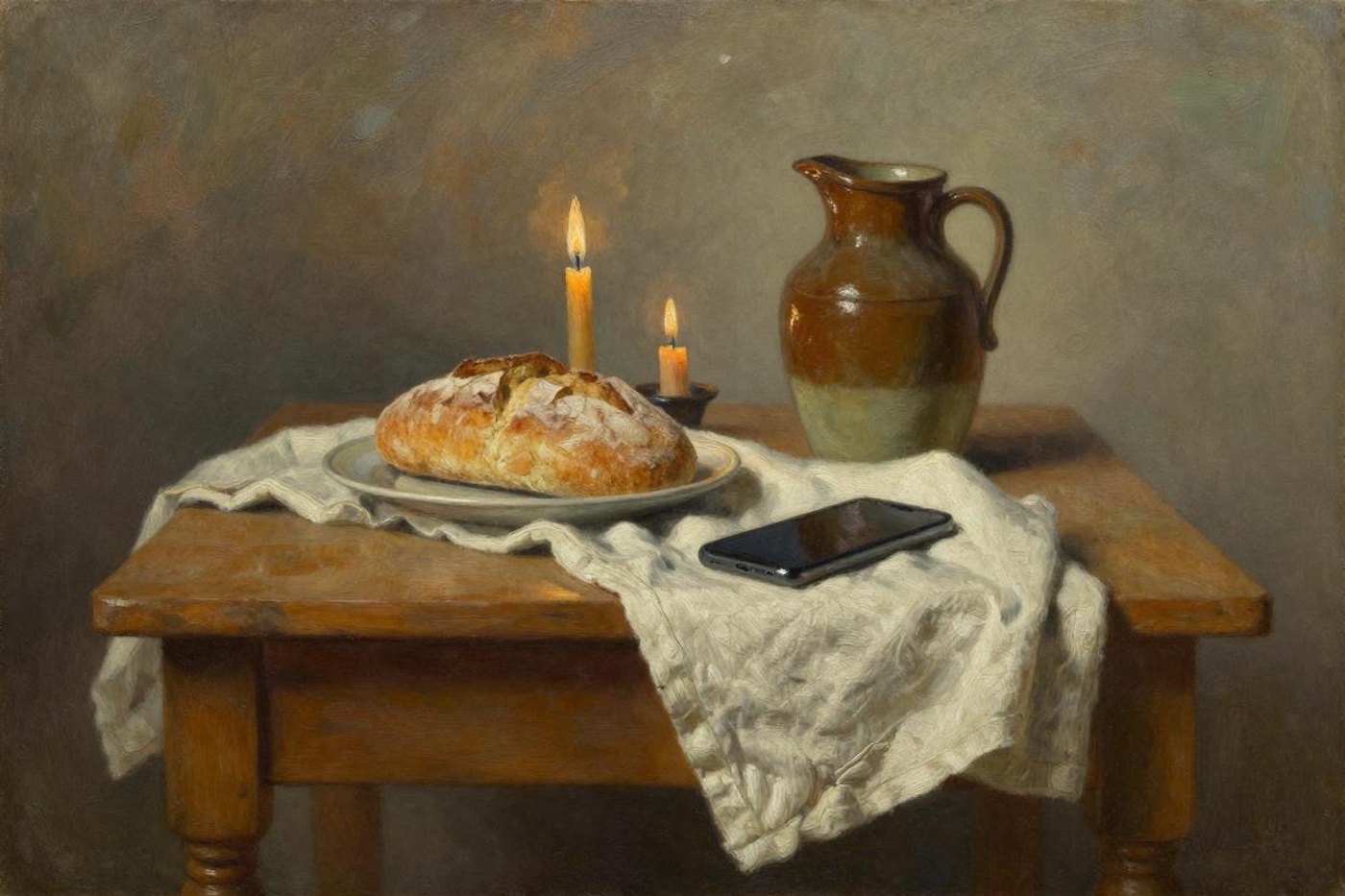
The digital detox has the opposite structure. You buy it, and you keep it by yourself. You lock your own phone and choose your own retreat weekend. Han's worker can buy a lockbox. He cannot buy a world in which nobody else is working while he sits.
The Sabbath turns a common withdrawal into law, renewed every week. Thoreau, in Walden (1854), looked at his Concord neighbors and wrote: "The mass of men lead lives of quiet desperation. What is called resignation is confirmed desperation" (Walden, Project Gutenberg). Years earlier, in a speech at his Harvard commencement in 1837, he had proposed reversing the week, so that a man would toil one day and keep the other six as his Sabbath. He wanted more Sabbath, not less. He went after it alone, at the pond, and he called the whole thing an experiment.
The four-day week sits between the two. It is shared inside a company, and nobody at a participating firm had to negotiate their own Friday. But employers granted it and can take it back, and it was justified in the currency of retention and output. It looks like a Sabbath in form and like a productivity program in its reasons.
The objection to a shared day deserves its full weight. A shared day of rest has never been universal. Someone keeps the hospital running, and Jewish law itself sets the Sabbath aside to save a life. A compulsory day is also somebody's day. In 1961, in Braunfeld v. Brown, the U.S. Supreme Court upheld a Sunday-closing law against Orthodox Jewish shopkeepers who already closed on Saturday, which left them to lose two days of trade each week to keep one. Deuteronomy, for all its care, regulated slavery rather than ending it. A Sabbath that protects the weak by being compulsory can also fall hardest on them.
Most countries that kept Sunday trading laws have loosened them, and they called it freedom. They had a point. The Sabbath limits what you may do with your own time as well as what others may demand of it. It trades the freedom to work whenever you like for the freedom from being always available. Pieper would ask one more thing: whether a day of non-production with nothing to celebrate is still a Sabbath at all.
So here is the choice, with its cost on each side. Freedom from work can be private, bought and scheduled and kept on your own, in which case it competes every week with everything else you might do and usually loses. Or it can be shared, a day a whole society keeps at the same hour, in which case someone must enforce it, someone will be excused from it, and someone will pay for a day that was never theirs. Deuteronomy chose the second and wrote the cost into the law, because it remembered Egypt. A culture without that memory still has to decide whether rest is something it will enforce, or only something it will sell.
Related topics: Religion & the Sacred and Flourishing. Part of the Then & Now series.
Further Reading
Orpheus Looks Back
The other Religion & the Sacred piece in this series, on a ritual limit set against a technology with none.
The other Religion & the Sacred piece in this series, on a ritual limit set against a technology with none.
The Dispossessed
Le Guin's Anarres shares out work with no masters, and finds the pressures a free society puts on its own members.
Le Guin's Anarres shares out work with no masters, and finds the pressures a free society puts on its own members.