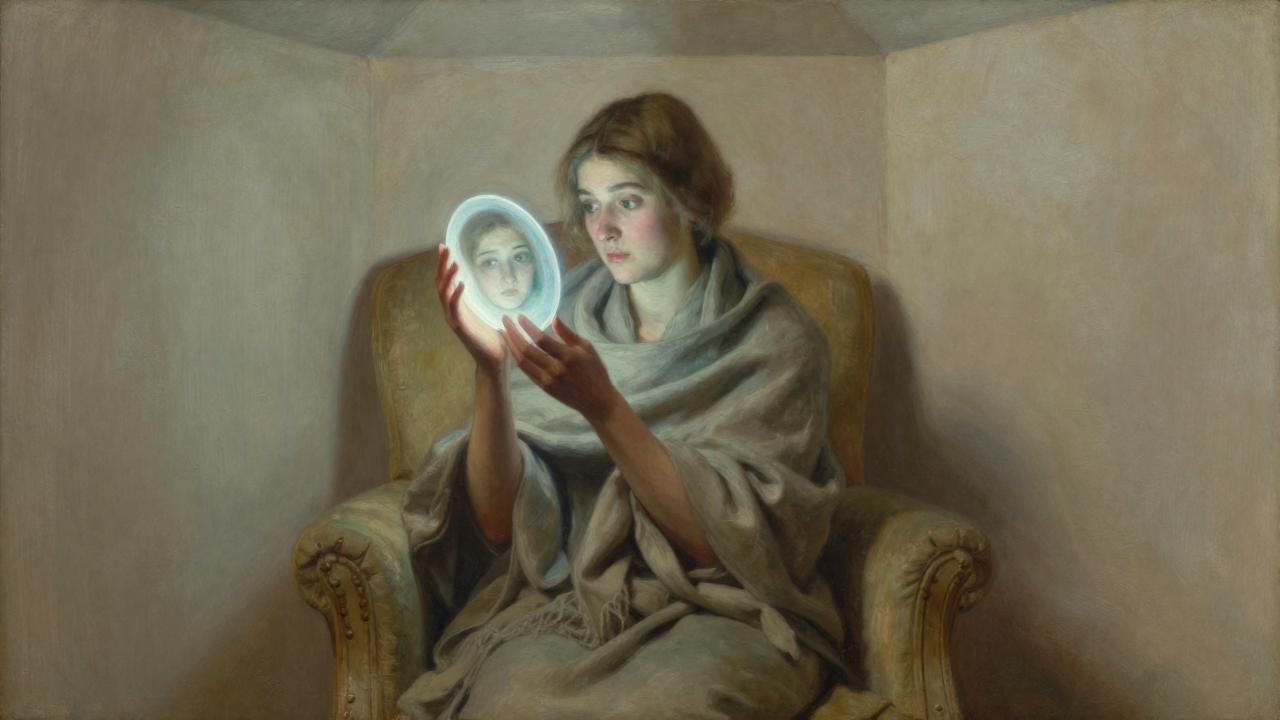
In November 1909 the Oxford and Cambridge Review printed a story by E. M. Forster, then thirty, with three novels behind him. It opens with an instruction: "Imagine, if you can, a small room, hexagonal in shape, like the cell of a bee." In the armchair sits Vashti, "a swaddled lump of flesh," who lives underground in a room she almost never leaves and talks through a glowing plate to people she never meets. "She knew several thousand people," Forster writes, and "in certain directions human intercourse had advanced enormously."
Read on a phone, the story asks what a life of constant contact does to the people living it. Forster's answer is that it multiplies contacts and thins out contact, until the body becomes an embarrassment and the system carrying the messages becomes the thing people love. The hardware in "The Machine Stops" is quaint. Its account of habit has aged far better, above all its picture of people adjusting, one defect at a time, to a machine that serves them worse every year and that none of them can repair.
Part II: What does the Machine give Vashti, and what does it take?
Vashti's room answers to buttons. One brings food, another music, another a bath, another her bed. A wall of switches connects her to anyone in the world. She is a lecturer, and her subject this evening is "Music during the Australian Period." Nobody comes to hear it. "The clumsy system of public gatherings had been long since abandoned," Forster explains, and Vashti delivers the talk from her armchair to an audience sitting in armchairs of their own.
Her son Kuno calls from the other side of the world with a request she finds absurd. "I want to see you not through the Machine," he says. "I want to speak to you not through the wearisome Machine." Vashti is vaguely shocked. She can see his image on the plate, and that seems to her more than enough.
She agrees to visit him, and the journey shows what the room has done to her. The air-ship has windows, and the light offends her. When she stumbles, the ship's attendant catches her, and Vashti recoils: "People never touched one another. The custom had become obsolete, owing to the Machine." As the ship crosses the mountains and then Greece, she declares "No ideas here" and pulls a metal blind over the view.
Back home she keeps one physical book, the Book of the Machine, a manual with instructions for every contingency. In private, half ashamed, she raises it to her lips. "Thrice she kissed it, thrice inclined her head, thrice she felt the delirium of acquiescence." The detail is early and quiet, and the whole story turns on it.
Part III: Why does Forster's world prefer tenth-hand ideas?
The story's funniest passage is a lecture on the French Revolution. "Beware of first-hand ideas!" one of the advanced lecturers cries. First-hand ideas, he explains, are only impressions produced by love and fear. "Let your ideas be second-hand, and if possible tenth-hand," because then they stay far from the disturbing element of direct observation. He recommends learning "what I think that Enicharmon thought Urizen thought Gutch thought Ho-Yung thought Chi-Bo-Sing thought Lafcadio Hearn thought Carlyle thought Mirabeau said about the French Revolution." Through "these eight great minds," the blood shed in Paris reaches the student safely diluted.
Forster meant it as satire, and it now reads as a fair description of a large share of what fills a screen: the reaction to the clip of the interview about the post about the event. Each layer adds an opinion and removes a little more of the thing itself. Vashti's world counts this as progress, because the original event, like the original body, is messy and frightening, and the commentary is clean.
The cost shows in the hours. In May 2023 the US Surgeon General, Vivek Murthy, issued an advisory titled "Our Epidemic of Loneliness and Isolation." It reported that Americans spent about 20 minutes a day in person with friends in 2020, down from about 60 minutes nearly two decades earlier, and that people aged 15 to 24 saw a 70 percent drop. About half of American adults said they had experienced loneliness. None of that proves Forster's mechanism. It does show the drift he imagined, toward more connection by wire and less in the room, running in the direction he feared.
Vashti would not count herself lonely. She has thousands of contacts and a lecture to give. That is the part of the story most worth sitting with. Her isolation feels to her like a full life, because every channel she uses is busy.
Part IV: What does Kuno find on the surface?
Kuno is the one person in the story who uses his body on purpose. He starts by walking, which nobody does, and relearns the meaning of near and far. Near, he decides, is a place his feet can reach quickly. The walking teaches him a principle. "Man is the measure," he tells his mother. "Man's feet are the measure for distance, his hands are the measure for ownership, his body is the measure for all that is lovable and desirable and strong."
Then he climbs. He finds an old ventilation shaft, forces his way up, and reaches the surface of the earth, which the Machine says is uninhabitable. He breathes the air and sees hills. The Mending Apparatus, a set of white worm-like tendrils, drags him back down. His punishment is to be threatened with Homelessness, which means exile to the surface and, everyone assumes, death.
When Vashti finally sees him in person, he tries to tell her what he has learned. "Cannot you see, cannot all you lecturers see, that it is we that are dying, and that down here the only thing that really lives is the Machine?" He goes further. "It has robbed us of the sense of space and of the sense of touch, it has blurred every human relation and narrowed down love to a carnal act, it has paralysed our bodies and our wills, and now it compels us to worship it."
Vashti hears a son embarrassing her. The Committee hears a threat. Soon the respirators that let people visit the surface are abolished, and the Book of the Machine becomes scripture in name as well as practice. The worship that began with a private kiss becomes public religion, and the Machine's own failures start to look like the will of a god.
Part V: Where does the story go wrong, and where is it right?
Kuno's measure is the able body, and that is where the story is weakest. Forster wrote as a healthy man of thirty for whom presence was easy. He gives no thought to the reader for whom the plate is the only contact there is: the grandmother an ocean away from her grandchildren, the person who cannot leave the house, the soldier calling home. For them the screen adds a face to a life that would otherwise have none. The story cannot imagine a machine that does this, because every scene treats mediation as a loss. A reader can grant Forster his warning and still refuse his contempt.
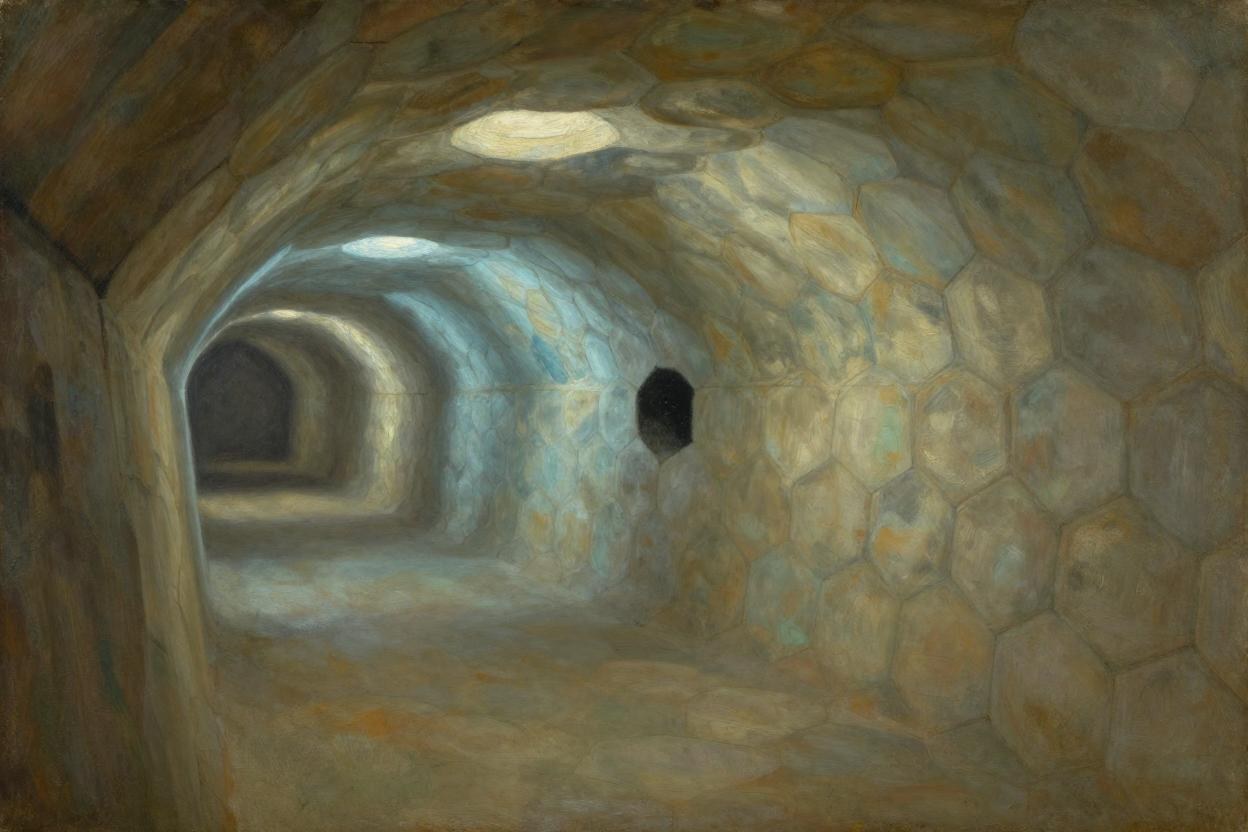
The ending is the other weak point. The Machine stops all at once, the city "broken like a honeycomb," and the survivors on the surface, the Homeless, are left to start again. Real systems rarely end that way. They degrade, they get patched, and they keep running.
Forster saw that too, and it is the best thing in the story. Before the stop comes a long middle stretch of small failures. The music gets worse. Vashti complains that "I can never be sure of my music now. It gets worse and worse each time I summon it." A friend hears "a slight jarring noise" and says, "I do not know whether it is inside my head, or inside the wall." They file complaints with the Committee of the Mending Apparatus, which does nothing, and then they stop complaining. "Time passed, and they resented the defects no longer. The defects had not been remedied, but the human tissues in that latter day had become so subservient, that they readily adapted themselves to every caprice of the Machine."
That sentence is the story's real prophecy. Anyone who has accepted an app that got slower, a feed that filled with filler, or a service that cut its human help line and called the cut an upgrade knows the move. Nobody decides to accept worse. People adjust, and the adjustment feels like their own preference. The Numbered Self traced the same surrender in Zamyatin's glass city, where the citizens come to love the schedule that runs them.
The last pages turn on touch. Vashti crawls through the dark toward her son's voice, over the bodies of the dead, and reaches him. Kuno, dying, says what he has wanted all along: "we touch, we talk, not through the Machine." He kisses her. Then Forster gives them a sentence that keeps the story from becoming a sermon. "They wept for humanity, those two, not for themselves." An air-ship falls through the roof, and for a moment, before they die, they see "scraps of the untainted sky."
The verdict splits the way the story does. On the body, Forster is too sure, and his story sneers at people whose only contact comes through a screen. On habit, he was ahead of his time and still is. His people are not tricked. They are comfortable, and they keep lowering what they expect until the music is noise, the noise might be in their heads, and the kiss goes to the manual. The question he leaves for a reader with a phone is a modest one: which defects have you stopped noticing? A life of contact is no worse for running through a machine. It is worse when, like Vashti, you stop being able to tell the difference between the machine's limits and your own.
Questions readers ask
When was "The Machine Stops" written?
Forster published it in the Oxford and Cambridge Review in November 1909. It was reprinted in his collection The Eternal Moment and Other Stories in 1928. In the introduction to his Collected Short Stories (1947) he called it "a reaction to one of the earlier heavens of H. G. Wells."
Did "The Machine Stops" predict the internet?
It imagined video calls, instant messages and lectures watched from home, all run by one worldwide system. It did not imagine computers or a network of separate machines. It is more accurate about how people would live with such a system than about how the system would work.
What is the message of "The Machine Stops"?
That comfort bought by handing every task to a system can cost people the use of their bodies and their own judgment, and that people adapt to a system's decline instead of noticing it.
What happens at the end of "The Machine Stops"?
The Machine fails slowly, then all at once, and the underground city is "broken like a honeycomb." In the dark Vashti crawls to Kuno, and they touch and talk "not through the Machine" before they die. The Homeless on the surface are left to start again.
Further Reading
The Numbered SelfZamyatin's We and what happens when a life becomes its measurements.