Most families know the conversation they are not having. A parent's scans come back worse. The doctor talks about options. At dinner everyone discusses the garden, the grandchildren and the next appointment, and nobody says the word that sits in the middle of the table. The silence is usually meant kindly. People do not want to frighten someone they love, or to look as if they have given up. In The Conversation Project's 2018 national survey, 92 percent of Americans said it was important to talk about their wishes for end-of-life care. Only 32 percent had actually had that conversation.
Leo Tolstoy wrote the plainest account we have of what that gap feels like from the bed. The Death of Ivan Ilyich, published in 1886, follows a judge from a fall off a ladder to his last breath, and most of its pain comes from the people around him agreeing to pretend. The story asks what a proper life looks like from its last weeks. Its answer is hard. A life arranged for comfort and approval has nothing to say when death arrives, and the only person who helps Ivan Ilyich is the one who will not lie to him. Read now, the story makes a strong case for having the talk while it can still do some good.
Part II: What kind of life did Ivan Ilyich live?
Tolstoy begins at the end. The first chapter opens with news of Ivan Ilyich's death reaching his colleagues at the law courts. Their first thoughts are about the vacancy, who will move up and who might be transferred. Under the official sympathy runs a plainer feeling. In Nathan Haskell Dole's 1887 translation, "Each one said to himself, or felt, 'Well, he is dead, and I am not.'" A friend pays the required visit to the widow, Praskovya Fyodorovna, and finds that what she most wants from him is advice on getting more money from the government. It is a funeral played as social comedy, and it shows you the world Ivan Ilyich lived in before Tolstoy shows you his life.
The second chapter opens with the sentence the whole story hangs on. "The history of Iván Ilyitch's past life was most simple and uneventful, and yet most terrible." The terror is in the word uneventful. Ivan Ilyich is no villain. He studies law, takes posts in the provinces and rises steadily. He marries because the match is pleasant and the right people approve of it. When the marriage turns cold, he retreats into his work, where the rules are clear and he is good at following them. He plays cards with the right people. His aim is a life that runs smoothly and looks correct, and he walls off whatever threatens it. Tolstoy does not mock him for this. He describes a career most readers would recognize as success.
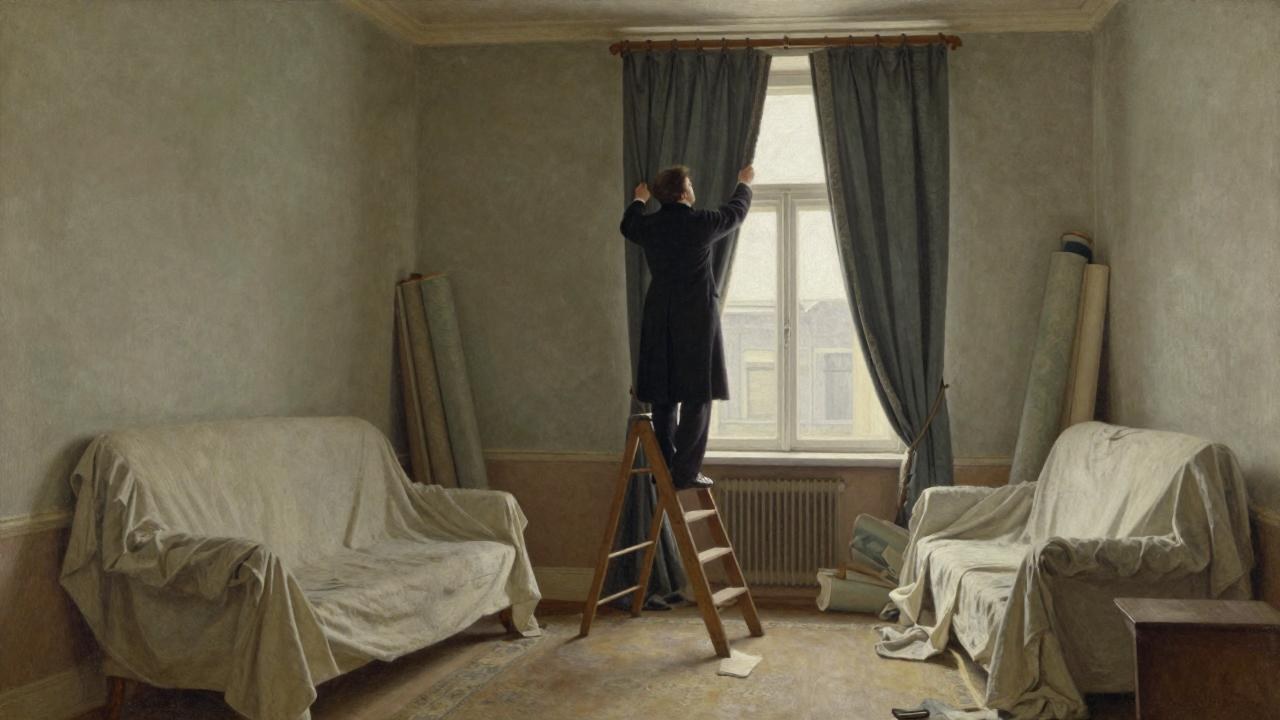
Tolstoy takes care to show a man who did everything his world rewarded. At last Ivan Ilyich gets a well-paid post in the capital, and he throws himself into decorating the new apartment. While showing an upholsterer how to hang the curtains, he slips on the ladder and knocks his side against the handle of a window frame. The bruise fades. A pain in his side does not.
The accident is small and almost comic, and that is the point. The death that undoes his life comes in through the furnishings he arranged so carefully.
Part III: Why does everyone pretend he is only ill?
The doctors offer diagnoses, a floating kidney, a problem with the appendix, and none of them will say what he can see in his own face. Ivan Ilyich notices something sharp about the famous doctor he consults. The doctor's manner, important and evasive, is the manner Ivan Ilyich himself used on the people who came before him in court. The one question that matters to the patient, whether his case is serious, is the one the doctor treats as beside the point.
Then comes the lie. "Iván Ilyitch's chief torment was a lie," Tolstoy writes, "the lie somehow accepted by everybody, that he was only sick, but not dying, and that he needed only to be calm, and trust to the doctors." His wife and daughter go on with their plans and treat his illness as a burden laid on them. One evening they come in dressed for the theater, say a few words and leave him lying at home. Nobody is cruel on purpose. Everybody is protecting something, a schedule, a mood, their own fear. The lie spares them the work of grieving in advance, and it leaves him alone with the one fact everyone can see.
The lie has a modern form, and it is rarely spoken outright. It lives in talk of the next scan and the next treatment, in visits kept cheerful, in questions that steer away from what the patient might want if things go badly. Each choice can be defended on its own. Together they produce the room Tolstoy describes, full of people and empty of truth, where the one person facing the largest event of his life has no one to face it with.
Tolstoy also shows the lie at work inside Ivan Ilyich's own head. In the sixth chapter he remembers the example from his old logic textbook. "Kai is a man, men are mortal, therefore Kai is mortal," had seemed to him all his life "true only in its application to Kai, but never to himself." Dole spells the textbook's Caius as Kai. The joke is old and the point is exact. Everyone knows that people die. Very few believe it of themselves, and the household's pretending helps him hold on to that belief a little longer, at the price of company.
Part IV: What does Gerasim do that the others cannot?
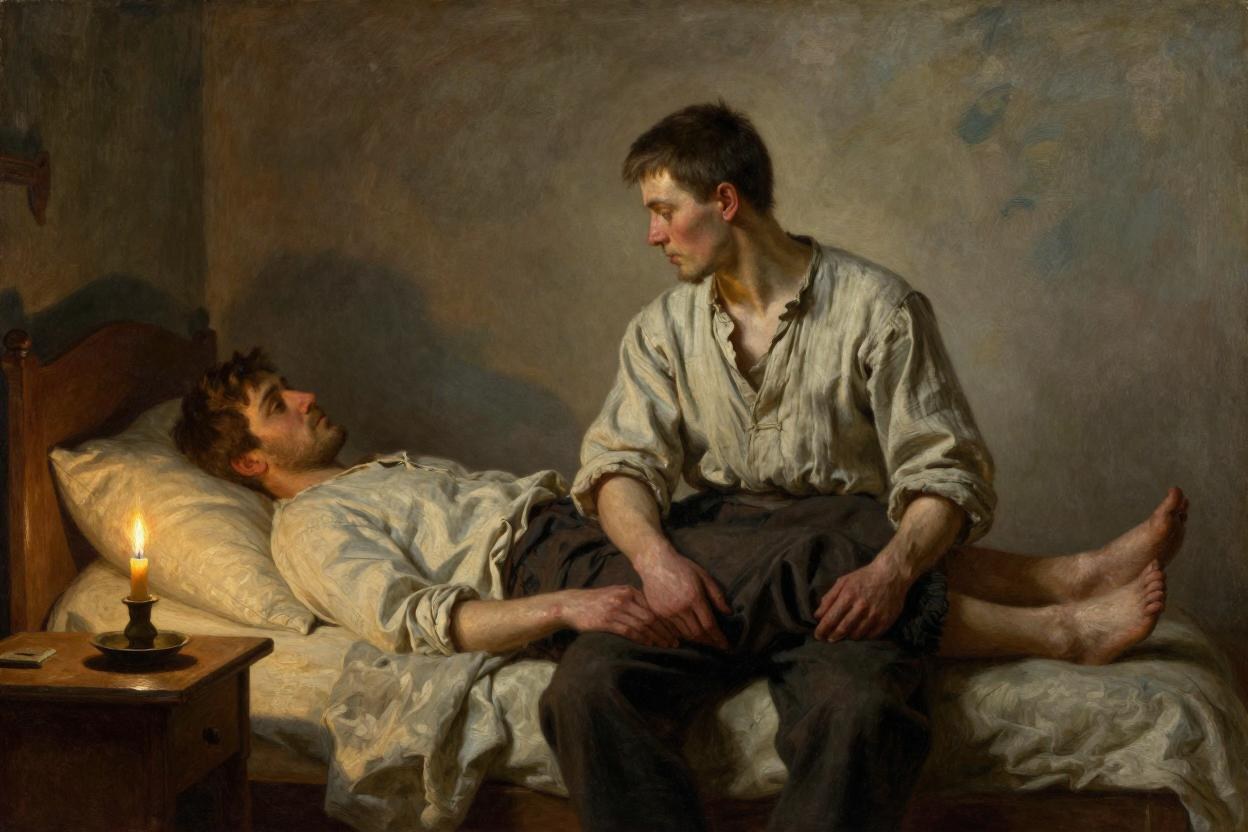
One person in the house does not pretend. Gerasim is a young peasant who works as a servant, strong and good-humored, and he takes on the most unpleasant jobs of the sickroom without any sign of disgust. Ivan Ilyich finds that the pain eases when his legs are raised, and Gerasim sits for hours, through the night, holding them up on his shoulders. He is not embarrassed either. The bedpans and the smells that the family treats as signs of disaster, he treats as the ordinary needs of a body. He handles the work that way, and he says why. "We shall all die. Then, why should I not serve you?"
That line carries the moral of the story, and it comes from the least educated man in the house. Gerasim offers no hope and no theory. He states the fact everyone else is hiding and draws the obvious conclusion. Because each of us will need this one day, of course he will do it. Tolstoy makes clear that Gerasim alone does not lie, and that this is why Ivan Ilyich feels at ease with him. The truth comforts him where the kind lie had only isolated him.
It is worth being exact about what Gerasim gives. He does not talk about death at length or ask Ivan Ilyich how he feels about dying. He lifts the legs, sits through the night and lets the truth stand in the room without fuss. For families who dread the conversation, that may be the most useful thing in the book. The talk does not have to be a speech. It can begin with one person who stops pretending.
Part V: What would he have needed to hear?
In the last chapters the illness forces the question Ivan Ilyich spent his life avoiding. In the ninth chapter, "Can it be that I did not live as I ought?" comes suddenly into his head. He pushes it away, since he did everything properly. The question returns in the eleventh chapter in a harder form. "But how is it if in reality my whole life, my conscious life, has been wrong?" He begins to see the career, the marriage, the card games and the furniture as ways of not looking.
Tolstoy's resolution in the final chapter is religious in shape, and readers who do not share his faith may find it hard to accept. After three days of screaming, Ivan Ilyich feels his schoolboy son kiss his hand. He feels sorry for the boy and for his wife, and the fear leaves him. "In place of death was light!" A short while later he dies.
You do not need Tolstoy's theology to take something from the ending. The change in Ivan Ilyich comes when he stops defending his own life and thinks of the people beside the bed. Pity replaces self-justification. The story suggests that this turn was open to him all along, and that the lie kept it closed until the last hours.
Here the book is hard on its reader as well as its hero. It is easy to blame Praskovya Fyodorovna and the doctors, and Tolstoy gives you every reason to. It is harder to admit that their pretending is the ordinary kind, carried on by frightened people who think they are being kind. Most readers of the story will sit in her chair someday, and few will sit in Gerasim's.
What Ivan Ilyich needed to hear was close to what Gerasim told him. You are dying. Everyone will. I am staying. Those sentences are hard to say, and the survey suggests most families never say them. The story's case is that the silence costs the dying person most, because it takes away the only company that helps.
There is a practical way to use the book. Read it before you need it, with the person whose wishes you will one day have to know, and talk about it. A story about a fictional judge is an easier way in than a direct question over dinner. Ask what they made of Gerasim. Their answer will tell you a good deal, and it may open the conversation that most families never manage to start.
Questions readers ask
What is The Death of Ivan Ilyich about?
A judge in imperial Russia hurts his side in a fall while hanging curtains, develops a fatal illness and spends his last months facing the thought that his comfortable, approved life was wrong. Tolstoy published the story in 1886.
Who is Gerasim in The Death of Ivan Ilyich?
A young peasant servant who nurses Ivan Ilyich, holding his legs on his shoulders to ease the pain. He is the only person in the house who does not pretend that his master is merely ill.
What does Ivan Ilyich realize at the end?
That his life was lived for appearances, and that he can still feel pity for his son and his wife. In his last moments the fear of death leaves him, and in Dole's translation, "In place of death was light!"
Is The Death of Ivan Ilyich a hard read?
No. It is a short novella in twelve brief chapters, written in plain language, and most readers finish it in a sitting or two. What is hard is its subject.
Further Reading
The Snake Ate the PlantGilgamesh, the plant of youth and the longevity movement that rereads the epic without its ending.