Two Americas in One Room
Du Bois described living as two people in one body, seeing yourself through hostile eyes. The feed has made that condition general, and called it discourse.
In 1903, a sociologist at Atlanta University published a book that named the problem of the age. The problem of the twentieth century, he wrote, was the problem of the color line. The book was The Souls of Black Folk, the author was W. E. B. Du Bois, and the sentence has outlasted the century it described. But the book's lasting idea was buried deeper than that line, in the first chapter, in a passage about what it does to a person to be a problem.
Part I: The veil
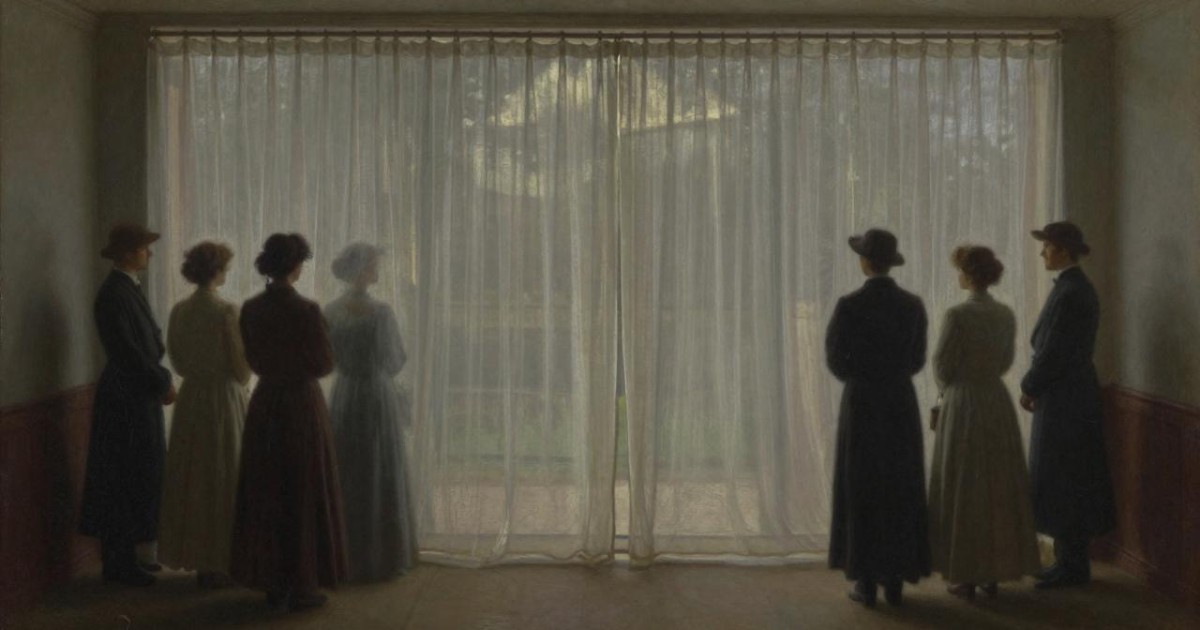
Du Bois called it double consciousness. He described the experience of Black Americans as living behind a veil, able to see out into the society that could not, or would not, see in. The veiled person develops a particular skill out of necessity: they see themselves twice. Once through their own eyes, and once through the eyes of a contemptuous world that measures them by a standard they never chose. "Two souls, two thoughts, two unreconciled strivings," he wrote, "two warring ideals in one dark body, whose dogged strength alone keeps it from being torn asunder."
Note what the concept is not. It is not simple self-consciousness, which everyone has. It is not hypocrisy, which is a performance gap between inner and outer. Double consciousness is a structural condition: a person forced to hold a self-image and a hostile external image simultaneously, and to do the constant interpretive labor of reconciling them. The veiled person must know the dominant culture exhaustively, because their safety and advancement depend on reading it, while being known by it hardly at all. Du Bois's famous formulation of the aspiration was for a world in which a person could be "both a Negro and an American," with neither self lost in the merging.
He was writing about Black American life under Jim Crow, three years into a century he would correctly diagnose. But the concept he built for that specific condition turned out to describe something larger: the psychology of anyone who lives inside a society that regards them as a category first and a person second. The machinery of the veil has been studied, applied, adapted, and contested for over a hundred years now. And somewhere in the past fifteen years, without anyone announcing it, the feed built a version of the veil for everyone, and lowered it over the whole population at once.
Part II: How the veil works
The mechanics deserve a slower reading, because they transfer with uncomfortable precision.
The first component is asymmetric visibility. Behind the veil, you see them; they do not see you. The dominant group has the luxury of being unreflective about itself; it experiences its own norms as neutral, as reality, as unmarked. The veiled group has no such luxury. Every interaction requires modeling the mind that is judging you, predicting its reaction, adjusting the presentation. This is a skill and a tax. Du Bois called the result second-sight, a gift and a limit at once. The veiled observer sees the whole society from the outside while trapped inside it, and the society that grants the sight "yields him no true self-consciousness."
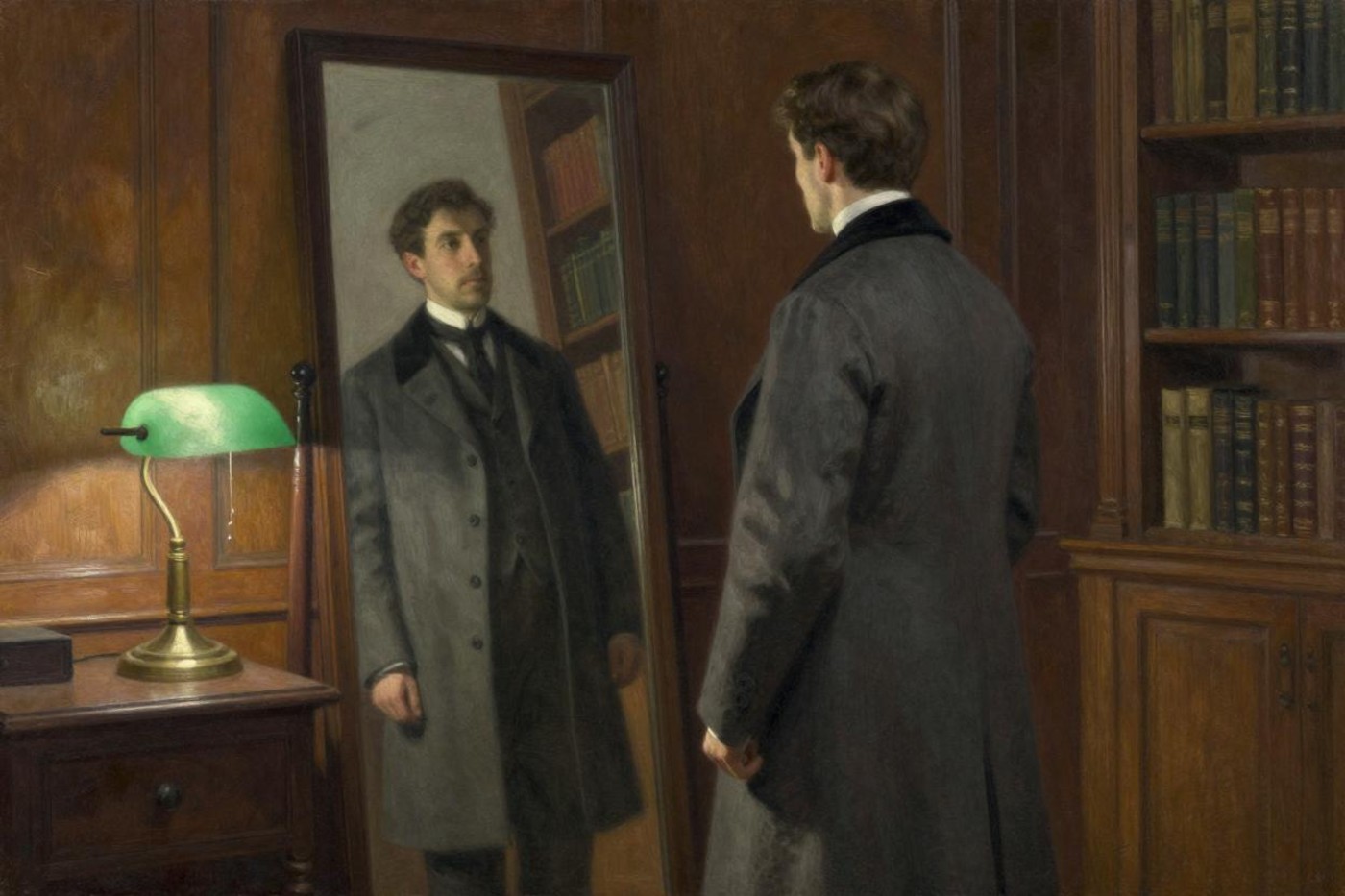
The second component is the internalized audience. Over time, the hostile gaze moves inside. The veiled person stops needing the contemptuous observer to be present, because the observer has become a faculty, a voice installed in the self, evaluating every action from the outside's presumed perspective. This is the "two warring ideals" condition: not two people, but one person permanently accompanied by an imagined assessor whose standards were never theirs. Du Bois understood this as an injury, and he also understood it as the source of a specific doubleness of vision, what he called second-sight.
The third component is the unreconciled striving. The veiled person is pulled toward full participation in a society that excludes them, and toward the integrity of the world behind the veil that the exclusion built. Du Bois framed the aspiration precisely: not to dissolve into the dominant culture, not to retreat from it, but to hold both memberships without the war. The tragedy he chronicled was how few institutions made that possible.
Keep those three components in view: asymmetric visibility, the internalized audience, the unreconciled striving. Then open the feed.
Part III: The veil, distributed
The internet was supposed to dissolve the veil. That was the promise, and it was made sincerely. Online, as the 1993 New Yorker cartoon had it, nobody knows you're a dog; identity is a chosen handle; geography and body dissolve into text; the marginalized find each other across distances that once made them isolated. All of that happened. The communities that formed behind the veil, dispersed and voiceless for centuries, built meeting places at a scale no physical geography ever permitted. That gift is real, and any accounting that ignores it is dishonest.
But the same architecture produced something the utopians did not order. The feed collapsed every veil-separated public into a single room. And the collapse did not produce mutual sight. It produced mutual performance under observation, with each public aware, continuously, that the others are watching.
Consider what the average user now does before posting. They model how the text will be read not just by allies but by the most hostile plausible interpreter, the bad-faith screenshotter, the person looking for evidence of category membership. Every phrasing decision is a negotiation with an imagined audience of judges whose standards are foreign and whose power over one's reputation is real. The question "how will this look?" has always existed, but the veil made it structural: the poster drafts, revises, softens, disclaims, performs the ritual genuflections, all before the first reader arrives. Asymmetric visibility: the poster must know every watching tribe's shibboleths; most tribes know only their own. The interpretive labor Du Bois described, once the specific burden of the veiled, has become the precondition of having a public self at all.
Then the audience internalizes. Du Bois's veiled person carried the hostile judge inside; the platform user carries the metrics inside. The like count, the ratio, the quiet dread of the screenshot: a self installed alongside the self, evaluating every impulse as content before it is even spoken. And the two publics that share the room, each regarding the other as the contemptuous dominant, have organized themselves into exactly the unreconciled pattern Du Bois named. Each side sees itself as the embattled truth-teller forced to see itself through hostile eyes; each side has developed its veiled second-sight, its exhaustive literacy in the other's weakness; and each side experiences the other's very existence in the room as an incursion. Two Americas, in one room, each convinced it is the one behind the veil.
Here is where the comparison must be handled honestly, because it can curdle into something cheap. Double consciousness under Jim Crow was not "discourse is stressful." It was woven from disfranchisement, lynching, and economic exclusion, a matter of survival under mortal threat, and the flattening of that specific history into a general condition of online unease is precisely the kind of appropriation Du Bois's heirs have spent a century resisting. The honest claim is narrower: the feed did not reproduce the harm, but it took the psychological architecture and scaled it. The veil is no longer drawn along one line. It is drawn along hundreds, and everyone is behind some section of it.
The result is a strange kind of equality. Nobody sees anybody whole. Everyone models a hostile audience. Everyone is simultaneously observer and observed, native informant and suspicious foreigner. Du Bois asked for a world where a person could be both, without war. The room we built guarantees that everyone is both, at war, all the time.
Part IV: The reconciliation that was the whole point
The strongest objection deserves the full paragraph, and it draws on Du Bois himself.
The veil, his argument insists, is where the gift grows. Second-sight is not merely an injury. The veiled observer, forced to see the society from the outside and the inside at once, can see it more clearly than the unreflective insider ever does. Applied forward: perhaps the two Americas staring at each other across the feed are undergoing exactly that education. Each side is being forced to learn how it looks to the other, and the learning, however painful, is the precondition of any shared polity. The old segregated America had the luxury of not seeing itself. The new room denies that luxury to everyone. On this reading, the misery of the discourse is not the disease. It is the symptom of sight returning to nerves that never had it, and the remedy is not fewer rooms but better seeing.
There is also the simple fact of escape. The veil was compulsory; the feed is not. Millions of people have walked away, thinned their presence, restricted their audience to actual intimates, and report feeling better. Du Bois could not log off. The comparison is real but bounded.
Both concessions are true. But notice what the second one implies about the first: the education only proceeds while people stay in the room, and the design of the room optimizes for engagement, not understanding. The platform's business is not reconciliation. It is the profitable maintenance of the war, because the war is what keeps everyone watching. Du Bois believed the tragic doubleness could resolve into a "truer self," a synthesis that used the second-sight without being consumed by it. Nothing in the feed's incentive structure is built to produce synthesis. Its machinery selects for the moment of maximum friction, because friction is engagement, and the synthesis, when it occurs, is silent. It is invisible to the metrics. It generates no content.
So the question this essay leaves you with is the one Du Bois carried for a century and never fully resolved into an answer: how do you hold both of your memberships, the ones you inherited and the ones you chose, without surrendering to the war between them, when every structure around you is optimized to deepen the war?
He spent sixty years answering it in public, in essays and organizing and encyclopedias and novels, and his answer, restated in a dozen forms, was that the two-ness ends neither by winning nor by hiding but by merger into a better thing, in which both strains survive. The feed offers you a different deal every day. It offers to let you keep both halves, permanently at war, permanently refreshing, because the war is the product.
Look at the room you are in. Two Americas, or twenty. Everyone watching, everyone watched. The veil was never lifted. It was multiplied, handed around, and hung floor to ceiling, and the only question left over, the one Du Bois left us, is whether the people behind it will use the sight it grants, or only the injury.
Related topic: Identity & Self.
Further Reading
The Weaker Argument Always Wins Online
Aristophanes, Socrates’ trial and a feed that rewards the argument aimed at the crowd.
Aristophanes, Socrates’ trial and a feed that rewards the argument aimed at the crowd.