Archive / Science & Technology
Dead Souls, Verified
Gogol's swindler buys dead serfs who still count on the census. Follower counts, bot farms and AI profiles have turned his scheme into an industry.
Science & Technology · 9 min read
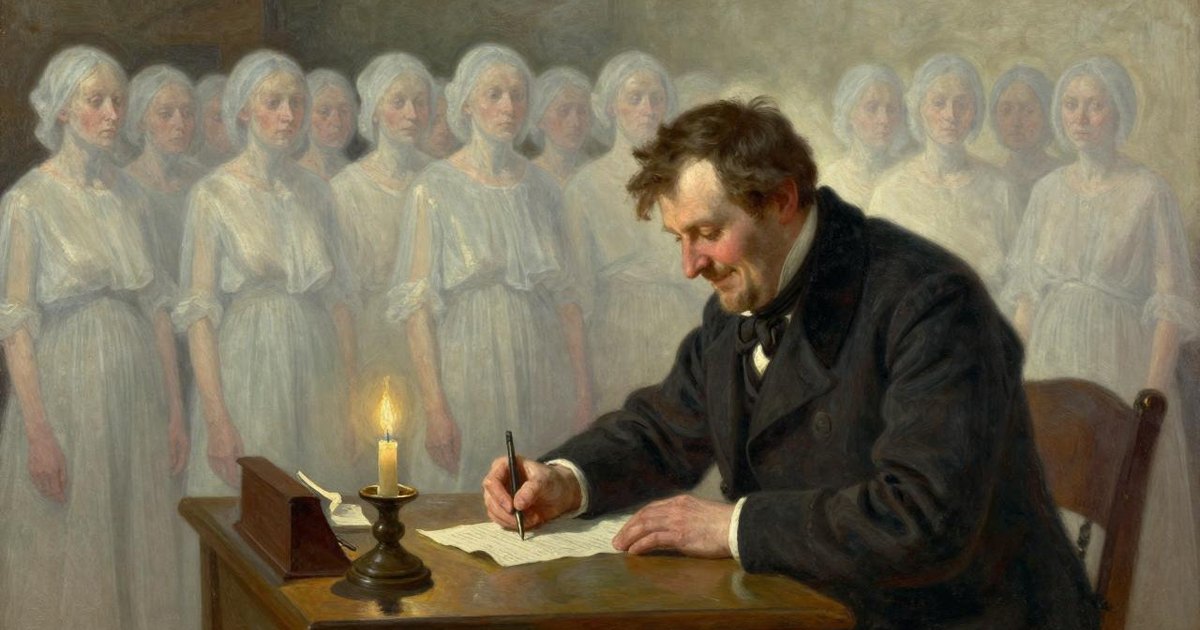
In 1842, Nikolai Gogol published the first part of a novel he insisted on calling a poem. Its hero, Pavel Ivanovich Chichikov, rides out to provincial estates offering to buy serfs who have died since the last census but still appear on the rolls as alive. Dead Souls asks what we now ask of fake followers and bot farms: what happens when a list of people becomes worth more than the people on it? Gogol's answer is that the list starts to live a life of its own, and that nobody paid to check it wants to.
Chichikov puts it plainly to Manilov, the first landowner he visits. In Constance Garnett's 1922 translation, "'I propose to purchase dead ones who would yet appear on the census list as alive,' said Tchitchikov." Manilov drops his pipe. He is confused, then flattered, and finally so eager to please his guest that he gives the souls away for nothing and pays the cost of the deed himself.
The scene is comic, and Gogol means it to be. But the comedy rests on a hard fact about the Russian empire. A landowner paid a poll tax on every soul listed until the next census, living or not. The dead were a paper liability. Chichikov had noticed that a liability on one ledger could become an asset on another, and that same trick of bookkeeping now runs through every follower count on every screen.
Part II: What exactly is Chichikov buying, and why don't the landowners ask?
Gogol withholds the plan until the last chapter of Part One. Chichikov, we learn, once worked as a lawyer's agent, mortgaging an estate to the Board of Trustees, which lent money against serfs as security. A secretary there reassured him about the serfs who had died on the estate: "'Well, why are you troubled about them? One dies, another's born, and all are just as good to pawn.'" The sentence is a shrug, and it tells Chichikov everything. The bank does not check.
Then comes the arithmetic, the novel's quiet engine: "Why, suppose I buy all who are dead, before the new census lists are sent out, if I get, let us say, a thousand of them, and suppose the Trustee Committee gives me two hundred roubles a soul: why there's a fortune of two hundred thousand!" He is buying entries. The dead men have no bodies and no names anyone remembers. What they still have is a line on a government list, and the list is the collateral.
The landowners do not respond as one. Manilov is baffled into generosity. The widow Korobochka worries mainly that she is selling too cheap. Nozdryov turns hostile and tries to cheat Chichikov at draughts. Sobakevich haggles as though the dead were prize livestock, praising each man's skill by name. The miser Plyushkin, whose estate is rotting around him and whose living peasants go hungry, is glad to be rid of them.
What none of them does, for long, is ask the obvious question. They argue over price and paperwork, over whether it is quite proper. The strangeness of trading in the dead dissolves almost at once into the familiar business of trading. A market can absorb nearly any object once it has a price and a form to sign, and provincial Russia shows how quickly.
Chichikov even anticipates the one legal worry. When Manilov asks whether the deed will describe the serfs as dead, he answers, "'Oh no,' said Tchitchikov, 'we shall write them as living, just as it actually stands in the census list.'" The fraud is not a forgery. It is fidelity to the record. A dead soul, in Gogol's sense, is an entry that still counts after the person it stood for has gone.
Part III: Is a follower count a census of souls?
Aristotle had a way of naming the appetite Chichikov serves. In the first book of the Politics, he distinguishes acquisition that serves the household, and so has a limit because needs do, from chrematistics, wealth-getting pursued through exchange for its own sake. Of the second kind, he notes, people come to think "indeed it seems that there are no bounds to riches and wealth," a view he takes to confuse wealth with money. His own sharpest words go to lending at interest: "For as offspring resemble their parents, so usury is money bred of money."
A follower count has the same shape. Nothing in it says when enough is enough. And Chichikov goes one step past the usurer: he borrows against nothing, credit bred from a record.
Marx, writing a generation after Gogol, offers a further tool. In the first chapter of Capital, commodity fetishism is the way the social character of labor appears as a property of the product itself: "There it is a definite social relation between men, that assumes, in their eyes, the fantastic form of a relation between things." Marx was writing about commodities and labor, not metrics. Stretching his ideas to a follower count is this essay's extension, and he should not be made to carry it.
A follower is supposed to stand for a relation. Someone chose to read you, to listen, to come back. The count is a census of those relations, a list of souls in the old sense. And like the Russian census, it is only as honest as the last time anyone checked who was still alive.
The case, worked through
Premise: A count represents people. A census lists souls who owe tax, and a follower count lists readers who chose to follow.
Complication: Representations detach. Chichikov shows the list can become the asset while no one asks whether the souls behind it are alive.
Revision: The number becomes a title. It is lent against as though it carried value in itself, and the relation it once stood for drops out of view.
Objection: Markets correct. Sophisticated buyers now pay for verified engagement and audited conversions, so a raw count is a cheap signal no one lends real money against.
Reply: The count still works. It sets rates and lends credibility, and the census-keepers profit from large numbers.
Part IV: What happens when the dead outnumber the living online?
On January 27, 2018, the New York Times published "The Follower Factory." It traced a company called Devumi, which sold Twitter followers. Devumi had a stock of at least 3.5 million automated accounts, each sold many times over, and had supplied customers with more than 200 million followers.
At least 55,000 of those accounts used the names and photos of real people, some of them minors. Slow down on that number. Each is a person whose face was lifted from their own profile and put to work vouching for a stranger. Chichikov at least bought the dead. Devumi borrowed the living.
The buyers wanted the look of reach, for the same reason the Trustee Committee lent: a large count reads as influence, and influence turns into pay. The New York Attorney General opened an investigation. For a moment, someone other than the sellers had checked the count.
The second case came from the platform itself. In 2023, Meta created a set of AI-generated personas that lived on Instagram and Facebook as accounts. They drew little notice until late December 2024, when a Financial Times interview with a Meta product executive described a future in which AI users would exist on the platforms much as human accounts do. Users went looking and found the old personas, among them one called "Liv."
The uproar was swift, and within days, by early January 2025, Meta had deleted the accounts, citing a bug that had kept people from blocking them. The accounts were reportedly labeled as AI. What drew most of the objection was that the company keeping the census had begun writing in souls of its own, and that its plan for the future seemed to count them.
Around these two cases has grown a larger unease, much of it filed under Science & Technology. "Dead internet theory," a conspiracy theory that took shape on forums and reached a wide audience through a 2021 piece in The Atlantic, holds that the web "died" around 2016 or 2017 and is now mostly bots talking to bots. As stated, it is false. But it has a real kernel. Imperva's 2025 Bad Bot Report found that automated traffic made up 51 percent of all web traffic in 2024, the first time in a decade it had passed human traffic.
That figure measures traffic, not users, accounts or posts. What it shows is narrower and odder. The census still lists souls, but a growing share of the knocking at the door comes from nobody.
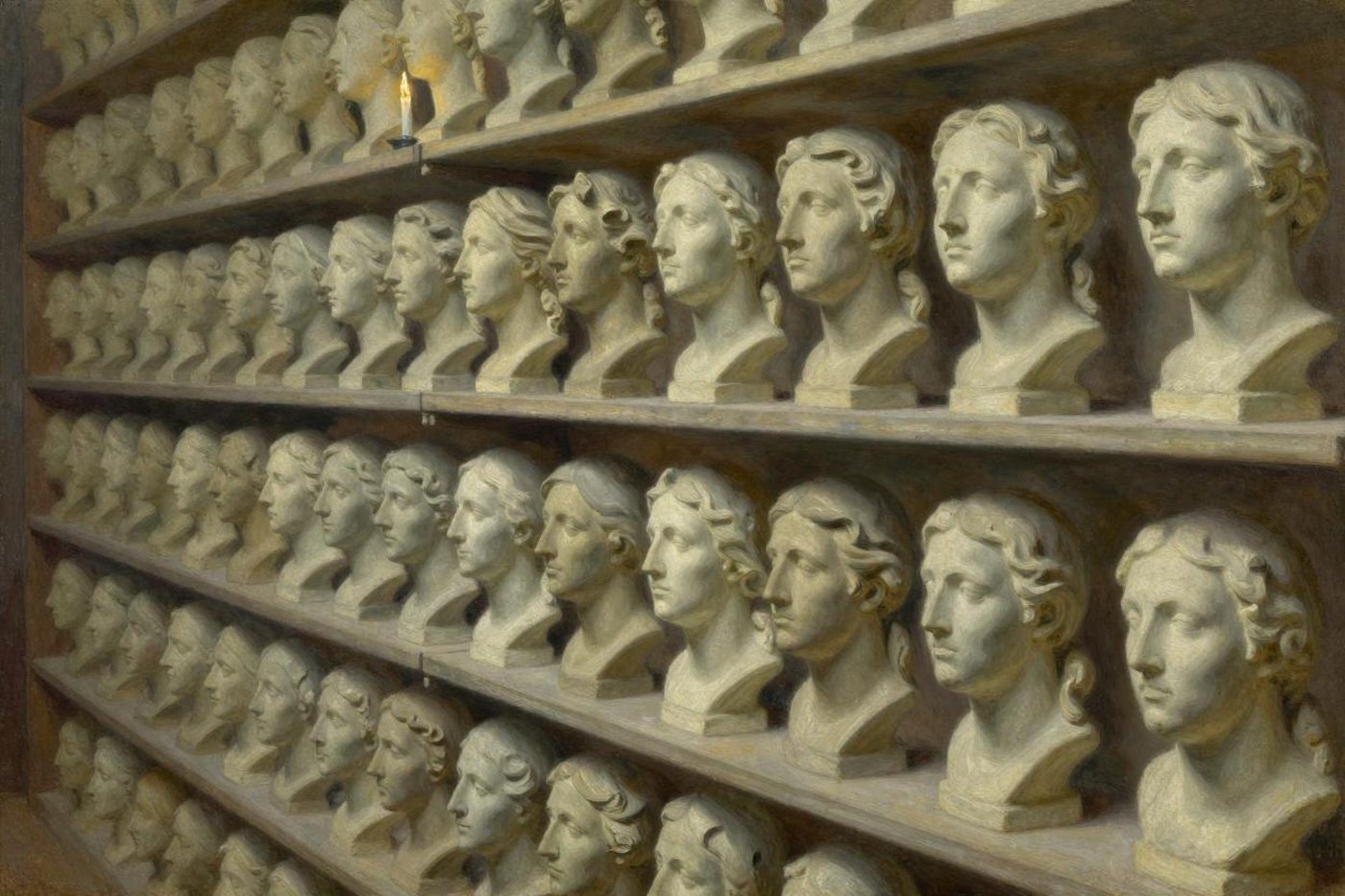
The simulacrum, Baudrillard's word for a copy with no original, is plain enough here. A persona that never lived and a purchased account wearing a teenager's face do the work Chichikov's peasants did. They are entries that count for someone who is not there, swelling a number that someone else will treat as collateral.
Part V: Does the market ever catch Chichikov?
The case for optimism runs through Goodhart's law. Charles Goodhart's own 1975 wording was technical: "Any observed statistical regularity will tend to collapse once pressure is placed upon it for control purposes." The version everyone quotes, "when a measure becomes a target, it ceases to be a good measure," comes from the anthropologist Marilyn Strathern, who put Goodhart's law that way in 1997. Either phrasing predicts that the number stops meaning what it did. The optimists add the next step: once followers can be bought, sensible buyers stop paying for them.
The optimists have a point. Serious advertisers say they buy on engagement, conversions and third-party audits, and a follower total is the cheapest signal in the room. On this view nobody lends real money against a count, so the analogy to the Trustee Committee fails. Proposals for proof of personhood, argued in Noema, go further and imagine a census that verifies the soul before it counts it.
The reply is that the count still does work. It still sets what many creators can charge, and it still tells an audience whom to take seriously before anyone has read a word. The census-keepers themselves have an interest in large numbers, and the long public quarrels over what share of a platform's users are bots or fakes have turned on figures the platforms report about themselves. None of that proves inflation. It shows who holds the ledger.
Gogol's own ending belongs to Power & Politics as much as to satire. In the final chapters the town turns on its guest and never works out what he did. Rumor makes Chichikov an abductor, a forger, a disguised Napoleon. The postmaster tells the tale of Captain Kopeikin, a veteran who lost an arm and a leg. The prosecutor, overwhelmed by the confusion, goes home and dies. The governor's household shuts Chichikov out, and he packs his bags and leaves.
The town had the information. What stopped it was fear. Half the officials suspect Chichikov might be an inspector sent from the capital, and each one's conscience has its own reasons to avoid a close look at the books. Whether a follower economy, in which platforms and creators both profit from large counts, has the same reasons to prefer rumor to reckoning, the novel does not say.
Goodhart predicts that the measure decays. He does not predict that anyone stops using it. A number everyone knows is inflated can go on being quoted for a long time, because the alternative is a world with no number at all.
Gogol's dead souls were inert. They waited on a list. The new ones post and reply, and the Meta personas were built to hold conversations. When the dead begin to talk back, the census stops being a record of who is present and becomes part of who is present.
Part One ends with Chichikov on the road, and Gogol lifts his eyes from the swindler to the country. "And, Russia, art not thou too flying onwards like a spirited troika that nothing can overtake?" He demands to know where it is going. "Russia, whither flyest thou? Answer! She gives no answer." Only the bells go on, ringing until they blur into music.
Gogol spent the next decade trying to write the answer, a second part in which, by most accounts, Chichikov was to be redeemed. Shortly before his death in 1852 he burned much of the manuscript, and Part Two survives only in fragments. The swindler is still riding, and the count on every screen is still going up.
Related topics: Science & Technology and Power & Politics. Part of the Then & Now series.
Further Reading
More Real Than Real
Baudrillard's simulacra and AI-generated media, the theory behind a persona that never lived.
The Weaker Argument Always Wins Online
Aristophanes' Clouds and the crowd that rewards the cheaper argument.